As I write, the rain is hammering down on the flat roof of the kitchen extension I had built a couple of years ago. I had planned to be outside, putting the remainder of my spring bulbs in the ground, but I’d need the oilskins of a North Sea fisherman. Instead I’ve got a cup of hot coffee, I’ve washed the pans from last night’s roast goose, and I am sitting down to write this piece. What is life, if not a life of achievement?
Much of the British media’s commentary on SpaceX has been consistently grudging, treating each explosion as disastrous incompetence, and refusing almost wholesale to be swept up in the joy of adventure
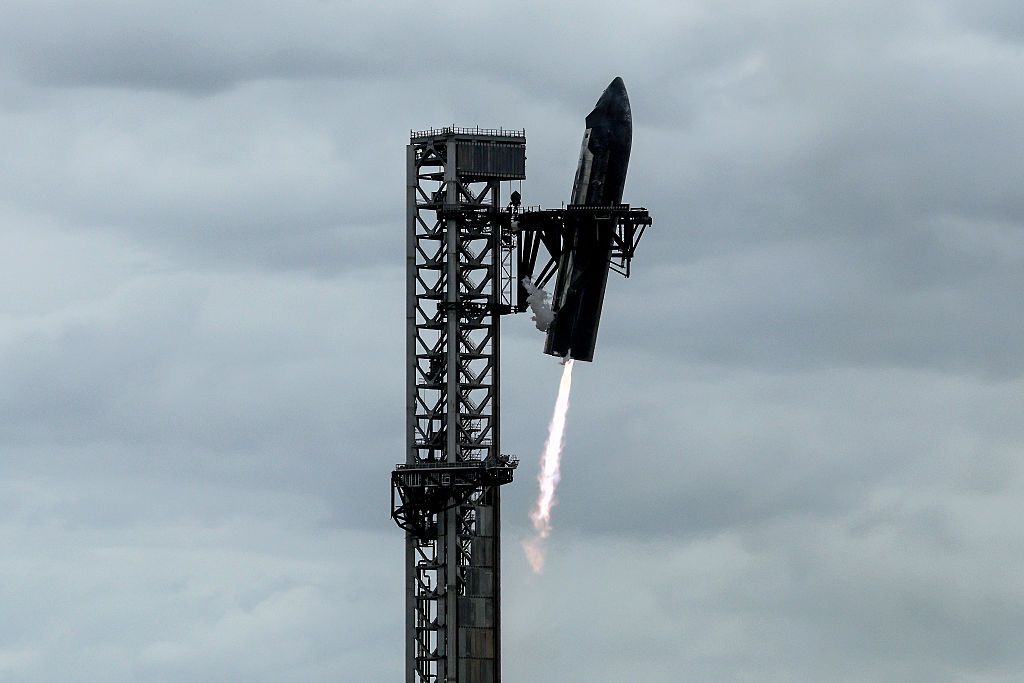
Yesterday, at about 9.20 p.m., we had finished the goose, which had been ordered for last Christmas and spent almost a year in the freezer. A tarte tatin, made with the last fruit from my trees, had been demolished. And in Texas, near the Mexican border, a 52-metre spacecraft called Starship, which had just orbited Earth 14 times, was caught on its descent by the arms of the Mechazilla launch tower from which it had departed the day before.
The booster aborted its own catch and redirected itself out to sea – a failure! – but the boosters have been caught before. This was the first catch for Starship. At a cost of one or two million dollars for fuel, and a potential payload of a hundred tonnes, the prospect of reducing launch costs by an order of magnitude has come closer. As has a realistic vision of fleets of reusable spacecraft, taking off regularly and reliably.
SpaceX has not been plagued by failures. Its plagues have been rehearsals. Move fast and break things has become a modern cliche, along with Rumsfeld’s delightful formulation of unknown unknowns, because both represent a truth about how to approach the world.
Much of the British media’s commentary on SpaceX has been consistently grudging, treating each explosion as disastrous incompetence, and refusing almost wholesale to be swept up in the joy of adventure. Starship’s catch was hailed as a commercial victory for SpaceX, not for mankind. Artemis II got more praise: not, I remember thinking, because it was a great step forward in human technology, but because it didn’t involve Musk.
We are allowed to marvel. And especially when the world feels cold and grey and gloomy, being able to marvel helps. Getting things done is itself a virtue. Britain once made that virtue manifest. There are precious few large examples of it in our society today, and many examples to the contrary. HS2, house building, an inability to turn talent into infrastructure – a failure of practical competence and the willingness to try. We are the only country to have developed and then abandoned a capacity for orbital launches. Yesterday’s Starship was Ship 42, and on its side were the words ‘Don’t Panic’. If we want to think the jokes are still ours, we should first look round for Douglas Adams’s successor. But when we recognise and admire the virtue of accomplishment demonstrated by our history, and the examples America offers, we show that our instinct to wish for it is not dead.
‘Intellectuals know nothing,’ wrote Karl Popper. ‘And their lack of modesty, their presumptuousness, is perhaps the greatest obstacle to peace on earth.’ He included himself, and we should probably all do the same. The popular contempt for Musk is remarkable. He is no Messiah and no Pope, and to suggest SpaceX and Tesla are entirely his work would be delusional – but less bizarre than concluding their success had nothing to do with him whatsoever. Musk’s intellect produces machines that are peer-reviewed by reality. He is a man of achievement, and capable of fostering achievement in others. When a Starship prototype crashed because one of its engines didn’t relight, someone tweeted to ask him why SpaceX didn’t relight all three engines, then shut down the one that wasn’t needed. ‘We were too dumb,’ he replied, and changed SpaceX’s procedure.
The Right Stuff, for Tom Wolfe, was a moral quality possessed by test pilots. But mostly the early astronauts were passengers – spam in a can, Chuck Yeager called them – and the thrill of progress relied on the right stuff in the engineers and managers and in the air force and Nasa. How things get done deserves attention, quite as much as how they fail. Musk’s success doesn’t make him right about politics, but it should make us take his views seriously, especially about what qualities in people and institutions and cultures support accomplishment and which hold it back.
Failures of accomplishment carry their own costs. Everything we have not built and everything we have not done has a cost, more insidious than the explosion of an experimental rocket and, because we seem so intent on hiding from our failures, far more damaging. To embrace our catastrophes and seek to learn from them is hard. To stubbornly admire success, wherever and whenever we come across it, is easier, and it can help.
I cooked that goose from frozen, in something of a hurry. SpaceX helped. Grok entered willingly into a discussion of steam ovens and defrosting. We don’t all have to be Tony Stark. The rest of us can deliver our goose 11 months late, with the help of American tech, all while procrastinating over our daffs.






Comments