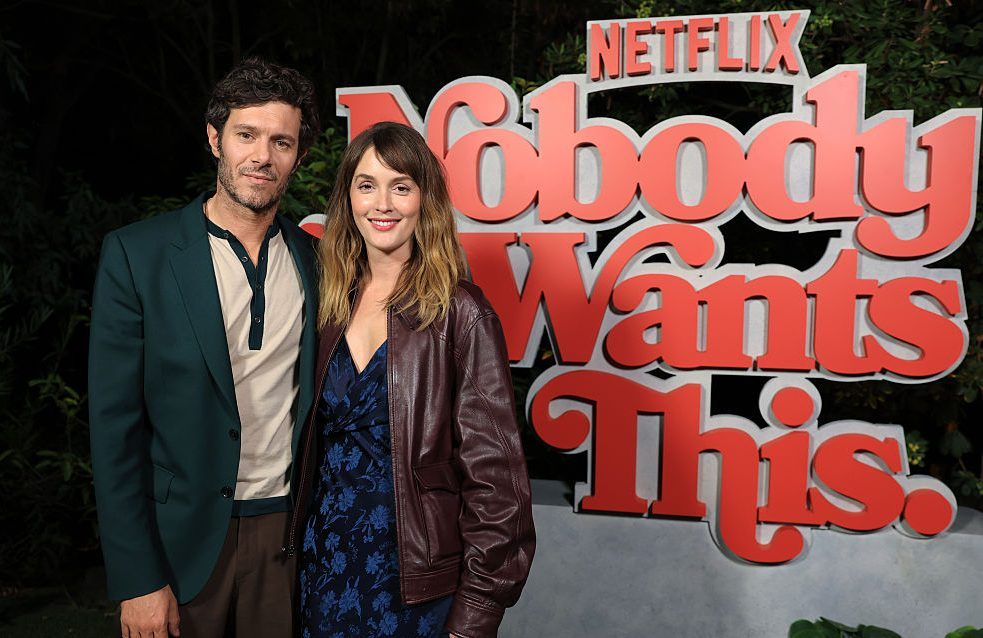
I usually stay away from American TV shows about Judaism or Jewish people, because it is hard to breathe amid all the kitsch, cliché or, in the case of Curb Your Enthusiasm, the self-regarding sourness. But Nobody Wants This, the buzzy Netflix series about an arch-gentile sex podcaster falling for a young groovy rabbi in progressive California (based on the true story of its creator, the Jewish convert Erin Foster), managed to be both of this ilk and different, better.
We are face to face with coastal Jewish America’s unbelievable divorce from their own reality
Despite all the cringe-worthy Jewish jokes and self-consciously performed neuroses, I watched the first series in September 2024 and found myself charmed. At that point, it was a relief to indulge in a world of Jews untouched by the horrors of Hamas. The clichés were outmanoeuvred by the touching depth of the central story: the temptation and the difficulty of trying to bridge that eternally awkward gap between Jew and gentile, who in this case were each lovable creatures, who came with a ragbag of family members, most of whom gave good comedy value.
Even with seasons one and two, there were murmurings of discontent by Jews about how uptight, unpleasant and unreasonable the Jewish women in the show are, compared to the fun, hot, sexual gentile sisters. But it was the third season, which aired in late October and is still being talked about, that became a sensation – for unfortunate reasons.
In an interview with GQ, the Jewish actor Adam Brody, who plays Noah, the rabbi and romantic star, opined with breezy offensiveness: ‘Put me down as thinking it’s a genocide. Put me down as wanting a free Palestine. It’s awful that it’s taken so much death and misery, but it does feel like it’s reaching a breaking point that it should have a while ago.’

At that point, many Jews who saw Nobody Wants This as a bit of much-needed California fun ceased to be able to: Brody had turned it gangrenous. It’s true that art and artist are or should be kept separate; if Brody the Jewish actor wants to repeat controversial and painful claims about Israeli ‘genocide’, it shouldn’t interfere with his skill in portraying Rabbi Noah.
Except it did, because sometimes there is leakage between the art and the artist. Like here, where the art is telling a true story, and the cast reflect the demographics of that story.
Erin Foster softly but publicly agreed to disagree with Brody, which was something. But the real rebuke of Brody came from the excellent Tovah Feldshuh, to the New York Post: ‘to accuse the Jewish people of genocide is wild. It’s right out of Hitler’s playbook. You take the victim, and you make the victim the perpetrator.’
The furore among Jews was intense. Many vowed they would not watch the third series of Nobody Wants This. I soldiered on, watching it despite Brody’s alienating effect. I enjoyed it, but a wall had sprung up between me and the show, stopping full suspension of belief and thus true immersion. Something kept nagging, making me feel tense. The judgemental edge had been sharpened and activated.
What Brody had done was spoil the show’s whole cosy fiction by giving voice to what we already fear about progressive American Jewry: their ideological uselessness. Before Brody’s interview, the thrill of the plot about the deepening connections between the most unlikely of people entirely outshone the vexing narcissism and shallowness of the show’s (voluminous) ‘Jewish’ stuff.
But Brody’s interview cast a new light on all that performative American ‘Jewish’ stuff and made it intolerable. It reminded us that inside the world of Nobody Wants This, just as outside, there is a kind of Jewishness at play that is almost exclusively detached from the gravitas of its European and Israeli counterparts, past and present.
That what’s left of Judaism, or what it’s become, in many wealthy US communities, especially on the coasts, is just a glinting, silly surface, literally just smoked salmon bagels and overdone hypochondria and a sprinkling of Yiddish words for effect, all without even the barest modicum of genuine interest in or knowledge of the theological, historical or cultural aspects of Judaism. Worse, they’re smug about it as they nibble sushi and work out and spend weeks planning what they’ll wear to so-and-so’s kid’s Bar Mitzvah.
Even all that would be acceptable, or at least ignorable, were it not for lethal luxury beliefs that spring up in such a landscape. Then we are face to face with coastal Jewish America’s unbelievable divorce from their own reality. That’s how you get Brody the Jewish TV star, born in San Diego to a graphic designer mom and lawyer dad (and many like him), saying: ‘Put me down for genocide’ against the only state that’ll have him if and when the shit hits the fan – and one which, more importantly, has not in fact committed the crime the Nazis did upon those who fled to live in it.
The Israeli podcaster Haviv Rettig Gur recently discussed the widening gulf between American and Israeli Jews – the latter simply cannot understand the lifestyle-choice version of Judaism that the former has forged, nor the former the existential, determinative version that Israelis live with, and for. Israeli Jews are on the coalface every day of what it still means to be the most hated, most conspired-against people in the world.
Some go mad, like the makers of the ‘documentary’ Naza, which purports to anatomise alleged Israeli targeting of civilians in Gaza, and conspire against their homeland. But most have more to them than bunfights about bagels and see the world much more clearly than the slouching Brody.




Comments