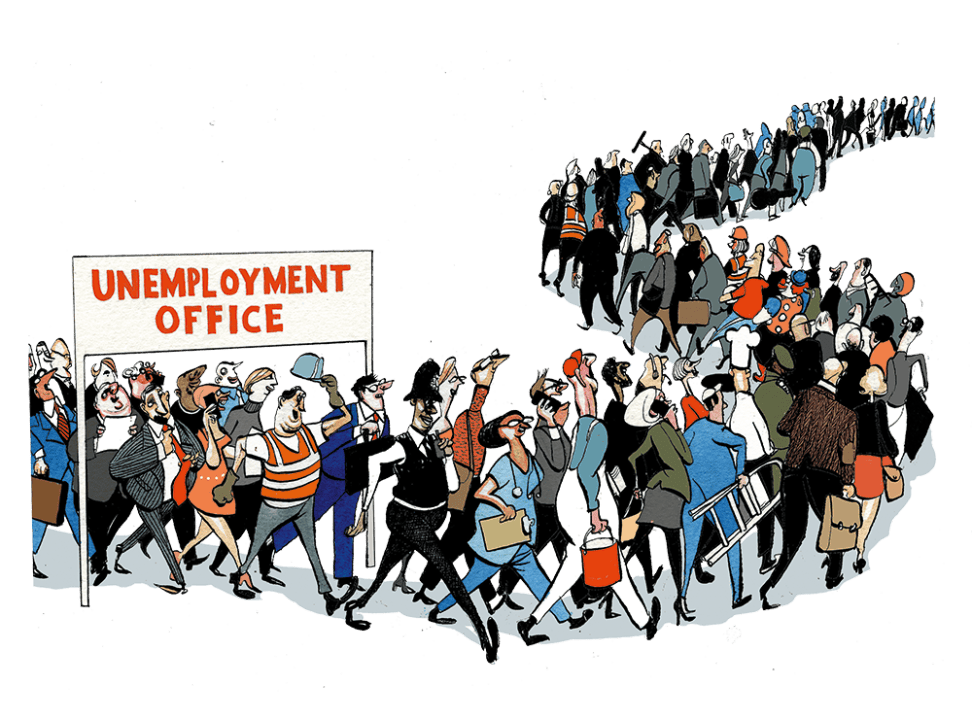


Pat McFadden, the Work and Pensions Secretary, was in a Job Centre in Bellshill, outside Glasgow, when he realised the urgency of the task he had assigned to Alan Milburn, the youth benefits tsar whose report will be published on Tuesday – the first step to reducing the burgeoning benefits budget.
‘The area manager said to me she ran a network of 13 Job Centres across central and east Scotland,’ he says. ‘Over 40 per cent of the young people that she was dealing with were what they call “on the health journey”, which is DWP’s term for either claiming or on the way to claiming long-term sickness benefits. That’s people under 25. I was really struck by that.’
Close to one million young people are not in education, employment or training (Neets). In 2024-25, 45 per cent of them reported having a disability, a figure that has more than doubled in ten years. Someone who is on sickness benefits at 20 is more likely to be on the same benefits when they turn 30 than they are to get into work. Less than 1 per cent of 16- to 25-year-olds on sickness benefits move into work each month, a lower rate than the over-55s. This means a growing number of young people have no experience of the workplace. Six out of ten Neets have never had a job.
‘This is what I call stickiness,’ McFadden says. ‘Once people are on these benefits, they tend to stay on them for a very long time, and that has long-term financial and health effects. It’s not enough for government or the welfare state to just give people an income. You have to give them a future.’
‘We spend £25 on benefits for every £1 we spend on employment support. That balance will shift’
Tackling the welfare bill is not just about moral failure, societal decay or even saving money. It poses several tests for the new government. Can an external expert, allied to a tenacious minister and a prime minister who needs some wins, galvanise an entire administration into action? Are Labour MPs really serious about making these difficult decisions? And is the British state even capable any more of delivering a joined-up reform programme?
The scale of the problem is mind-bending. The Office for Budget Responsibility projects that welfare spending will rise from £353 billion this year – half of which goes on working age benefits – to £431 billion by 2031. The increase alone over the next five years (£78 billion) dwarfs the budgets of defence (£68 billion) or schools (£67 billion). Since the pandemic, the number of people on disability benefits has risen from 4.7 million to 6.9 million and the incapacity benefit caseload has risen from 2.5 million to 3.7 million.
Keir Starmer and Liz Kendall’s attempt to shave just £5 billion off the rate at which the benefits bill is set to rise was a disaster. They built their argument about cost savings, which was never going to survive contact with the Labour MPs (among them Louise Haigh, now Burnham’s deputy). McFadden, then at the Cabinet Office, messaged Peter Mandelson to say: ‘Every meeting I have is “who can we tax in order to pay benefits to others?” They’re asking the wrong questions.’
Which makes his explanation for why he picked Milburn particularly telling: ‘I knew that he’d think in a deep way about it and that he, as an experienced politician, could craft an argument as well as a report.’

It is hard to escape the conclusion that McFadden decided to deal with youth unemployment first because that is the easiest moral argument to win over his party. The Milburn report will set up a new system to get young people into work, shifting money from handouts to unemployment support. ‘We spend £25 on benefits for every £1 we spend on employment support,’ a Whitehall source admits. ‘That balance will shift.’
Part of this will involve the creation of a new ‘work allowance’ – equivalent to 16 hours a week on the minimum wage – to avoid the incentive-killing reductions in benefits once someone starts earning. At the moment, Universal Credit claimants lose 55p for every £1 they earn. Milburn’s proposal would (at the current rates of minimum wage) let 16- and 17-year-olds earn £128 a week, those aged 18 to 20 £173.60, and those aged 21 to 25 a total of £203.36 before their benefits begin to reduce. This and his other measures will cost several billion, though DWP sources dispute claims that it will be as much as £6 billion extra.
The extra support will come with a ‘duty to engage’ to force young people to undergo workplace skills training and work experience. Both Milburn and McFadden have visited the Netherlands and McFadden was in Denmark only last week to see how much more proactive its employment officials are. In Britain, 13 per cent of young people are Neets; in Denmark it is 8 per cent and the Dutch have got it down to 4 per cent, the lowest in Europe, despite having similar neurodiversity and mental health rates as here.
McFadden says: ‘They will literally go and knock on the door of a young person and say: “We know you’re unemployed. We want you to come to the youth desk. We think we’ve got some options for you.” They just intervene over and over again. We’d like to see a more active approach here.’ At the moment, those on unemployment benefits must report every two weeks to a Job Centre, but those on incapacity benefit are left to their own devices.
McFadden has already put in place a pilot scheme to chase those who are on benefits. Around 100,000 people across the whole age range have responded positively. Milburn will also recommend supercharging the rollout of ‘youth hubs’ to enable young people to receive employment and mental health support in the same place.
‘The way to think about it is this is a system reset across government departments,’ says McFadden. ‘It is not just a narrow DWP welfare reform package. This has to be a new settlement for young people.’
Officials say this argument is already changing opinions. ‘A few months ago, the media said [young people] were all lazy snowflakes who should get a job. By the time of the interim report that changed to: they have a really tough time. We need to help them. Alan has been very successful in making the case that it’s not kind to continue the current system and send people on sickness benefits from which they never come off.’
There is evidence this is also winning over Labour MPs. After McFadden addressed the Parliamentary Labour Party last week, his team were pleasantly surprised to find Meg Hillier, one of the most prominent welfare rebels, telling journalists in the corridor outside how well he had performed. McFadden says: ‘We’ve been having a different conversation this year compared to last year, and I think a lot of Labour MPs – however they voted last year – would agree with that.’
After the Milburn report is published, there will be another report before Christmas, by Stephen Timms, which will outline reform of Personal Independence Payments, to focus payments around a person’s ‘actual costs and needs’ rather than the nature of their condition. McFadden will make a ministerial statement on the government’s response to both reports early next year, and a white paper will follow. ‘We intend to legislate next year,’ he says.
Whitehall insiders say Andy Burnham’s interest in tackling the issue far outweighs Starmer’s
But even passing a bill would be just the beginning. There is talk of NHS cuts to pay for the upfront costs of Milburn’s scheme, to be resolved in the 2027 spending review. The Danes claim that once the system is fully up and running, every £1 invested will save £9 further down the line. But sources admit that it will be between five and ten years before the costs start coming down.
We have been here before. Most policies which require buy-in from multiple government departments fail. I think too of the Saturday in 2017 when Milburn summoned me to a café near London Bridge to announce that he was resigning as social mobility tsar, because the government had done ‘zero’ to enact his plans. McFadden hopes it will be different this time. Whitehall insiders say Andy Burnham’s interest in the issue far outweighs Starmer’s.
The PM’s influence is also a factor in Milburn’s recommendation that the responsibility for running his schemes should fall on local authorities, since they are better connected to local businesses. ‘That gets away from the problem about Whitehall departments working with one another properly and in a joined-up way,’ says McFadden.
None of this will remove welfare as a political issue. On Tuesday, Kemi Badenoch outlined details of how the Tories would slash £36.1 billion from the benefits budget, most of it by excluding foreign nationals and those claiming for mild mental health conditions or routine back or joint pain.
McFadden believes voters will buy a more nuanced argument. ‘I look at my opponents, many of whom didn’t change the system, running around with ever-greater claimed numbers of welfare savings. Apart from the scepticism about them ever being able to do this because they didn’t do it when they were in office, I just don’t think it’s the right approach either. We want to get the cost down in the longer term, but you have to do that through a new settlement and a new deal, not just coming along with a chainsaw.’






Comments