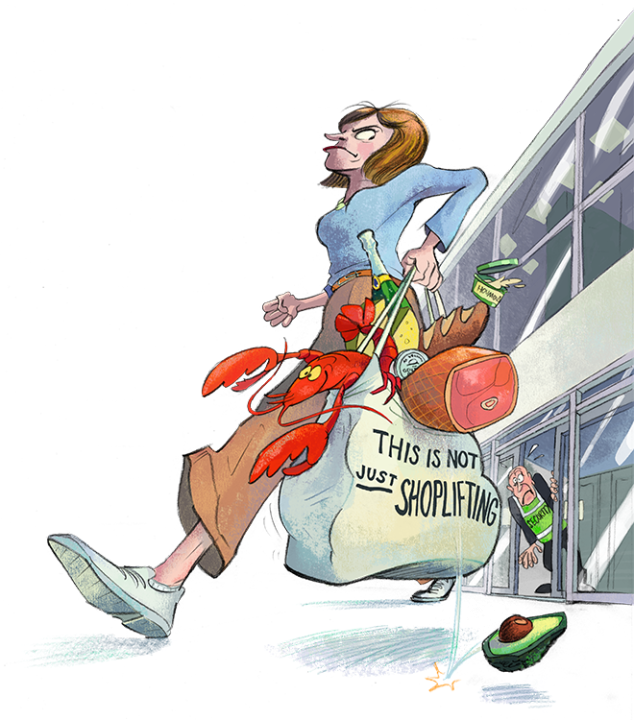

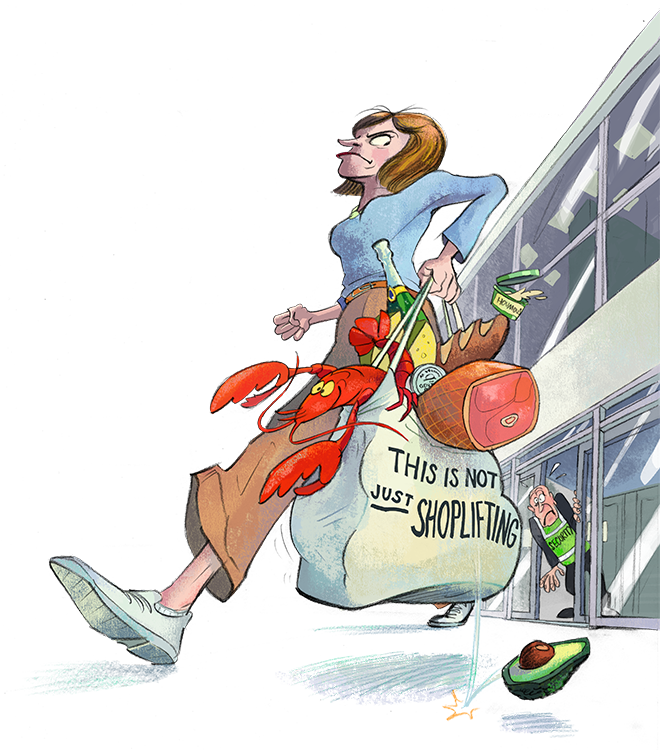
Shouts in the street caught my attention. As I rounded a corner, I saw the aftermath of a botched supermarket raid. A skinny druggie stood on the roadway, yelling at a security guard who had chased him out of the store and grabbed his wire basket full of loot. Across the roadway lay boxes of luxury chocolates, packets of cereal and cartons of strawberry milk. The thief dared the guard to fight him.
‘Come on then!’ A blonde cashier ran out of the store. ‘You’re banned,’ she yelled at the thief who snarled back. ‘Yeah? Let’s have it!’ His shirt was open and he slapped his chest angrily. The guard stepped forward, vaguely shaping for a punch-up, but the thief ignored him and started collecting the fallen goods and placing them in his wire basket. The guard darted forwards and kicked it neatly out of his hand, and everything spilled everywhere. The milk cartons burst apart. The boxes of Frosties tumbled on to the road. A jumbo pack of Maltesers broke open and the little chocolates rolled into the gutter. The loot was ruined. But the thief hadn’t finished yet.

‘I’ll be waiting for you at 11,’ he said, jabbing his finger at the blonde cashier, ‘I’ll see you later.’ The guard, incensed by this ungallant threat, lunged forward menacingly while the blonde grabbed his uniform and held him back. He tried to shrug her off, a little half-heartedly, while she clung to his sleeves and urged him to calm down.
They did a little push-me pull-you routine in the street – but it was all for show. The thief stomped away, empty-handed. ‘I’ll be back at 11,’ he yelled, as a parting shot. He was pumped full of adrenaline by now and he strutted down the middle of the road like a conqueror in a vanquished city, beating his chest and shouting abuse at motorists who slowed to let him pass.
He was joined by an accomplice carrying a big empty holdall. Now I saw the plan in full. The first thief was supposed to sprint out of the store carrying a pile of easy-to-grab produce which the second thief would transfer to the getaway bag. Then they would race off in different directions, thus confusing their pursuers. But the master plan had failed. Not that this seemed to trouble the thieves, who strolled away, showing no fear of being stopped. I followed at a discreet distance and I watched them amble past a parked police car which, of course, had received no report of the crime. Should I have told the cops? Probably not. I’d have been tasered for defaming two vulnerable drug addicts.
They entered a corner shop and came out a moment later carrying goods which they had evidently paid for. But of course. Corner shops are guarded by men who hit thieves on the head with wooden clubs. Supermarkets are different. A thief is free to breeze through the exit doors carrying armfuls of loot like a celebrity leaving a premiere with a goody bag. The staff hang back respectfully when thieves are on the premises.
Shoplifting has changed. Once it was the preserve of experts who palmed the valuables into secret pockets or bags equipped with hidden flaps. The thief was a craftsman who spent his nights at his workbench stitching false sleeves into voluminous overcoats and inserting hidden pouches in the linings of tweed jackets. He worked undercover because he knew that his calling was criminal. Today’s shoplifter has no such shame.
Should I have alerted the cops? Probably not. I’d have been tasered for defaming two vulnerable drug addicts
Recently I saw a broad daylight raid at a supermarket in south London. A tall, bearded chap, aged about 20 and wearing a military greatcoat, sprinted down the aisle and did a scissor jump over the flappy gate at the entrance. He landed athletically, without upsetting his wire basket which was crammed with whisky bottles, and he raced off into the car park. In hot pursuit ran a security guard who seemed familiar with the thief’s face and methods. The guard lunged at the thief’s ankles and brought him crashing to the ground. A bottle of whisky cracked open as it hit the tarmac. The guard, using his bulk as a weapon, dived on to his victim and pinned him to the floor. ‘Assault,’ shouted the crook, ‘He assaulted me.’
It’s amazing how quickly a trapped robber turns into a human rights activist. ‘Help me. Assault!’ The bout ended peacefully as the thief sloped away, empty-handed, and the guard returned the surviving bottles to the liquor aisle. His heroics had saved the shop at least £200 but he was unlikely to have received a reward.
Shoplifting is horrible. It makes us feel angry and powerless. And yet I think we can fix it. Aversion therapy is the answer. Any thief caught in the act should be taken into a side-room and given the chance to keep the loot on one condition. He has to compose a written submission explaining why he needed the goods he tried to steal. As we know from school, writing an essay turns any activity into an object of horror that we never wish to repeat. This form of literary torture can help us beat crime by making crooks see theft as loathsome and painful. It works for Shakespeare. Why not shoplifting?




Comments