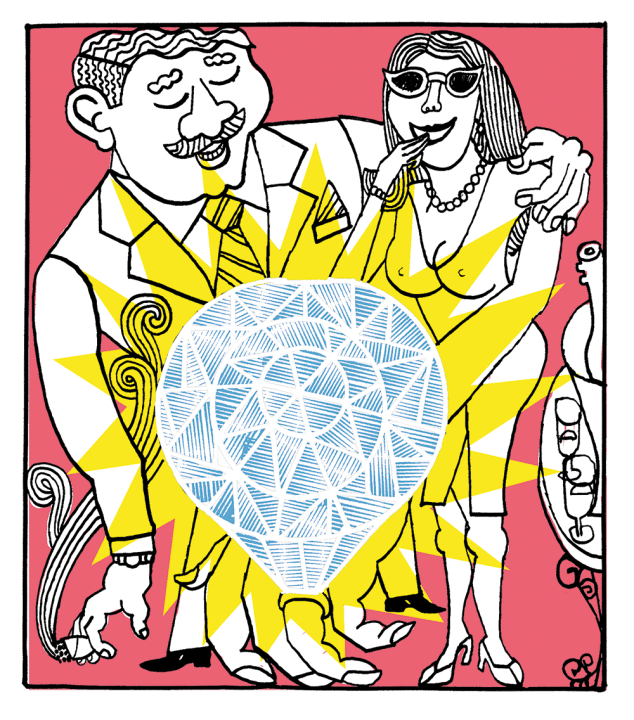


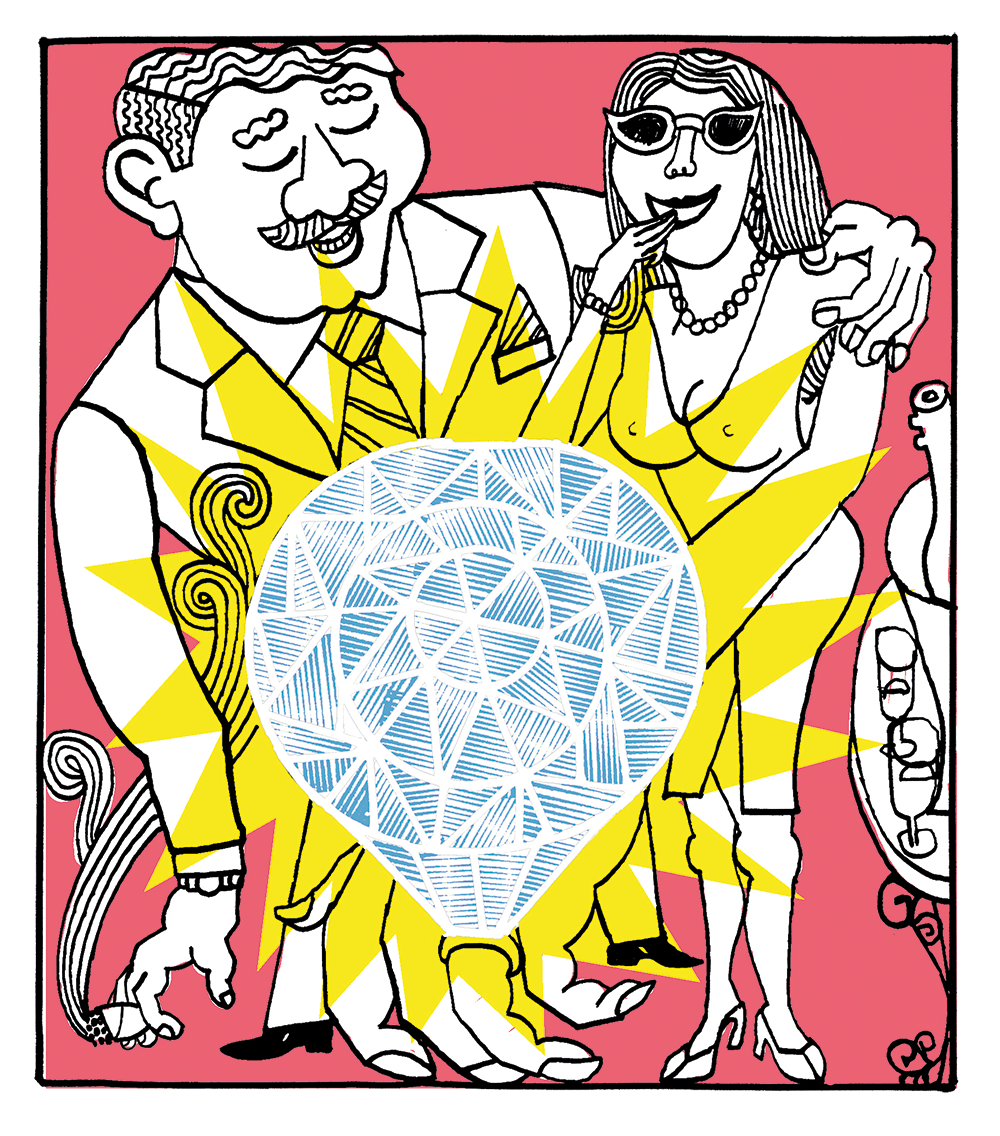
These days, when I spot a proper bobby-dazzler of a diamond on a woman’s ring finger, I feel a bit sick. Not with envy, but with the queasy certainty that I am looking at a comically large, factory-made fake.
A real diamond is one of the most ancient things in this world. Under the heat and pressure of billions of years trapped in the earth, scraps of carbon transformed into a precious stone. Everything we have valued in diamonds – the hardness, the fiery glitter, the rarity – comes from that long and improbable journey. The impersonations – although we’re meant to call them ‘lab-grown’ or ‘synthetic’ – are mainly produced in Indian or Chinese machines and cost a fraction of the real thing.
De Beers understood the story behind diamonds better than anyone, which is why, in 1938, having cornered most of the world’s supply, it hired an American advertising agency to further the myth. Diamonds had not been the automatic choice for an engagement ring until De Beers made them so; one of its copywriters, Frances Gerety, produced the line ‘a diamond is forever’, and over the following decades the adverts told men precisely what forever ought to cost, which was to begin with a month’s salary, by the 1980s, two – and now, well, it’s debatable.
Scientists worked out how to make synthetic diamonds in the 1950s. You take a pressure cooker, drop in a pinch of diamond scraps for seed and a lump of industrial graphite, which is made of carbon, cook the lot at around 1,400ºC and come back to a one-carat stone about a week later. I know I am not supposed to call the result fake, since it is carbon arranged precisely as nature would arrange it, but I note that the Advertising Standards Authority has ruled that calling it a ‘real diamond’ is also too far the other way.
For a while, jewellers either declined to stock synthetic stones or steered customers away from them. When De Beers launched its own synthetic brand, Lightbox, in 2018, it priced the stones at $800-$1,500 a carat and sold them as jewellery for ‘less serious occasions’ in an attempt to keep the upstart in its place.
But when shops shut during the pandemic everything changed: the business of buying jewellery moved online and manufacturers in India and China filled warehouse after warehouse with machines that turned out 100 diamonds at a time, flooding the market with cheap, large, almost-perfect stones and reducing their price further in the process. Between 2020 and 2023 the price of a one-carat lab-grown diamond fell by about 75 per cent. But still the lab-grown diamond market is projected to grow to nearly $92 billion by 2034, marking a more than 300 per cent increase from the $29.46 billion it was worth in 2025, according to Fortune Business Insights.
Now Argos will sell you a pair of one-carat lab-grown studs for £550, to be collected from the counter between a kettle and a paddling pool. Alex Moss, jewellery designer for rappers Drake and A$AP Rocky, puts it succinctly: ‘Your lunch costs more than the fucking diamond.’ In Hatton Garden, Queensmith reports synthetic stones have gone from less than 1 per cent of its diamond sales in 2019 to 87 per cent today, and the rocks have swollen in size accordingly: the average lab-grown stone it sells is now nearly two carats against just over one for the natural kind. Many of their customers are attracted to the transparency of lab-grown diamonds (not in aesthetics) as they come without the ethical concerns of sourcing and mining natural diamonds.
My objection is a simple one: tackiness. A four-carat stone grown in a week in Henan is the quickest way I know of being a cheapskate and gauche at the same time. (If you ask a bride if hers came out of the ground, see if she changes the subject.) What does wearing a fake rock that could take your eye out say about the wearer other than ‘naff’? Nor are synthetics an investment, since a lab-grown stone has, to all intents, no resale value.
A four-carat stone grown in a week is the quickest way of being a cheapskate and gauche at the same time
The value of the real thing has not been spared. A natural one-carat stone has on average halved in price since 2021 and De Beers’s average realised rough-diamond price fell by 19 per cent in the first quarter of this year. Bloomberg reported recently that De Beers had actually slashed prices on many of its stones because demand is so low. Pearls are a warning of the way the diamond market could go. A century ago, a Japanese noodle-seller’s son worked out how to get an oyster to make one to order, after which the price fell and never recovered.
The more hopeful precedent is moissanite, the diamond lookalike that had its moment on late-night shopping television in the 1990s before falling quickly out of fashion. Like moissanite, perhaps lab-grown diamonds will reach their own shelf-life: the factories of Henan creating the stones for jewellery are already being tempted to stop doing so and instead shift to producing material for semiconductors and AI machinery.
The people still buying ‘natural diamonds’ are, naturally, the rich, and so the real diamond remains a wealth marker, with the added frisson that often only the wearer knows that it’s genuine. For those who want people to know, there is the desert diamond: a warm-toned brownish-colour diamond, with obvious signs of natural life. Perhaps unsurprisingly, desert diamonds have leapt up in popularity and price.
I accept my view is probably snobbish, but I can live with it. To have a real diamond is to wear something that spent a billion years under pressure, and is probably something worth thinking about when entering a marriage. To have a gobstopper-sized fake, less so.




Comments