

Tel Aviv
The Tel Aviv neighbourhood of Hatikva is everything Israel’s critics across Europe fail to understand. This run-down suburb is home to many working-class Mizrahim: Jews who, save for their skullcaps, would not look out of place in a London mosque. They, or their parents, came to Israel from across the Islamic world: Iraq, Iran, Tunisia, Algeria and Yemen.
Finally safe in the Jewish homeland, many have become some of Benjamin Netanyahu’s most ardent supporters. These deeply religious taxi drivers, cleaners, administrators and shopkeepers still feel the trauma of life under the iron fist of Islamism. Boycotts and finger-wagging from London or Paris will not sway them. They will vote for the strongman they believe most likely to launch the fastest and farthest-reaching rockets, quashing any possibility of a return to the Islamic world they left behind.
A partnership between the opposition and the Arabs could signal a change in direction to the world
Twenty minutes away, in Neve Tzedek, affluent, secular Israelis of Ashkenazi descent see things differently. Sipping martinis, they hear I live in London and ask: ‘Are you OK?’ I’m curious why they are so concerned and they tell me they are watching the rapid expansion of Islamism in Europe. The increasing sight of niqabs; Jewish communities subjected to campaigns of terror by new arrivals in their countries.
Israel is the first line of defence against Islamist domination spreading from the Middle East, and these Israelis, many descended from Holocaust survivors, are dumbfounded by Europe’s embrace of people who despise the West. People who cried tears of joy as terrorists crossed into Israel to massacre civilians, then helped launch one of the most successful propaganda campaigns of all time: the woke European cause of Palestinianism.
But, unlike their compatriots in Hatikva, these voters believe sticking with Netanyahu is a death wish for Israel. Since 7 October they have watched him preside over the country while failing to tackle, to the delight of the BBC, Jewish terrorism in the West Bank. They see him unwilling to strengthen an exhausted IDF by requiring the ultra-Orthodox to serve. They are also troubled by the increasingly hostile rhetoric of Netanyahu and his far-right allies towards the West.
Some voters take heart from the promise of Gadi Eisenkot, the opposition candidate, to ‘destroy Hamas’s military wing’ within 18 months of taking power. For the sake of preserving a liberal, secular state with an outstanding economy and strong ties across the globe, they say, Netanyahu must go.

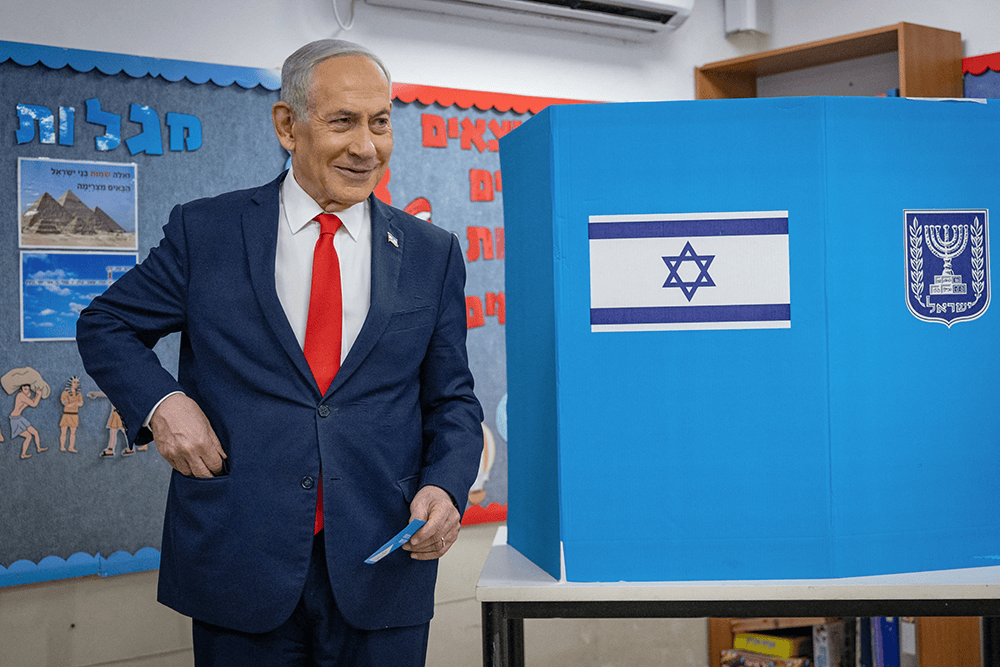
The stark divide between Jewish voters, embodied by these two Tel Aviv neighbourhoods, set the stage for the elections this week. Netanyahu’s Likud party has the most seats, but, at the time of writing, his right-wing bloc is set to be short of the 61-seat threshold necessary to form a government.
The most striking story of this election, however, has been the rise in support for the Arab parties. Arab – or Israeli Muslim – voters have traditionally taken an apathetic approach to elections. This time, the racist rhetoric of the National Security Minister Itamar Ben-Gvir and the government’s increasingly far-right complexion helped inspire a get-out-the-vote campaign. Overall turnout stood at 77.7 per cent. In the Arab demographic, it surged to 80 per cent, giving the two main Muslim-majority parties a projected 19 Knesset seats. Twelve are expected to go to the hardline Arab nationalist and communist parties, vehemently opposed to Israel’s existence as a Jewish state. Around seven are estimated to go to Ra’am, the socially conservative Islamist party.
Ra’am is led by one of the most fascinating figures in Israeli politics: Mansour Abbas. The 52-year-old has put his life at risk from Islamist and Jewish extremists alike by taking a more pragmatic approach to politics. He believes the best way to improve Arab lives is from within the Knesset. Abbas has acknowledged Israel’s Jewish character as a political reality, albeit one his supporters did not choose, and said he will set aside the question of Palestinian statehood to work with Jewish parties. The other hardline Arab party, the Joint List, is vehemently opposed to Israel’s existence as a Jewish state.
A former national security adviser to Netanyahu described Abbas to me as a ‘great man’. Kobi Marom, a retired colonel and friend of Eisenkot, likewise said that Jewish parties should work with him to improve national cohesion and security. Yet the Jewish population lives in a permanent state of trauma and paranoia. On 7 October, the Palestinians who rampaged through kibbutzim, killing women and children, were some of the same people who had been granted permits to work and earn money in the lush, peaceful communities they destroyed. Trust between Jews and Palestinians is broken; I do not believe it will be repaired for at least a generation. The 7 October impact extends to the Arab population, many of whom – though by no means all – welcomed and even celebrated the attack.
For these reasons a deal between the opposition bloc – hovering short of an outright majority on 47 – and the Arab parties, which would secure a majority coalition, is nigh-on impossible.

There are other routes to forming a government: members of the two Zionist blocs could retrench on their campaign promises and join forces under a ‘unity’ banner. This would secure a triple victory for the Israeli centre-right of sidelining the ultra-Orthodox draft dodgers, the far-right rabble rousers and the Arab parties. But again, the opposition ran on a campaign promising ‘change’. Their entire political identities would be discredited by doing a deal with Netanyahu.
But the opposition has a larger question to confront. A partnership with the Arabs would not resolve Israel’s problems, but it could give a new minority government a route to address the settler violence issue and signal a change in direction to the world. The obstacles would remain formidable: the wounds of 7 October, the shattered trust between communities and the fury such a deal would provoke among more right-wing Israelis. A minority government would be fragile.
Still, after everything that day did to shake the foundations of one of the world’s most persecuted, complicated and miraculous countries, can the fear of what Israel stands to lose under Netanyahu persuade its opposition leaders to risk a pragmatic partnership for change? Or can Bibi pull off one more great act of survival?





Comments