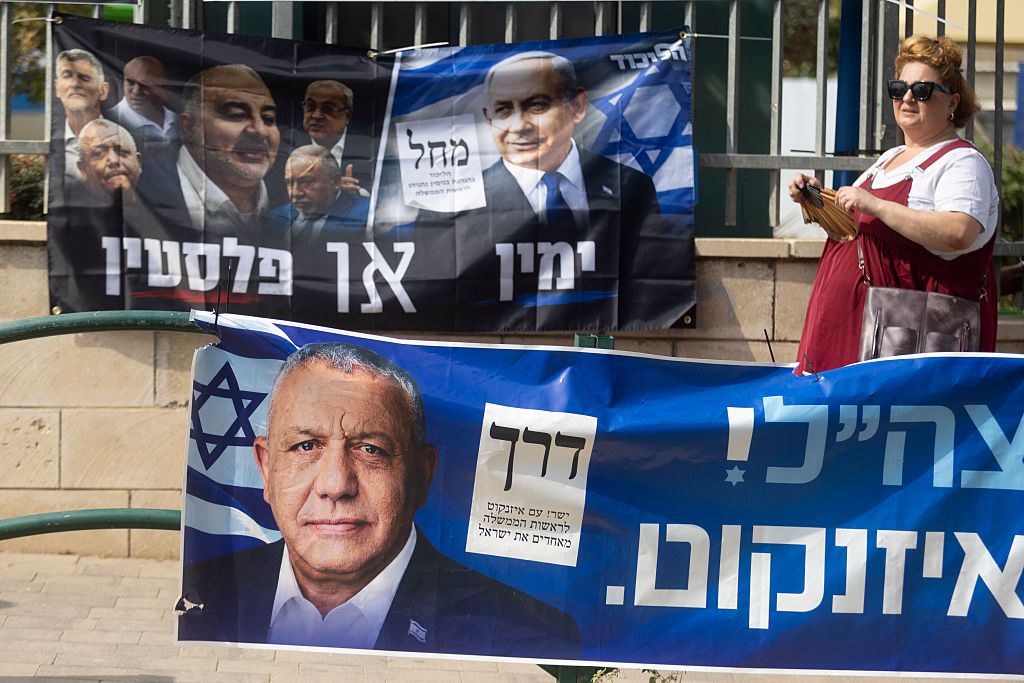
The final results of Israel’s election will not be determined until Friday, when the ballots cast by military personnel are counted. However, the exit polls released last night at 8 p.m. London time point to a political deadlock that will make it extremely difficult to form a government, let alone a stable one. In any case, even the final results will not change the reality that Israel has never been more divided, fractured, and polarised.
Amid all this uncertainty, four conclusion are clear.
A long and exhausting period of political negotiations lies ahead. Until a new government is formed, Netanyahu will remain caretaker prime minister
First, voter turnout reached 77.7 per cent, the highest since 1999. This reflects the political engagement and heightened awareness of voters, who regarded this election as the most important in the country’s history since its establishment in 1948.
Second, Prime Minister Benjamin Netanyahu and his coalition have forfeited nearly 20 per cent of their strength, leaving them unlikely to form a new government. Nevertheless, according to the exit polls, Netanyahu has once again demonstrated that, despite being ill and 77 years old, he remains a fighter and has emerged as the leader of the largest party.
Third, in Israeli politics, however, what matters is the bloc, not the individual party. The opposition bloc, consisting of four parties, which calls itself the Change Bloc, is projected to be larger than the bloc of parties that make up Netanyahu’s coalition. Although one broadcaster has projected that Netanyahu’s bloc will have a lead of three seats.
Fourth, the biggest and most unexpected winners of the election are the two Israeli Arab parties. The problem is that all the Jewish parties, both in the coalition and in the opposition, have decided in what is an unmistakably racist act, to exclude them from the political game. They have made it clear that they will not include either party in a government under any circumstances.

This leaves a crucial decision in the hands of the opposition leader, former IDF Chief of Staff Gadi Eisenkot, a bereaved father who lost his son and two nephews in the war against Hamas in Gaza.
Eisenkot will have to decide whether he is prepared to break his pre-election pledge. Politicians in general, and Israeli politicians in particular – including Netanyahu – have hardly hesitated to break their promises in the past. Eisenkot could bring at least one Arab party into his coalition to reach the 60 to 61 seats out of 120 members of the Knesset (the parliament), needed to form a government.
The alternative is for Eisenkot to form a minority government supported from outside by both Arab parties, thereby removing Netanyahu from power.
There is also, at least in theory, the possibility of forming a broad national unity government comprising the Change Bloc and Netanyahu’s Likud party. The problem is that the leaders of the Change Bloc regard Netanyahu as a liar and manipulator who has broken promises to his coalition partners in the past. They would therefore find it difficult to include him in a national unity government.
In any case, a long and exhausting period of political negotiations lies ahead. Until a new government is formed, Netanyahu will remain caretaker prime minister.
There is a serious danger that he will try to stage a provocation to incite Iran to attack Israel, thereby providing a pretext for launching a major retaliatory campaign and drawing the United States into a war.
Netanyahu tried to do precisely this in the weeks leading up to the election. His ultimate aim was to declare a state of emergency and prevent the elections from taking place, knowing that his chances of winning were slim. He ordered the Israeli Air Force to send dozens of fighter jets toward the Iranian border. Iran understood Netanyahu’s game, refrained from taking the bait, and limited itself to military signals of its own, including ballistic missile tests and the launch of drones in Israel’s direction, without intending to approach the border.
Two other factors helped avert war: the opposition of IDF Chief of Staff Lt-General Eyal Zamir to any military provocation before the elections and the veto imposed by the US president. Trump made it clear to Netanyahu that he would not support a war before the US midterm elections, which are less than a week away.
What happens after the US elections will also determine the course of events in Israel. If Trump, who has twice endorsed Netanyahu, orders an attack on Iran, Israel under Netanyahu will join the campaign. If Trump reaches a diplomatic agreement with Iran, Netanyahu’s chances of remaining at the helm of Israel – even as caretaker prime minister – will be slim.
One way or another the challenges – both domestic and international – facing Israel have not been reduced by this election.





Comments