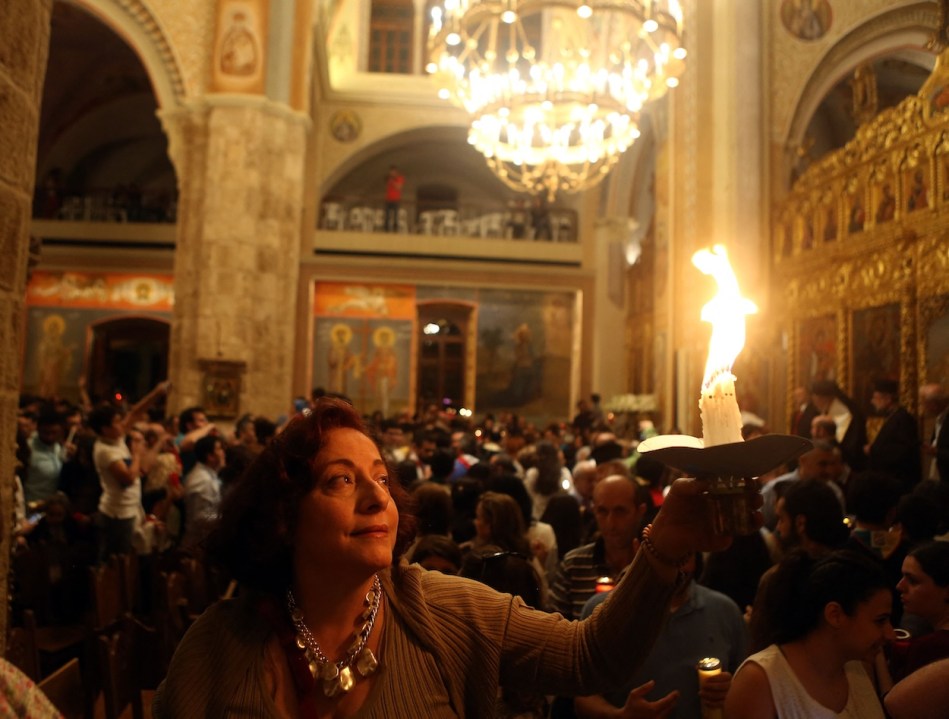
At least nine people died and 40 were injured in a terror attack on a church in Hamoud, Jordan, on Friday. Mourners had gathered for a funeral at St George’s Greek Orthodox church, and three gunmen arrived in a pickup truck, detonated a small explosive device outside the parameters of the building and opened indiscriminate fire shouting ‘Allahu Akbar’. The CCTV footage reveals the perpetrators facing no resistance and fleeing.
While the gunmen remain unidentified, and a group is yet to claim responsibility of the attack, there are unverified reports of the militants being affiliated with the Islamic State (Isis). Former Jordanian intelligence officers are suggesting the same. Isis-linked raids are either carried out by militants directly recruited by the terror outfit, or undertaken by jihadists around the world who are inspired by the group’s radical Islamic ideology, as in the Bondi Beach massacre or the Berlin Pride attack. In a meeting following the attack, Jordan’s King Abdullah ordered an ‘iron fist’ response to the ‘despicable terrorist act’. Prime Minister Jafar Hassan said it was rooted in ‘terrorist takfiri ideology’.
Takfir, which in Arabic means excommunication, is the act of declaring someone a kafir, or nonbeliever. While jihadists use takfir to apostatise Muslim sects or individuals to justify their killings, the ideology also uses the hostility against non-Muslim beliefs and communities, as established in Islamic scriptures, to unleash violence against them. The need for takfir as a prerequisite for radical Islamist attacks arises from the fact that, as per Islamic theology, jihad can only be waged against those outside the fold of Islam.
Even as Islamist militants represent the goriest manifestation of takfir, its fundamentals are enshrined across the Muslim world, resulting in the codification of discrimination against non-Muslims via Islamic sharia. Islamic blasphemy and apostasy laws embolden Muslim mobs and suppress the rights and freedoms of religious minorities. The declaration of Islam as the state religion, as established in Jordan as well, invariably subjugates non-Muslims as second-tier citizens.
Unlike many other Arab and Muslim states, Jordan doesn’t explicitly uphold violent sharia penalties, but its sharia courts ensure Islamic discrimination. Where converts from Islam to other religions are especially under the sharia gun, and face increased monitoring from government and security officials, non-Muslims also report institutionalised marginalisation, especially when it comes to preaching and evangelising. This is especially true for the local Christian community, which makes up 2.1 percent of the around 11.5 million Jordanian population.
Killing religious minorities, especially at their worship places, has long been a tactic of jihadist groups to intimidate the most vulnerable. Going after non-Muslims, especially Christians, is often a message to the ruling elites to reconsider their alliance or cooperation with western powers. In 2016, Isis launched a series of shootings in Karak, killing 19, as a message to the ‘apostate’ security authorities. Most of the victims were security personnel, but three civilians also died, including a Canadian tourist. In Jordan, where such a manoeuvre exclusively aimed at civilians has not been seen since the 2005 Amman bombings, the onslaught on local Christians could be designed to force the government to reconsider its recent ban on the Muslim Brotherhood and its assistance for Israel in the ongoing war against Iran.
Christians in Jordan have been better protected than in many other Arab and Muslim-majority countries, with reservations for believers in government and military, but they have nonetheless lived under the constantly looming Islamist threat. In 2008, a Christian choir group in Amman was targeted by al-Qaeda, followed by a foiled bomb plot in the Marka district of the Jordanian capital. Another terror raid aimed at a Latin Catholic church in Irbid was foiled the following year.
In 2016, Christian-born writer Nahed Hattar was shot dead for committing blasphemy against Islam. Hattar wrote extensively about the Islamic persecution of Christians in the Middle East. He attacked what he dubbed the ‘propaganda’ of tolerance: ‘For 14 centuries, Christians of the region… have resisted systematic waves of genocide and displacement, by resorting to one of four options: converting to Islam, joining tribal alliances whenever and wherever possible, fortifying themselves in mountainous areas, or accepting an inferior status as dhimmi [a non-Muslim subject under Islamic rule].’
Radical Islamists are also increasingly targeting Christians in Africa
Christians in the Middle East, some of the oldest populations in the region, are fast declining, with some ‘close to extinction’, owing to a combination of state-sanctioned discrimination and the perpetual extra-state jihadist threat. Christian populations in Iraq and Syria have plummeted from millions to today being a few-hundred-thousand. Christians were once in the majority in Lebanon. They are now a fast-reducing minority.
Radical Islamists are also increasingly targeting Christians in Africa, most notably in Nigeria. When Donald Trump spoke out about the persecution of Christians in Nigeria and designated it ‘a country of particular concern’ last year, many in the West deemed it ‘far-right propaganda’.
The widespread Islamisation of the region, and the elimination of non-Muslim indigenous communities, is an ominous fact. After practically eliminating many other Christian groups in the region, this denialism is helping embolden the jihadists to go after the rest.




Comments