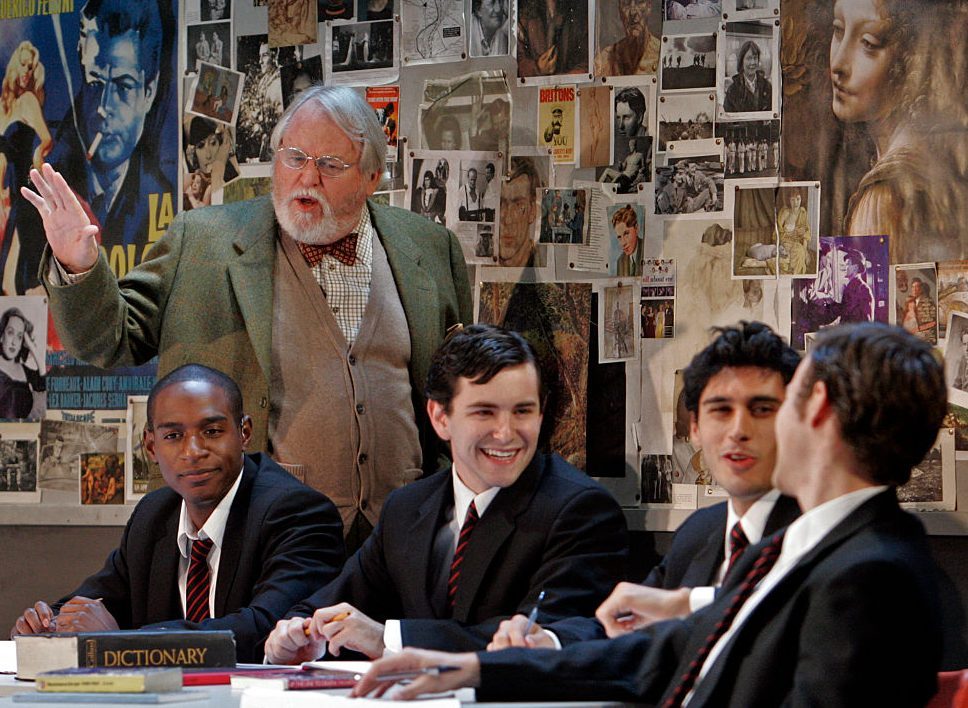
Should we be horrified that The History Boys, Alan Bennett’s 2004 play about a grammar school class applying to Oxbridge in the 1980s, is to be revived for a 16-week run at the Theatre Royal Haymarket next year? It was, after all, voted the nation’s favourite play in 2013. But it comes with a very big problem, which is inevitably going to attract negative attention when put on stage now: it revolves around a pederast schoolmaster who is portrayed extremely sympathetically, even to the point of making him the hero of the piece. An awful lot has happened in the field of public opinion on that subject over the past two decades.
Younger audiences should understand how the pederast used to hide in plain sight
If you haven’t seen The History Boys, the schoolmaster in question is Hector. He is a terrible teacher, although it is clear that Bennett wants us to think the opposite. He is popular because he is entertaining, getting the boys at one point to act out a scene in a Parisian brothel – a scene interrupted by the entrance of the headmaster. To prevent Hector getting into trouble, the boys pretend that one of their number has his trousers around his ankles because he has been injured in the Great War. In Hector’s class, it is perpetually the last day of term. But it is hard to imagine that he has taught his pupils anything of use to help them pass the Oxbridge entrance exam. If they succeed, it is in spite of, not because of, his lessons.
But Hector has another issue which would see him very quickly removed from the classroom nowadays, and indeed jailed: he likes to grope his charges. He does this by enticing them onto the back of his moped as he gives them a lift home, and reaching behind him. All the boys are presumably 18, because they are depicted as taking what was known at the time as the ‘seventh term’ entrance exam – the term after Upper Sixth, or Year 13 as it is now known. But that hardly lets Hector off the hook. As for the younger boys in the school, we never see them, so we don’t get to know what, if anything, he is doing to them.

I have always had an affection for The History Boys. For me, it is nostalgic. I took the Cambridge entrance exam at a boys’ grammar school in 1984, the year after the History Boys are shown doing the same. By coincidence, I also had an Oxbridge extension teacher who was nicknamed Hector – although there, I hasten to add, the likeness ended.
But I first realised that the play might have a problem with modern audiences when, seven years ago, I signed up for a course in writing lyrics for musical theatre. One of the assignments we were set was to write a song for a musical version of The History Boys. Among the younger members of the group – those in their 20s – there was general horror at the play. Here was a fictional Jimmy Savile. How could you depict such a monster so sympathetically on the stage?
I can answer that: because Hector is treated exactly as he would have been in the 1980s. The play has historical accuracy. I never encountered a pederast master at school, but my path did cross with that of a rather similar character at Cambridge who had an interest in 18-year-old undergraduates. He was treated as Hector is in The History Boys: as a subject of mirth. In real life, the History Boys wouldn’t have reported Hector’s behaviour, and they wouldn’t have been horrified by it. They would have found it amusing, and they would have defended him from being caught.
There is just one thing which Bennett gets wrong: heterosexual boys would not volunteer themselves to take a ride on a schoolmaster’s moped knowing that they were going to be groped. Rather, they would develop a game amongst themselves in which they tried to volunteer each other. Out of the remnants of respect for authority, which still existed among middle-class youth in 1983, once chosen by Hector, they would have struggled to decline the instruction to get on the back of his moped.
All this seems terribly objectionable now, especially now that we know what went on in some schools, involving much younger boys and much more than groping. Victims tell us they have been scarred for life, and I see no reason to disbelieve them. Hector doesn’t ultimately get away with his proclivities in The History Boys. In the film version at least (I can’t remember if the play version is the same), he is seen mid-grope by a lollipop lady and, but for being killed when he crashes his moped, would have been doomed to dismissal.
Yet, in spite of the tectonic shift in attitudes towards sexual abuse since The History Boys was written, I think it deserves to be seen by younger audiences so they can better understand how the pederast used to hide in plain sight in society, often quite popular among those he targeted, and without being seen as the monster that he would be now.






Comments