What a show at the Royal Academy. You go straight into a room of Cézannes and Renoirs and that is how it continues, with one coup de théâtre after another, at the hands of Monet, Signac, Braque, Matisse, Derain, Bonnard and more, all of them in thrall to the astonishing light and colour of the Côte d’Azur.
The completion of the Paris-Lyon-Méditerranée railway suddenly made this spectacular seaside accessible
It hadn’t always been like that. These artists, Cézanne excepted, came from northern France and knew nothing about the southern coast. What changed it all was the completion of the Paris-Lyon-Méditerranée railway in 1860, which suddenly made this spectacular seaside accessible. Cézanne was from neighbouring Provence, and he arrived on the coast before anyone else. In the 1860s he based himself at L’Estaque, at the westernmost edge of the French Riviera, barely 20 miles from his home inland at Aix. Now, with the sea in front and the rocky Provençal hills behind, he developed his distinctive manner of landscape painting, with its planes of geometric forms and aggressive brushwork. A delightful remark by Cézanne reflects how his new surroundings led him in that direction: ‘It’s like a playing card. Red roofs against the blue sea.’ In 1882, Renoir – always eager to learn from a friend – came to stay. His canvases from that time are a kind of soft-focus version of Cézanne’s, although ‘Rocky Crags at L’Estaque’ of 1882 is a wonderfully tough response to the countryside.
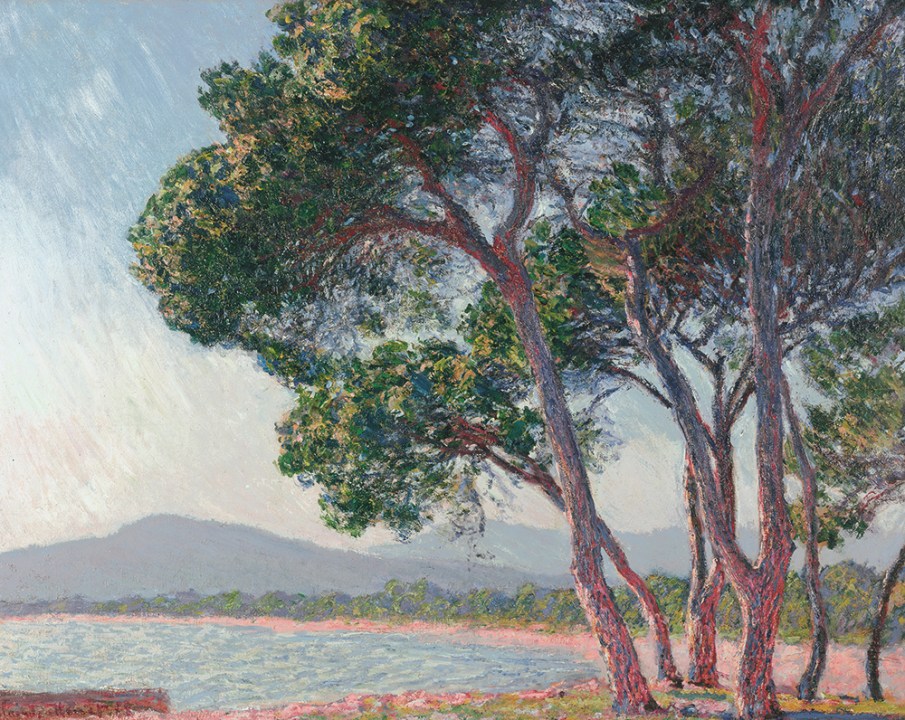
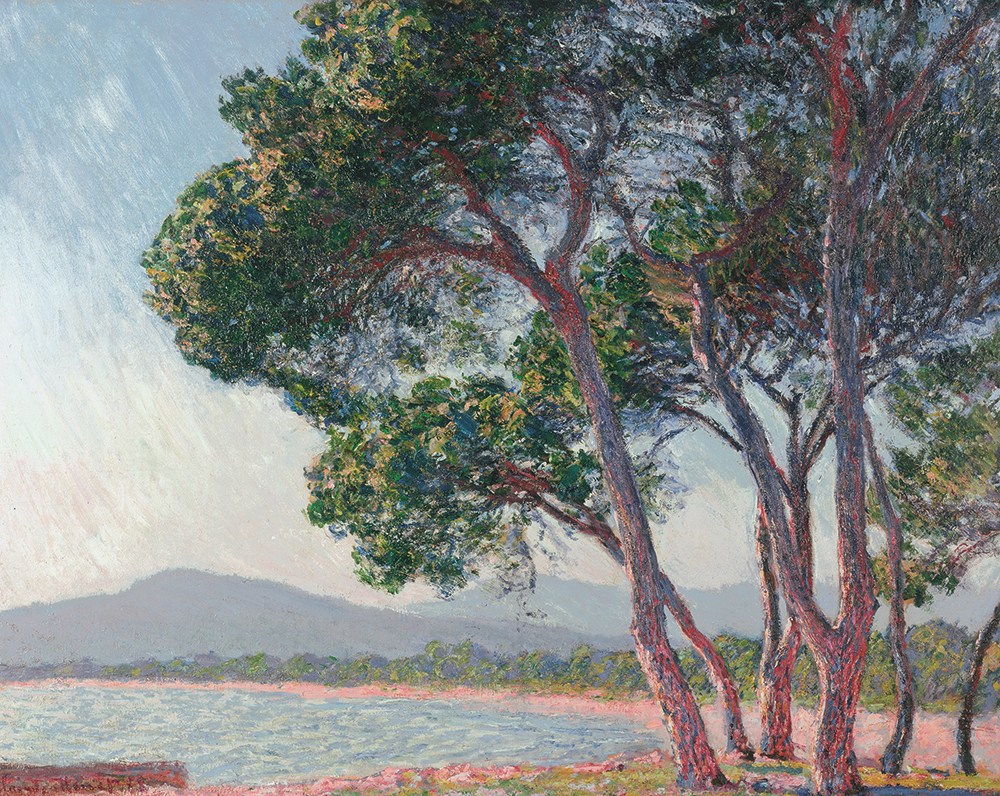
Then along came Monet, Renoir’s close friend, to see Cézanne’s little paradise for himself. A roomful of Monet masterpieces, many of them unfamiliar, includes several from his first almost bewildered visit to the Riviera in 1884. He wrote home to say that he felt he might need ‘a palette of diamonds and jewels’ to do justice to this brave new world. The landscapes from his second trip in 1888, when he stayed at Antibes, show he had mastered it: ‘The Beach of Juan-les-Pins’, a new one on me, is out of this world.
Half the vast main gallery is given over to the pointillist canvases of the neo-impressionists, guided by Paul Signac, whose love of sailing led him to discover an unassuming fishing village in which to settle: Saint-Tropez… The rest is history. For many visitors, the big surprise here may be the vibrant paintings of Henri-Edmond Cross. The fauvists take up the rest of this majestic space, with a revelatory wall of intensely colourful canvases by Braque from a brief period of his life, 1906–7, that is often forgotten. Braque had been inspired to go to the Côte d’Azur by seeing the Paris exhibition in 1905 of the Riviera paintings of Matisse and Derain, which had been derided by the critics as the work of ‘wild beasts’ or ‘fauves’.
Pakistan-born Toor, who has lived in America since 2002, has made painting people fashionable again
A whole room is devoted to the utterly delightful paintings of Pierre Bonnard. Most of these light-filled compositions are, typically, looking either half-in or half-out of the windows of his charming little villa, Le Bosquet, in the town of Le Cannet where he lived from 1926. A separate gallery is devoted to the 1920s, revealing Matisse developing his pared-down mature manner, with Raoul Dufy on the opposite wall fighting to keep up: an unequal struggle. And from here on the temperature drops (though don’t miss Max Beckmann’s knock-out ‘Landscape, Cannes’ from 1934), with Picasso rarely seen on top form, and the show ending with the abstracts of Yves Klein. They are in a sort of Mediterranean blue, you see. But, as Gertrude Stein might have said, a splodge is a splodge is a splodge.
If painting the Riviera is about place, Salman Toor’s exhibition at the Courtauld Gallery is all about people. And what a change that makes. I well recall that the late Richard Kendall, the Degas scholar, was threatened with expulsion from art school in the late 1960s. ‘This can’t go on, Mr Kendall’, the principal said, ‘painting people!’ (Ron Kitaj came to the rescue.)
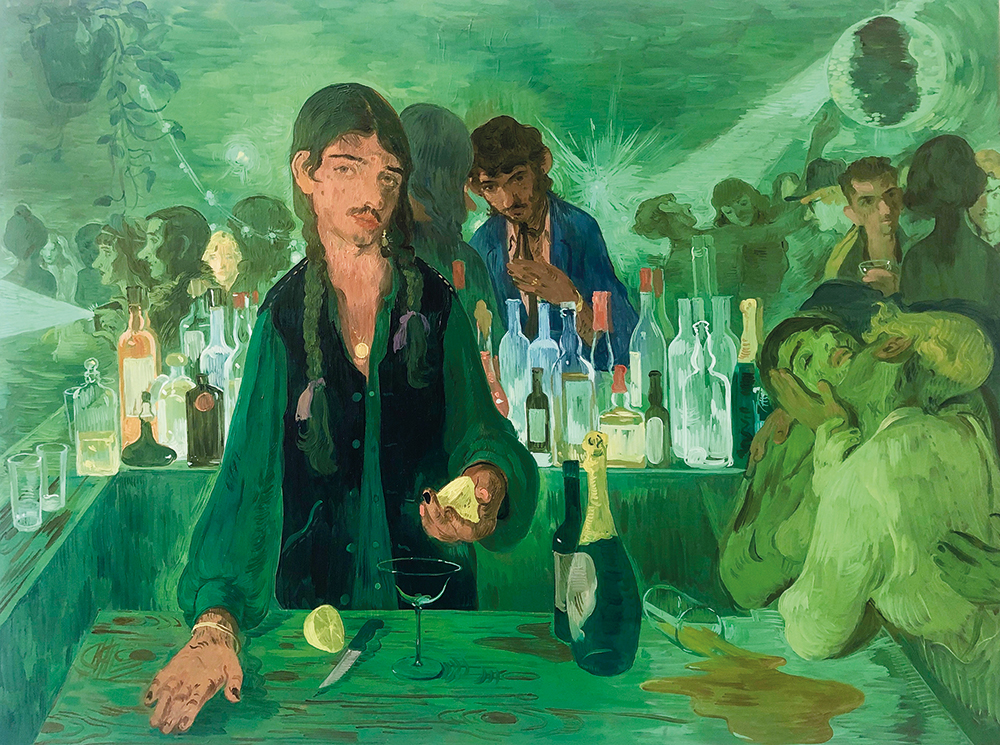
The Pakistan-born Toor, who has lived in America since 2002, has made painting people fashionable again, in New York at least, even if the trendy art world elsewhere has not noticed. The Courtauld Gallery’s exhibition is the first chance to see his paintings in the UK. They are mostly devoted to the city’s gay scene, and many of them are ingeniously full of light generated often from modern electronic devices. Toor is clever, but not ‘clever-clever’, as shown by his ‘Bar on the East 13th’, a delicate reinterpretation of Manet’s ‘Bar at the Folies-Bergères’ (which is in the main gallery some 40 feet away). Toor’s fluid style of brushwork is distinctive, while he seems to owe a general compositional debt to Michael Andrews and another, more obviously, to James Ensor in the ghoulish effect of a face lit from below – in Toor’s case, by a mobile phone.




Comments