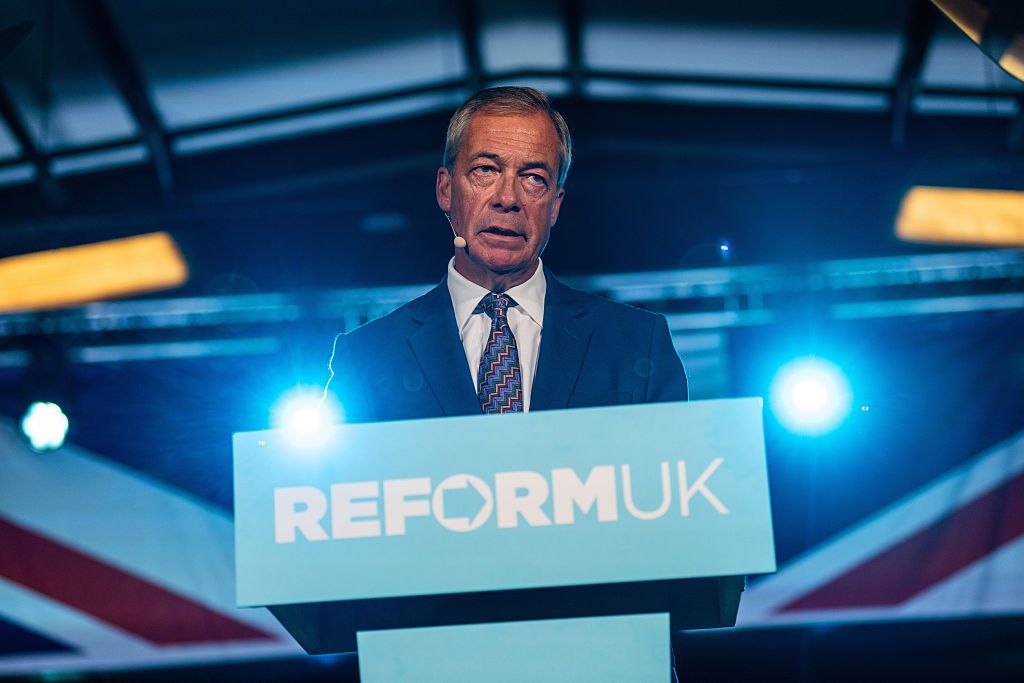
ITV clearly hoped their latest documentary would be a shocking exposé of Reform. Their year-long investigation involved an undercover reporter infiltrating Reform HQ by securing employment there. Now that their full documentary has aired – after a week of drip-feeding extracts – we can safely say it is a damp squib.
We cannot allow a sting operation exposing a few bad apples to be used to shut down legitimate debate about the issues Reform is raising
To be clear, it does show a few Reform councillors and activists making some appalling comments – racist, misogynistic, you name it. But absolutely any political party, organisation or business subjected to a year-long fly-on-the-wall sting, with every possible conversation recorded and attempts to coax as much incriminating language out of people as possible, would reveal some disgusting language and viewpoints. Which is why nor should we hold it against the Tories that perhaps the most egregious of those caught in the sting was a Conservative councillor who has posed for photos with Kemi Badenoch until he defected to Reform last year. The point is, it is absurd to define an entire party by the behaviour of a handful – and yes the documentary shows just a handful, from a Reform party membership now numbering some 285,000 – of individuals.
What else? They caught Nigel making a rather good joke at the Reform Christmas party about the allegations concerning his schooldays (‘I do feel in the office, it is fun… there’s lots of banter… some of the banter I’ve no doubt I’ll get a hard time for in 40 years’ time’). Meanwhile the reaction online to the documentary’s coverage of a Reform councillor saying he would, ‘quite happily’, personally execute grooming gang members in the garden of 10 Downing Street, shows that ITV are perhaps not quite as in tune with the public mood as they might think.
It’s good that Reform have been robust in responding. Where genuinely inappropriate things have been said, people have been suspended. But it is also right that the party has come out swinging: Richard Tice has accused ITV and Hardcash Productions of tampering with passport information and providing fake addresses to fraudulently secure employment for its undercover reporter, as well as trying to gain access to Farage’s security and travel arrangements. Leaving aside the safety implications, let us ask why ITV thought this sort of sting operation remotely appropriate.
It is of course perfectly legitimate for the broadcaster to test Reform’s fitness for office by shining a light on its operations. But if it begins implying that supporting the party is itself somehow morally disqualifying, it has gone far beyond what should be deemed appropriate for any broadcaster. We have to ask whether parts of the establishment media ecosystem are losing sight of the distinction that the theorist Chantal Mouffe makes between an adversary, whose ideas one contests but whose participation in democratic politics one accepts, and an enemy to be eliminated. It is fair for us to ask whether Reform is being scrutinised fairly as a legitimate participant in the political fray, or whether it is being treated as inherently beyond the pale. Quite often, it feels, the tone of its treatment suggests the latter.
Of course, media bias need not mean fabricated footage. It can concern what gets prioritised and how representative isolated examples are presented as being, as the sociologist Pierre Bourdieu has written about at length. The criticism of ITV is one about selection.
All this matters. The broadcasters still exert a huge influence over our politics, despite the challenge posed by new media. And when one of the challenges Reform faces is acquiring cultural respectability among influential institutions and the chattering classes, the hostility with which it is treated by ITV and others makes things significantly harder. We cannot allow a sting operation exposing a few bad apples to be used to shut down legitimate debate about the issues Reform is raising. The broadcasters’ job should be informing the public about what a prospective government actually proposes to do. Sting operations on junior officials and rank-and-file members are a poor form of scrutiny.
It hardly needs saying but having spent plenty of time with Reform activists and members, not least at the party’s conference, I have found them to be lovely people. Many hold views that would have been considered common sense, or even rather progressive, just a few decades ago. They want Britain to remain, in some intelligible form, Britain. They want this to be a country where everyone who loves it – its history, its culture and its people – is treated fairly and has the opportunity to get on in life.
Perhaps ITV could devote its clearly ample resources to interviewing in good faith people up and down the country that vote for Reform, to understand what they think and fear and feel. Or perhaps, if sting operations are their thing, they could conduct a year-long undercover investigation into the grooming gangs, the hate marches or anti-Semitism within the Green party. Scrutiny may be a broadcaster’s duty. But consistency is the test of its credibility.



Comments