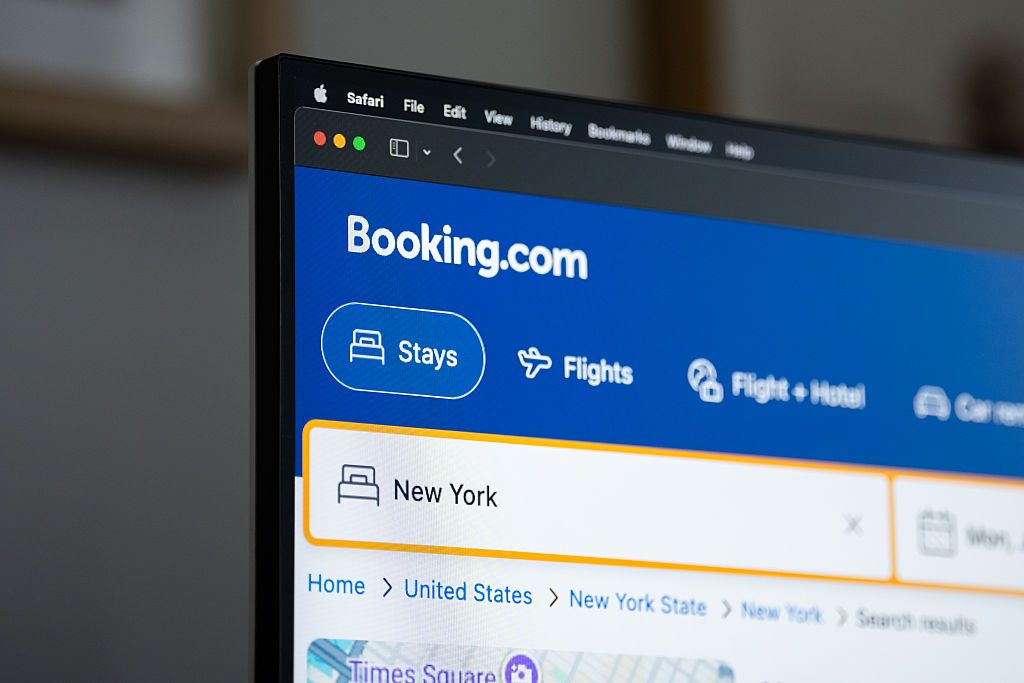
Back the 1980s, travel agents controlled 90 per cent of all holiday bookings in the UK, face-to-face or via phone, with thousands of agencies and high street branches such as Lunn Poly and Thomas Cook. Then the internet struck. Like much else in modern life – supermarket checkouts, cab ordering, music streaming, stock trading – the boozy man in the drab suit or Silk Cut-mainlining woman in shoulder pads was jettisoned for greater value for money and control.
As things stand, the mental cost of planning outweighs the pleasure of travelling
But where travel is concerned, losing the middleman was a big mistake. Now, not only is actually getting to your destination hell – there has been much comment of late about the horror of airports and flying in the era of unspecified network breakdowns – but booking it all in the first place has become an impossible burden. The exact thing that killed the travel agent is the very thing that’s murdering the fun of travel now: the saturated, direct-to-consumer, social media-splattered booking engine ecology of the internet.
For a start, there are too many choices, most of which aren’t actually choices, because they’re unrealistic to get to in your allotted time, or much too expensive, or a scrum with crowds to be beaten off to get anything from a room to a dinner reservation. Often all three.
Still, one begins hopefully, carefully reading the cool itineraries and hotels described in the weekly slurry of ‘best of’ articles by journalists lavishly entertained in their destinations (I know, because I used to be one). Their roundups, often a good starting point, must still be cross-checked with the infinite rain of proletariat reviews to make sure the illuminated prose checks out. Then you have to look it all up on a map to find out if you can get there in the time you have or if it’s actually 36 hours by plane, boat and bus each way.

But even doing all that doesn’t necessarily get you anywhere. If you’re looking to go anywhere nice, or rather, famously nice (courtesy of those ‘best of’ articles, travel blogs and sites, and Instagram hashtag porn), you’ll find the nice lodgings never have availability. And they certainly won’t have much in the way of off-season pricing.
Is there even an off-season any more? Unclear. Even as short-haul air travel becomes ‘purgatorial’, as Melanie Reid put it recently, figures show that passenger numbers are up by 6 per cent in the last year. And all those people are booking out hotels. Many of them, like me, want the best only – cutest, most atmospheric, most characterful, best-located, well-priced. And why not? There is nothing more depressing than leaving home only to be washed up and stuck in a drab and unfamiliar establishment. Nothing.
Yet if the internet age in 2026 has one main message for the traveller, it is this: ‘You’re always late to the party and there is no room at the right inns’. There it sits, rendered in ugly bold type, reading ‘There is no availability at this property for your chosen dates’, followed by alternatives that look, frankly, terrible.
Managing all this in relation to a destination abroad, where it’s hard to really know the lay of the land from one’s sofa, has become too much. I now find myself looking domestically if I want to go somewhere.
Last month, with a semi-free hand of travel for work, I ended up in Scotland. Glasgow felt manageable as a base, and I had a nice time. Last week, on a work-related trip, I went to Wales. Greece, Israel, France were all considered, but all threw up such a thicket of arduous, seemingly irresolvable logistical questions that, after months of digging and changes of mood, I abandoned them. At least the British rail network is intelligible (if you’re used to it). The idea of calling a taxi rank isn’t laced with embarrassment and fear. But smart hotels – even in the absolute middle of nowhere, off-season and mid-week – will still set you back over £300 a night. A mediocre pie in a remote Welsh pub, as I found out last week, will set you back £19.
Did I escape travel booking hell by staying at home? Not entirely. Not knowing Wales, I spent roughly six hours arranging my three days, including trains and taxis. This was mainly having multiple tabs open at once while I tried to Google every hotel in a ‘best hotels in Pembrokeshire’ article, gave up halfway through and then picked two almost at random, checked availability, train times to and from, how to get between them, and local bus and train timetables to understand what I, sans car, could do, eat and so on. Even when I threw down my laptop triumphant, booking completed, the task dribbled into the next day as the hotels couldn’t verify my payment method.
Of course, travel agents have not been entirely extinguished. It’s just that they’ve been reborn as ‘concierge’ services for the ultra-wealthy who won’t be combing Booking.com for venues with an 8/10-and-above ranking that has availability on their dates, then reading hundreds of random Americans’ reviews before taking the plunge, any time soon. Rather, they have ‘concierge’ services, like Quintessentially, Velocity Black and Bluefish, which sort their private jets and ‘experiences’, such as private dinners with only Michelangelo’s David and Andrea Bocelli for company.
Most of us don’t need this and can’t afford it. But I for one would pay a premium at this point for someone else to sort it out, so it’s their multiple tabs, their Trainline and Google Maps and booking portal and payment verification, open, not mine. For as things stand, the mental cost of planning outweighs the pleasure of travelling, and that is sad.






Comments