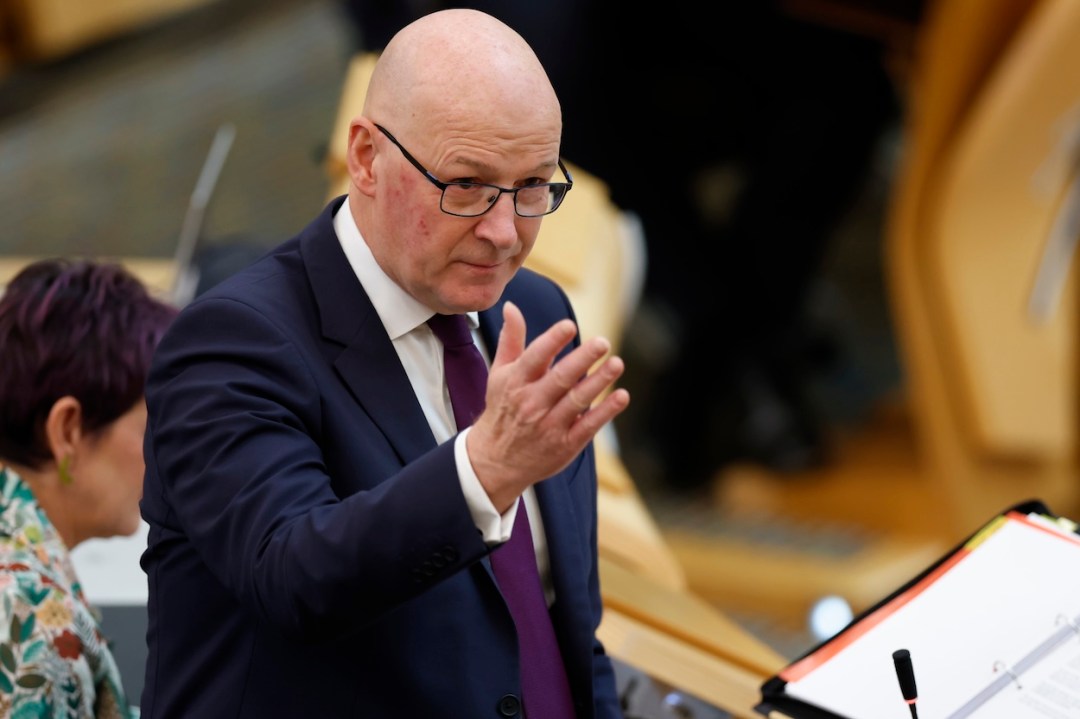
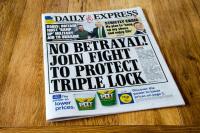
There’s a question mark over who will pay for Andy Burnham’s proposed national care service – and First Minister of Scotland John Swinney thinks he’s found the answer: Scottish pensioners. He said today: ‘I have received the first official estimate of the cost to Scotland’s pensioners of the Prime Minister’s attack on the triple lock. It will take up to £4 billion from Scotland’s pensioners. And the Prime Minister plans to use it to pay for social care in England. This would mean in real terms every pensioner in Scotland being almost £2,000 worse off in 2050. This is unacceptable and the PM must abandon these plans.’ But there’s a question mark over Swinney’s statement too, which now has an X community note to add context – the platform’s polite way of saying that he’s wrong.
Burnham’s plan is that after 2030 the state pension will, over the long term, keep up with – but not permanently outpace – average earnings growth, while growing by at least 2.5 per cent each year. The money saved compared to the triple lock will be used to fund a new national care service in England. The Department for Work and Pensions estimates that the triple lock change could save £50 billion a year by 2049, or £30 billion in today’s prices – but pensions aren’t being reduced, they may just rise more slowly. So that £4 billion is not something being ‘taken’ from Scotland’s pensioners; it is a smaller increase.
The state pension is a reserved matter, controlled and funded for the whole country by parliament, not Holyrood. If the government raises pensions more slowly, that decision affects the whole of the country. The decision would be made by a government of the whole country and legislated for by a parliament of the whole country, including Scotland.
Care, however, is devolved. (And Scotland has already used that freedom – with its higher per-person funding for public services – to bring in free personal care irrespective of income.) When the government increases spending on devolved services in England, it usually means a proportionate increase in Holyrood’s block grant, thanks to the Barnett formula. (Savings on pensions don’t reduce the grant at all.) This will be true if the care service is funded centrally. It may be that it is funded from council tax, or business rates – but those increases would not affect Scotland.
As the savings from Burnham’s change to pensions uprating would start at zero and build over time, at first they won’t provide enough to cover his care service. That means the change to pensioners’ incomes would be negligible in early years, while Scotland would receive more funding, which it could use to top up pensioner incomes if it wished. In the long run, Scottish pensioners will be no harder hit than those elsewhere in the country. And wherever the savings end up, Scotland gets its share: through the Barnett formula if it’s spent on devolved services, or through country-wide services if it’s spent on, for example, defence, or through greater fiscal stability and lower taxes that benefit the whole of the United Kingdom.
What Swinney can’t claim is that Scotland is being singled out by a policy that will apply to every pensioner in the country.



Comments