
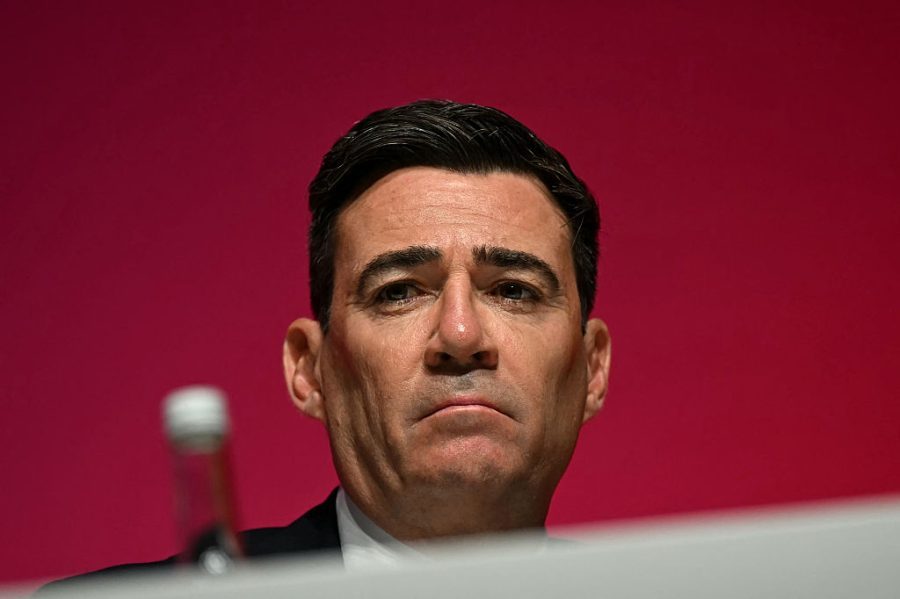
Labour conference is done and dusted, and Andy Burnham will be a happy man. His speech yesterday went down well in the hall and continues to make waves outside it, too. The Prime Minister’s address was fairly insular, with few references to the world beyond these shores – despite this being a time of global uncertainty, as Tim Shipman notes here.
The one major exception was Europe, with Burnham declaring that ‘Brexit has done more harm than good’. He then suggested, implausibly, that he would try to ‘find consensus’ around ‘Britain’s long-term relationship with our European partners’ – a feat that eluded all his postwar predecessors. Not for nothing is this country still regarded by some Europeans as ‘perfidious Albion’.
Burnham clearly has no idea what kind of relationship he wants
In post-speech interviews broadcast today, Burnham confirmed that he would consider rejoining the European Union. He told the BBC he did not want to leave the question of the EU relationship ‘hanging’ and said he wanted to be clear on ‘where we want Britain to go in the next decade’. Asked whether he wanted the UK to rejoin the trade bloc, he replied that he wanted to ‘look at the options’. ‘We could stay as we are. That’s definitely an option, if people think this is the right place to stay,’ he told the programme:
We could look at what George Osborne has said about a customs union, we could look at what the Liberal Democrats said at their conference about the single market, or we could go all the way.
He added: ‘So there are clearly options that need to be considered, and we have to look at what is doable and what would be the pros and cons of each.’
There are three obvious issues with Burnham’s stated position. The first is that it completely flies in the face of everything he said during the Makerfield by-election. Less than four months ago he was telling Tony Blair that Labour’s ‘relentless focus now should be on domestic issues’ rather than on ‘re-running divisive arguments about rejoining the European Union’.
The second is that he clearly has no idea what kind of relationship he wants, as evidenced by the fact that he is citing Osborne – the supposed architect of austerity – as a guru for Labour thinking. Old government hands ask whether Burnham has properly considered the cost opportunity of considering rejoining the EU: a proper customs union debate would consume much of the oxygen and agenda over the next few years. This leads to the third problem: he is willing to put himself at the mercy of European leaders just as nationalists are rising across the continent.
Incumbent leaders such as Emmanuel Macron and Pedro Sanchez have hailed Burnham’s stance on the EU. The French President said it would be ‘excellent news’ while the Spanish premier said that Britain would be welcomed back ‘with open arms’. Yet with the radical right leading in the polls in both of their countries, and in Germany and Italy, allies of Nigel Farage will probably be much less willing to take Britain back. Even if negotiations were successful, the Europeans would surely demand the abolition of sterling and propose a far more integrated arrangement than we had prior to Brexit.
The ongoing rows in Whitehall about the forthcoming UK-EU summit and Britain’s failure to get access to the continent’s £128 billion SAFE defence fund shows just how hard it will be for this government to achieve a good deal. On the European question, as with so many others, one wonders how much work Burnham has done to ensure his thinking is not already out of date.





Comments