

Kemi Badenoch, like many in the Labour party, is not sorry to see the back of Keir Starmer. ‘I did not find Starmer an interesting person,’ she says. ‘He never said anything interesting.’ Andy Burnham is a different proposition. ‘Quite interesting,’ she thinks. ‘He has more of a clear sense of who he is politically, which makes him more confident in terms of what he wants to do. But who he is politically is so far removed from who I am politically that I think that there’s a sharper contrast between us.’
We speak in her office in Portcullis House with the Labour conference in full cry in Liverpool. ‘It feels very much like student union people who’ve got older, but they still want to do the stuff that they did in the student union,’ Badenoch says. Her verdict on Burnham’s big speech on Tuesday is that the Prime Minister is offering ‘Corbynism with better packaging’, with socialist solutions from the 1970s that ‘will fail again’. But that sharper contrast has energised her. ‘Hearing his speech, it’s clear we are now about to have a battle of ideas. It’s given me more confidence that, even in this messy political era, the Conservatives are going to win.’
‘Even families on benefits know that the system is out of control. But no one wants to get off the treadmill first’
Burnham, she says, ‘likes to say yes to everyone – and that is something which I learned a long time ago is a recipe for disaster’. Nowhere, she believes, is this more obvious than in Labour’s approach to the ballooning benefits budget. ‘They are the welfare party. It’s in their DNA. They’re not the party of the working classes at all.’ If Burnham is a ‘people pleaser’, Badenoch wants to make a virtue of her abrasive reputation – the people displeaser the country needs. ‘No one wants to be the person to say “No”. And I want Spectator readers to know that the person who’s saying “No” has arrived and is leading the Conservative party.’
At Tory conference, which begins in Birmingham this weekend, she will announce plans to ‘put the fair back in welfare’ – both for taxpayers and those condemned to a life on handouts. The Tories will advance two principles: that those who have paid in are entitled to more than those who have not. ‘If you have worked for a very long time, you can be on benefits for much longer because those people are less likely just to sit back and not look for a job,’ she explains. ‘After six months, if you haven’t found a job and you’re just not taking that seriously, you will lose money.’
Second, those who can work should do so. ‘It’s unfair to the people who get up and go to work, having others earn more than them for not working. Even families on benefits know that the system is out of control. But no one wants to be the one to get off the treadmill first. We need to force that. Government has to do that.’ Badenoch is incensed by ‘sickfluencers’ on YouTube teaching people how to claim benefits for ADHD or anxiety. ‘There are a lot of people who do not have a mental disability but claim to have one using low-level conditions… These are conditions you can work with, and so you should be working. We’re not going after the vulnerable. It is the people who can work who aren’t working that are the target.’
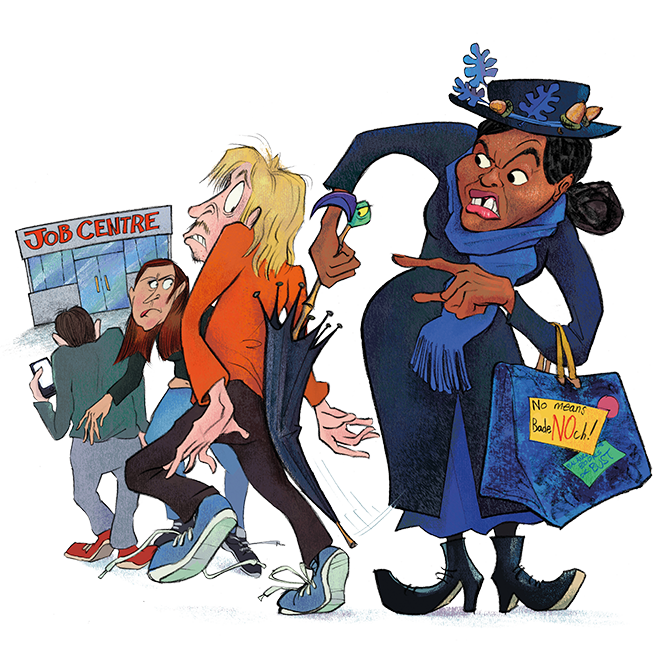
One of the most striking policies Badenoch will announce is a ‘tough love’ approach to young people. A Tory government would set up a ‘Get To Work’ programme, banning young people who have not worked from drifting straight onto benefits. Under 25s who have less than six months in continuous employment will no longer be able to sign on to universal credit when they leave school or turn 18.

Those without a job or an apprenticeship will only be able to claim a new ‘Get to Work Allowance’ – and they’ll only get that if they participate in a six-month Get to Work programme. To get the money, they will have to complete work activities, such as daily attendance at a local job centre, work-experience placements, training courses or community work. They will need to apply for jobs and go to interview-prep workshops, plus attend group sessions to develop the communication skills that employers complain young job applicants lack.
Those who complete the Get to Work programme will receive a ‘Ready for Work Award’ recording their skills. But after six months on Get to Work, young people still not working will drop down to a basic Subsistence Allowance. There will also be steps to make young people more the responsibility of their parents rather than taxpayers (with mitigations for those without parents or in the care system). ‘This is a tough love policy,’ a source says. ‘It will provide help as well as enforcement.’ This is the nanny state with menaces; Mary Poppins with an umbrella gun.
Badenoch also signals that she wants to toughen the statutory cap on total welfare spending. ‘That’s certainly something that we are considering,’ she says. ‘MPs just vote for it to increase, an automatic ratchet, because no one wants to be the person to say no.’
Some will doubtless say Badenoch is making the Conservatives the ‘nasty party’ once again. Refreshingly, she doesn’t care. ‘The people who are going to say “nasty party” will always say it. Quite frankly, the reason why we’re in this mess is because we kept pandering to those people and trying to make them like us. And did it work? No, it didn’t.’
Indeed, she attributes a new optimism among Tory MPs to her plain-speaking approach: ‘We’re finally saying what we believe and we’re not scared to say it. We should be more aggressive.’
A year ago at conference she stabilised her leadership with a pledge to abolish stamp duty. She downplays recent speculation she will announce the outright abolition of inheritance tax this time: ‘I’m not someone who likes to play the same movie twice. Inheritance tax – we want to get rid of it, but we’ve got to do our working first.’
Expect far more focus on the economy than Labour. ‘Burnham has no plans to make anybody wealthier,’ she says. ‘He has no plans to get businesses hiring people. Where are the plans for ownership, whether it’s people owning their own property, owning shares, owning businesses? There are none, because he doesn’t want people owning things or being responsible for their own lives. People hated that model so much that it ushered in the era of popular capitalism which we saw in the 1980s and 1990s. That is what people will see at my party conference.’
Badenoch will also emphasise security. ‘Defence and national security are going to be the defining issue of the next few years,’ she says. ‘We have become so complacent as a country, as politicians, and we need to get serious.’ She is critical of Ed Miliband, the Foreign Secretary, who ignored intelligence advice before sanctioning Israel, a country she calls ‘a critical security partner’. She says Miliband’s glad-handing of the foreign minister of Iran, the world’s leading state sponsor of terrorism, was ‘incredibly naive. Gormless, in fact, is probably the word that I would use.’
Badenoch was incredulous when Burnham said at PMQs that he would not promote national security at the expense of social security. ‘I thought I couldn’t possibly have heard him say that. I genuinely couldn’t believe it. I don’t think he will ever say that again.’ She puts Burnham’s mistake down to him not having a leadership contest to hone his lines. ‘He’s now doing all his thinking out loud and this is what he really believes.’
She can’t resist a parting shot at her former leadership rival turned Reform defector. ‘Rob Jenrick never exited leadership contest mode. And he’s now doing it in his new party.’ As a wheeze at conference the Tories have produced an 88ft-long illustration of Labour’s first two years in power in the style of the Bayeux Tapestry. It features 150 taxpayers being shot in the eye with a tax arrow, 14 political journalists, including this one, and numerous images of a tiny wailing Jenrick.
Jenrick and Suella Braverman’s defections in January were a relief: ‘It was like watching someone come in and pick two unexploded bombs that I was working out how to defuse and just take them away. Now in shadow cabinet, we just talk freely. No one holds anything back. No one’s taking notes.’
Badenoch has faced criticism for banning former ministers, such as Grant Shapps, from the list of Tory candidates. Grandees say that Badenoch, despite her seemingly impregnable position, fears a leadership challenge before the next election if she doesn’t turn things around in the polls and that Shapps’s habit of running a spreadsheet of dissenting MPs was a threat to her position. Others see a reluctance to let Penny Mordaunt return in the same light. ‘She was frightened of Grant’s spreadsheet,’ a former cabinet minister says. ‘She’ll let Penny back but is deliberately keeping her waiting.’
Badenoch admits she has ‘slowed down the former MPs who are coming back’, but says that is giving ‘some new candidates a chance’. She is proud that there will be ‘no more Heidi Allens’ (the former MP who tried to overturn Brexit and welfare cuts before joining the Lib Dems). She won’t comment directly on Shapps, but in response to a question about him, she criticises MPs who plot. ‘I am looking for improved standards of conduct. When people have nothing except politics, that’s when the psychodrama comes, when they’re in the bars all the time. They’ve got nothing else to do.’ She says Mordaunt ‘hasn’t been blocked’.
‘We’re finally saying what we believe and we’re not scared to say it. We should be more aggressive’
The Tories overtook Reform in a recent poll but are still below where they were when Badenoch took over. Nonetheless, she is encouraged by Nigel Farage’s recent wobbles. ‘We call Farage “Grumpy Grandpa” because he’s always complaining about something.’ She accuses the Reform leader of ‘trying to intimidate’ journalists who probe his affairs. ‘It’s not fun when the press are all over you and there’s endless scrutiny. But it’s the job.’
She also strikes a different tone to Farage on Donald Trump. The President’s recent call for a united Ireland made her ‘very irritated’. She understood American concerns over Iran’s nuclear programme, but calls it ‘frustrating’ that the Americans ‘clearly hadn’t thought about what could happen in the Strait of Hormuz. I just don’t think these guys think past page one.’ She adds: ‘It’s Trump’s actions rather than the words that I really focus on. If you focus on the words, then we’re all over the place. He’s quite erratic.’
While Reform’s recent receipt of £72 million is a huge challenge to the Tories, Badenoch says: ‘It’s actually encouraged quite a few people to give us a bit more. People who were thinking of splitting their money between the two parties said, “They don’t need my money now”, so that’s helpful.’
Badenoch knows she still has a mountain to climb. ‘My own ratings have improved but the party brand is still not enough associated with me,’ she says. ‘This is a different party from 2024. And I’ve got to show that. I think the public are screaming for a party with common sense. We’ve got sensible plans that are actually going to work this time.’
Sensible plans will help. ‘This time’ is a reminder of the challenge to overcome public scepticism of Tory pledges. But Badenoch wants to make her own luck. ‘I’m not just waiting for other people to fail,’ she says. ‘I think that’s foolishness and I get better every day.’





Comments