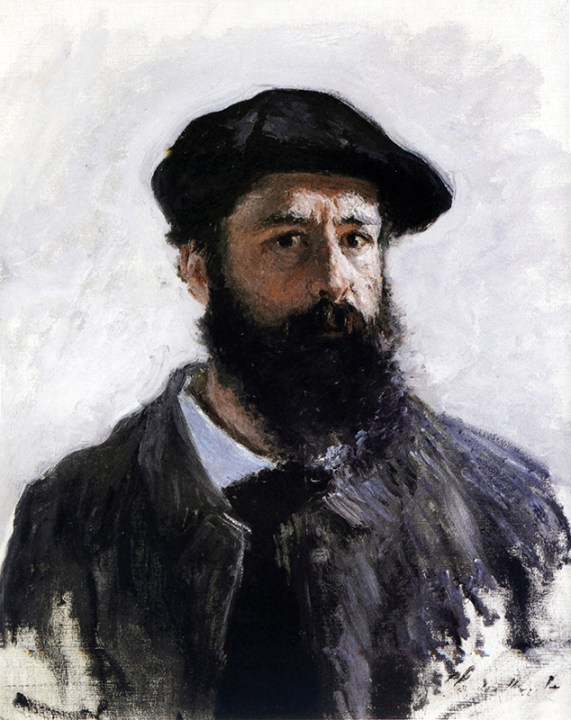
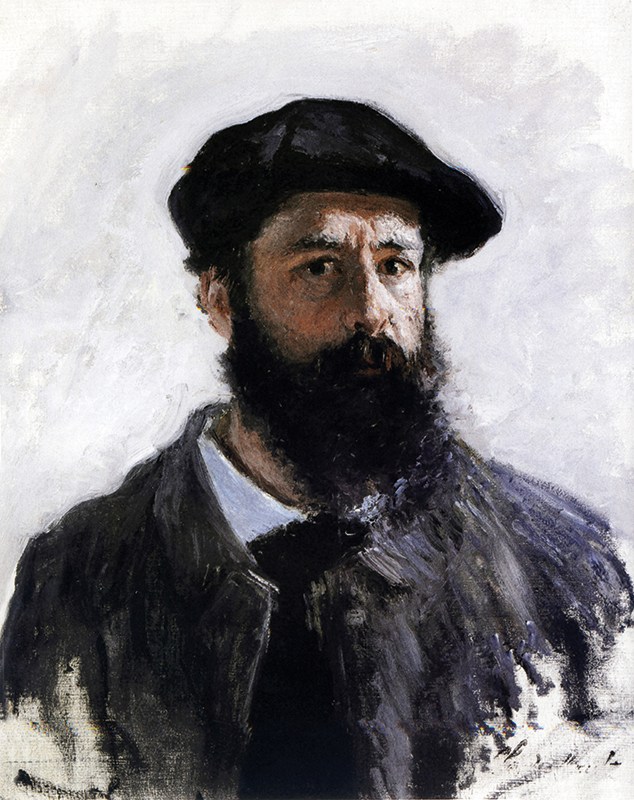
For a painter we acknowledge as a master of atmospheric effects and ever-changing light, whose early work ‘Impression, Sunrise’ sparked the artistic revolution that became Impressionism, Claude Monet (1840-1926) spent an awful lot of time complaining about the weather. He was obsessed by it, cowed and crushed by it, inspired by it to flights of genius, and its vagaries would become the intrinsic focus of his art: ‘I have just returned, covered in mud and soaking wet, the weather is so awful it is impossible to do any work’ is a constant grizzle. He seethes with frustration as he is
forced to make constant changes as everything keeps growing and getting greener… In brief, because of these changes, I am following Nature without being able to capture her… Each day I find it harder, and then there is the river, which falls, then rises, green one day, yellow the next, now nearly dry, but it will become a raging torrent tomorrow after the terrible rain we are having.
He takes us right there to the river bank, his letters often reading as a litany of anguish, a record of unremitting struggle with the elements and so much else.
Given his battles with the climate, let alone the grinding poverty and nagging self-doubt that beset his early career, it is remarkable that he never gave up. His obsessive commitment to painting, his wild ambition and courage – even arrogance – in overturning convention, and his shrewd management of his career and profile, are all on display in this newly translated selection from his correspondence: 417 letters in all, including some never previously published, to friends, family, dealers, patrons, fellow artists and statesmen. Selected (and authenticated) to chart the trajectory of Monet’s life as a painter and family man, they provide a scholarly and volatile portrait of the artist in his own words on the centenary of his death.

His volatile nature affected his writing as much as his painting. If there are glimmers of brilliance to be savoured, there is also the prosaic business of just getting along. The personal letters chosen here, covering some seven decades, are the most compelling, veering from elation to despair, with little middle ground.
In early adulthood, the provincial boy from Le Havre was fired by excitement at works he saw in ‘this dizzying Paris’– by Delacroix, Corot, Courbet, Daubigny, the Barbizon School – and dazzled by the range of painterly possibilities. But his father’s disapproval and lack of financial support condemned Monet to penury from the off, and he scrabbled to sell enough to house and feed himself, let alone his first wife Camille and his growing family. He was constantly importuning friends and dealers, hustling for work or money, initially with little hope of success.
Desperation tinges every line of his begging letters: ‘I am being punished now for being too ambitious… I am on the verge of having everything seized and sold: all my studies would be taken,’ he writes to Courbet while completing his monumental ‘Luncheon on the Grass’ (now a star exhibit at the Musée d’Orsay). Sometimes he could not work for lack of paints even, and cursed his fate. He lashes out to his friend Frédéric Bazille:
I have nothing left to do but bang my head against the wall, for I have no claim to an instant fortune, and if everyone who said the same thing as you sent me 50 francs or even 40, I would certainly not be in this situation.
Then the sun would come out, and he would be working again, hope renewed.
Monet was a plein-air painter at heart, and his moves, first to Argenteuil on the Seine, then to a riverside house at Vertheuil, marked his transition to a painter of effects, or the vaporous effects of weather. But life was no easier, and the art market no more receptive to this experiment, and he sank to new depths of despair during the 1870s, as his wife ailed and the debts built up.
What a relief, then, to see him gradually emerge from self-laceration in the 1880s, as his efforts finally bore fruit – adverse weather notwithstanding – and he achieved domestic happiness in an unconventional ménage with Alice Hoschedé, the estranged wife of his former patron. They pooled their eight children, two sons from Monet’s marriage to Camille (who had died in 1879), and six of Alice’s, and defied social opprobrium to live together, initially at Vertheuil and then from 1883 at Giverny, the house of Monet’s dreams.
His letters to Alice in their early years together betray a tentative, cautious sensibility; he addresses her as ‘Dear Madame’ until the eventual day of their wedding in 1892, and plainly has to manage fluctuating expectations on her part, threats of separation and fears of abandonment until their relationship settled into one of absolute trust and intimacy, and he could confidently address her as ‘My dearest darling’. She was his first port of call, and he wrote to her daily – sometimes twice daily – whenever his frequent painting forays separated them.
He constantly importuned friends and dealers, hustling for money, initially with little hope of success
His solicitous courtesy to Alice and a wide circle of friends sets a different tone from his correspondence with dealers and collectors, with whom he could be crisp. He bares his inner steel even to the faithful and endlessly proactive Parisian gallerist Paul Durand-Ruel, his prime dealer and champion from the early 1870s. Despite signing off ‘Your devoted’ or ‘Yours devotedly’, he regularly hounds Durand-Ruel for money and upbraids him for lack of better promotion and visibility. And he openly gives his work to other dealers, calculating that the resulting rivalry will boost his prices, which it does. The financial breakthrough came with Durand-Ruel’s exhibition in 1891 of the first of Monet’s acclaimed series paintings, ‘The Grainstacks’. Thereafter, his market grew not just in France but in Germany and America, and by the end of the century Monet would be a millionaire.
Wealth did not mellow him. He remained a beady curator of his newfound celebrity and still suffered almost suicidal bouts of artistic despair. Grief, too, after his beloved Alice died, followed by his elder son Jean, in middle age. Each of these was enough to stop him temporarily in his tracks; but his pool at Giverny, shimmering with water-lilies, rescued him, offering him one last project in which to invest his all. Conceived during the first world war as a ‘retreat for peaceful meditation’ from the fray, in which his son Michel was fighting and friends were dying, these magnificent studies on canvas were Monet’s apotheosis, his retort to the barbarity and destruction of war.
He had always been generous to fellow artists, campaigning for their recognition and legacy (he masterminded the bequest of Manet’s shocking ‘Olympia’ to the Louvre), and his warm friendship with Georges Clemenceau now paved the way to lavish gifts of his own to the state, notably the 22 ‘Water Lilies’ panels that found a permanent home in the Jeu de Paume.
We learn from the Introduction that the 417 letters presented here were selected from 3,642 identified by scholars to date. Organised into six chronological chapters, with introductory essays to give context, they certainly narrate a life of rare struggle and fulfilment, but I wonder if every one earns its place: some are, frankly, dull business notes, and the youthful pleas for funds to all and sundry become wearyingly repetitious. I wished for more of the warmth and humour so evident in the letters to Alice and friends, vivid with anecdote and observation – how Monet nearly lost his life when engulfed by a huge wave in Etretat, or bunked down miserably on a sodden painting trip between rats (above) and a pig (below) with only a tallow candle to read by; or his ecstatic reaction to Bordighera on the Riviera. ‘One would need a palette of diamonds and precious stones’ to do it justice, he declared.
As he confessed to his beloved stepdaughters, ‘writing is not my forte’, and why should it be, when painting so evidently was? But cumulatively, with their well-chosen illustrations, these letters give us a granular portrait of a life of ceaseless striving and self-criticism in which the personal and painterly were inextricably braided. As he recollected in 1917, Monet ricocheted between ‘moments of great discouragement and of courage, but such is my life’.





Comments