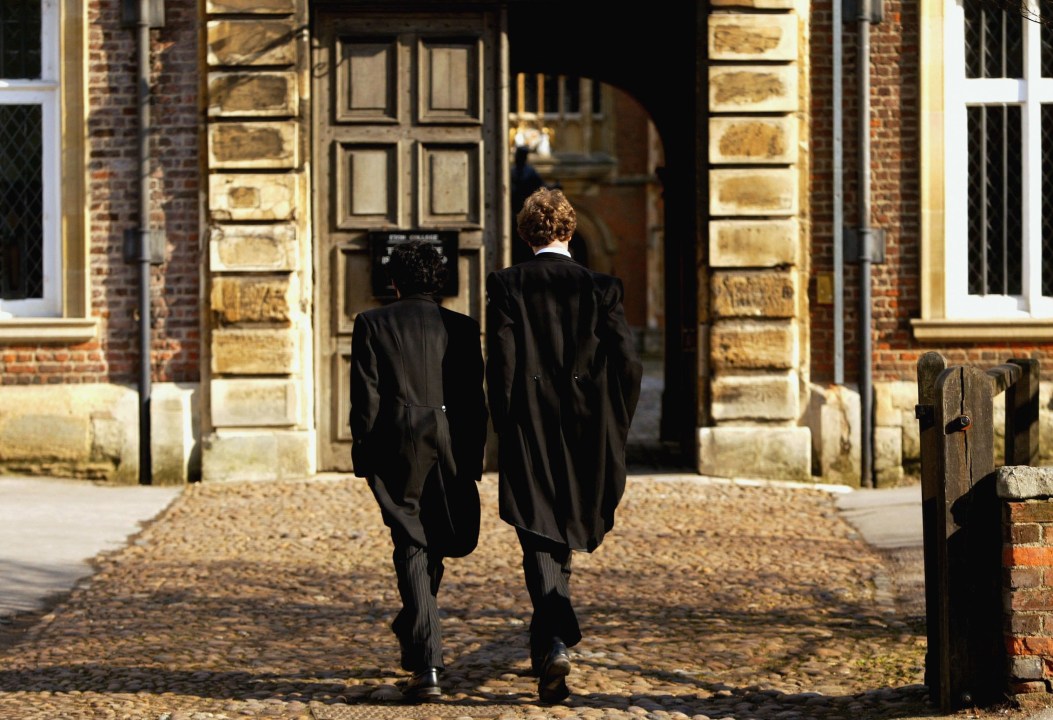
Harry Potter, the poor little orphan, can’t afford Hogwarts these days, now he has to pay VAT. James Bond, another orphan, can’t manage Eton’s £65,000 school fees. And he won’t join MI6, either – no civil servant, licensed to kill or not, can afford to live in central London any more. Now only the super-rich can afford them, private schools have become little more than gilt-edged finishing schools, with parents determined for their children to become their mini-clones as hedge-funders and private-equity tycoons.
In the last 30 years, as school fees have rocketed, so the nature of private schools and their pupils has changed for good. In the days of cheap school fees – that lasted into the early 1990s – those schools turned out selfless, decent, unflashy figures: lieutenant colonels, doctors, local solicitors and magistrates, the reliable, ancient infrastructure of local life.
Ancient schools – like Eton (founded 1440) and Westminster (1560) – were expressly set up to educate poor scholars. Winchester was partly founded in 1382 to train priests after so many died in the Black Death. The Royal School, Wolverhampton, was set up for orphans. Eric Idle of Monty Python – whose father, serving in the RAF, was killed in a car accident in 1945 – was a pupil. He says in his new book, Idle in Provence, ‘It was half an orphanage, because I was half an orphan.’
Plenty of these private schools still have scholarships and bursaries – but there are fewer of them since last year’s imposition of VAT. So it’s out with the poor scholars, and in with a tiny elite of gazillionaires. Not only do the poor scholars suffer by their ejection from these intellectual hothouses. But the schools themselves suffer by becoming a money-obsessed monoculture.
When I was at Westminster School 40 years ago, a far broader range of parents could afford it. In 1988, the year I left, the fees were £5,000 a year – that’s £15,000 now, adjusting for inflation. Today, the fees are £49,000 a year for day pupils and £69,000 for boarders.
The vast majority of 1980s parents couldn’t now afford to pay more than three times what they paid then. Yes, there were exceptions – particularly on the fabled ‘Golden Corridor’ of one house, where the sons of two retail kings boarded next door to the son of a Coca-Cola executive, said to be one of the four people who knew the real formula of the drink.
How many writers can afford to send their children to private school today?
But, otherwise, the parents were dons, teachers, engineers – comfortably off, yes, but not mega-rich. And they in turn produced bright children determined to do something other than make huge amounts of money. Old Westminster Antonia Romeo, now Cabinet Secretary, who I briefly tutored, is the daughter of a physics professor father and a biochemistry professor mother.
There was a self-replicating writing clan at Westminster. Boys in the years above me included Louis Theroux, son of writer Paul Theroux, and Giles Coren, son of journalist Alan Coren. Another boy, Tom Hodgkinson, editor of The Idler, is the son of two journalists. How many writers can afford to send their children to private school today?
Once these schools lose this idiosyncratic, bohemian mix of parents and children, paradoxically they lose their attraction to plutocrats, too. They like the idea their mini-hedge-funder offspring are mixing with Harry Potters and James Bonds. But they aren’t there any more.
20 years ago, a university friend of mine looked round his old Cambridgeshire prep school as a possible place for his infant son. His old English teacher, still there, said to him, ‘Sam, do send your son here.’ My friend said, ‘We are thinking of it but we’re not sure.’ ‘You really must,’ said his old teacher, desperately. ‘Super-rich parents from around the world want to send their children here for the full English experience. But there are hardly any English boys for them to see in the flesh.’
Meanwhile, the pupils become increasingly money-obsessed, as emerges in London Falling, Patrick Radden Keefe’s new bestseller (full disclosure – it’s edited by my sister). In 2019, the tragic protagonist, Zac Brettler, 19, fell to his death from a luxury block by the Thames. In his last months, he’d been so desperate to move among London’s gilded rich that he pretended to be Zac Ismailov, a Russian oligarch’s son. His money obsession began at Mill Hill School, where oligarchs’ children were also educated. Hooked on The Wolf of Wall Street, he watched his schoolmates order Ubers from one school building to another – and once hired a chauffeured limo to take him home from school.
Gone are the days when showing off about money was non-U. Gone, too, the austerity of boarding schools – whose prisoner-of-war alumni would declare Stalag Luft III was much more comfortable than Eton. As great British private schools have become luxury hotels catering to a tiny, self-perpetuating elite, they’ve lost their Hogwarts magic, too.



Comments