Every tribe has its rituals; mine – Oxford undergraduates in the last gasp of the vacation – is no exception. As Michaelmas term looms, my Instagram feed becomes the site of a curious annual competition, over the whiteness of beaches, the depth of tans and the performativity of poses. This year I chose a different path. I spent a week trudging alone across Norfolk on the Walsingham Way.
The Walsingham Way was once among England’s great medieval pilgrimage routes
I am not especially religious, but I had wanted to go on a pilgrimage for some time. My Gold DofE, despite my school’s best efforts, had not put me off the prospect of oversized waterproofs and blister-inducing boots. My parents were bemused by my choice to spend some of my summer walking, alone on the outskirts of Norwich, when I should have been tackling that long reading list or saving a few hundred quid towards somewhere considerably sunnier next year. I did what all twenty-year-olds should and ignored them. Thus, one Sunday morning, they dropped me at Norwich Cathedral.
The Walsingham Way was once among England’s great medieval pilgrimage routes. Henry III, Edward I and a young Henry VIII (before his marital difficulties began) all made the journey to the shrine at Walsingham – ‘England’s Nazareth’. The story goes that in 1061, a noblewoman named Lady Richeldis de Faverches was shown a vision of the Holy House in Nazareth by the Virgin Mary and instructed to build an exact replica in Norfolk. Whilst she had the advantage of skipping newt surveys and planning applications, she still faced a marshy, waterlogged site that made building impossible. Until, after a night of prayer, the house appeared, fully built on drier ground nearby. This story was evidently a good one, and by the fourteenth century, Walsingham had overtaken Canterbury as England’s premier pilgrimage destination.
The route runs about forty miles through Norfolk’s country lanes, littered with churches. Many offer a stamp for the pilgrim’s passport, with my favourite depicting a mouse. At Great Ryburgh, on my last day, I found a church that was evidently well loved, with laminated signs plastering the walls detailing the history of the building, and what it meant to be a pilgrim. It took only a few minutes to be met by Peter, the culprit, a relic of that eccentric breed of local historian that is immensely passionate and knowledgeable. This individual soon realised his enthusiasm was matched, and so we climbed up the Anglo-Saxon tower, saw the wooden beam carbon-dated to 960 AD, and observed an 1,000-year-old coffin found in the next village along. This hospitality was not unique; nearly every church, however empty, had drinks and biscuits laid out for weary pilgrims.
In the pubs, people knew the route and were curious how I’d found it, with my fluorescent orange rucksack cover (mandated by my parents for safety) rather giving the game away, as did the walking sticks my grandparents had insisted I’d need to fend off dangerous men. Fortunately, their sharp ends were not needed. What I did meet, though, in one pub, was a recently single man telling me how he’d dismissed the priesthood, largely on account of the vow of chastity, who gave me a Bible and a coquettish baby-pink rosary. He was, I think, flirting in a new way perhaps contiained only in these isolated quarters of East Anglia.
I refused throughout to listen to music or podcasts, a considerable departure from a life in which silence is usually filled at all costs. Instead, I started noticing things like the bees nesting in sandy roadside banks, and a Shetland pony couple with fringes akin to Claudia Winkleman, looking both mysterious and pleading at once. The days passed slowly. Despite a blister developing on my little toe, and a back complaining under the weight of an overpacked bag, I found myself wanting to stretch the last few kilometres out.
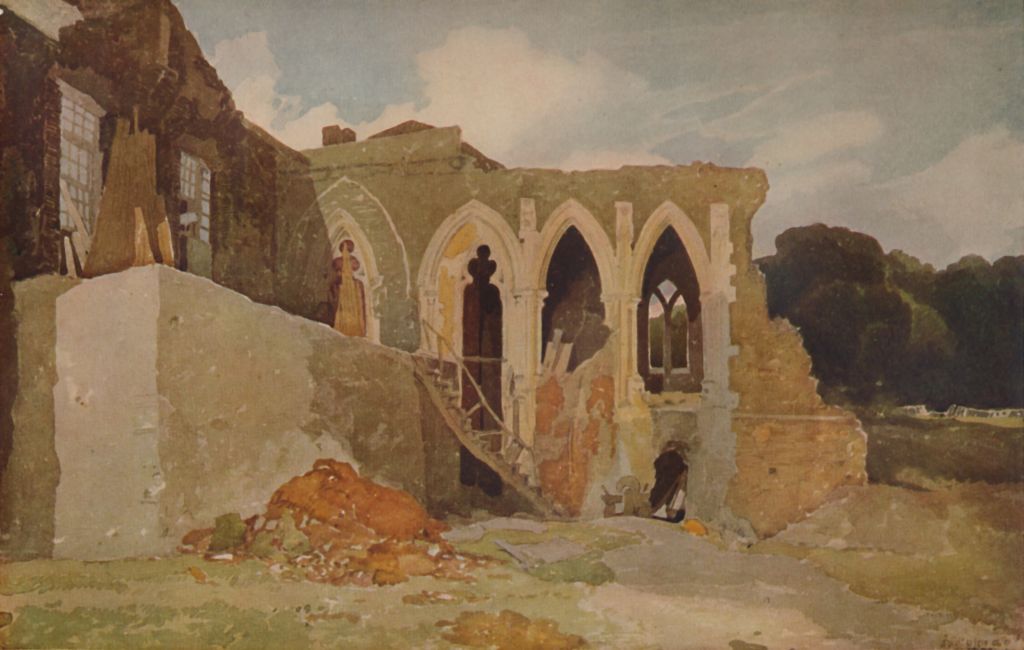
Walsingham arrived in sunshine, red brick, bunting, a warm welcome after the many miles alone. Soup first, to refuel; then the ruins of the priory, with the East Window arch serenely looking down. The shrine, when I reached it, was crowded, a marked change from the solitary walk that had brought me there. It was in the Anglican church down the road, sitting under a very high, very whitewashed ceiling, that I finally felt that I had arrived.
I did not have a religious experience (unless you count the rosary). What I did have was proof of other people’s kindness, from Peter at Great Ryburgh to the strangers who congratulated me on the way, to the church committees who ensured the Ribena was stocked up for pilgrims that rhey would never meet. It may not be as exotic as a yoga retreat in Bali or riding across Central Asia. But I proved, at least to myself, that trudging forty miles alone through Norfolk makes a far better story than a tan.



Comments