Each time I fly back to Odesa, my hometown, to see my family, I notice how things have changed since my last visit to Ukraine. Which is to say, how much worse they have become.
Take the bombing raids, which used to happen only at night. Now they take place in the daytime as well and have grown much more violent and unpredictable. The Russians send over a cocktail of drones, ballistic missiles and guided aerial bombs. You never know where they’ll hit – residential buildings, shopping centres, pharmacies, trains, you name it (‘Russian Roulette’ is the new, blackly comic Ukrainian name for it).
The war, all the time, is getting closer to you and your loved ones. It used to be happening in another part of your region. Then in another area of your city. Now you feel lucky if it isn’t happening in your street. On my last visit, a neighbour was killed in his sleep when metal pellets packed inside a drone struck him as it exploded.
People have asked me what it’s like to live under sustained bombing. I can only say that your heart starts beating faster and you feel acute fear. Banderol missiles (I’m getting to know the different bombs) are the worst. They travel at about 400 miles per hour, make a terrible screeching roar as they approach, and you feel they’re coming right at you. The seconds of waiting are the worst – there are no profound thoughts, no memories of your life-flashing-before-your-eyes: you simply feel paralysed with fear.
Ukrainians are physically and emotionally wrung out from endless sleepless nights
If you wake to an explosion, it’s disorientating and takes a while to understand what’s happening. Then you immediately start waiting for the next one. I myself can fall asleep again quite quickly, but others lie awake for hours, frightened and worked up. All this is having an inevitable effect on people’s nervous systems. A friend told me that children in playgrounds have become more anxious and on edge, more jumpy and abrupt in the way they interact with other kids. It’s significant that when an area’s hit, along with the firefighters, ambulances and a special shelter-bus that arrive (miraculously quickly) on the scene, psychologists are sent too.

People are increasingly resigned to the war lasting many more years: any hope that its ending is in sight has gone. But the way they talk about it feels quite different from before. If the war has brought stages of grief, Ukrainians are now at the ‘acceptance’ phase. But is that a good thing?
This isn’t to say there aren’t different points of view on what should happen. Some are pushing for a peace deal, arguing that ‘Russia will destroy our entire country, building by building. Give them Donbass and sign a ceasefire’.
Others feel this will solve nothing: ‘The Russians won’t stop. Giving them Donbass will only encourage them to keep going. They’ll be dug in closer to the rest of the country and their attacks will be even worse.’
Another group entertain the possibility the whole of Ukraine might fall to Putin: ‘Frankly, we don’t know which country we’ll be living in in the future.’
But before that, winter is coming – the worst, we’re told, of the war – and the immediate problems are more practical. People are stocking up on imperishable foods, buying power banks, getting stores of essential medicines. Those who can afford to are installing solar panels – you never saw them in Odesa before war broke out – or digging wells for water supplies. There have been a lot of scare stories going round about what might happen to Odesa’s drinking water, and it’s clearly on many people’s minds. When a friend phoned a well installation company, she found they were fully booked for the next four months.
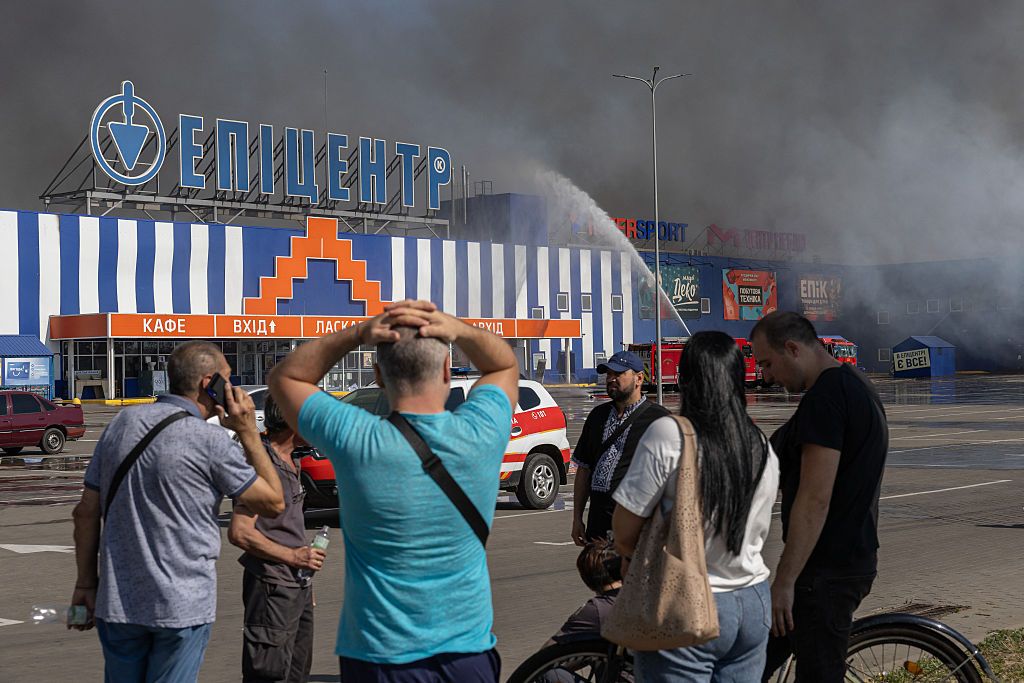
Other businesses are less fortunate. When a recent, all-too-believable rumour went round that Epicentr, a beloved Odesan home-improvement store, was on Putin’s to-bomb list, the shop shut its branches – so hurriedly, you wondered what they knew and what we didn’t. We are steadily losing the things that make up our known, normal world, and each loss registers. Of course, you can buy the same products at other shops or markets. But for Odesans, another piece of their routine – a reassuring one, which looked like it would be there forever – has been taken away.
What’s extraordinary, though, is what the local people will do to take their minds off things. Ukrainians are physically and emotionally wrung out from endless sleepless nights. But even after a bombing raid, they still look great in the morning, with make-up, styled hair, a cup of coffee in their hands. The Odesan sense of humour – quite famous – carries on, as does the fierce individualism of its citizens. I saw one woman leading a cat about on a leash, another a parrot on a string. Meanwhile, in one café, there was a jar for tips on the counter, beside which a barista had written: ‘To pay for the psychologist after work.’
Then there are the dawn piano concerts that have recently sprung up. A pianist from the Kyiv region, Ihor Yanchuk, has started giving them each morning on the Odesa seafront, and hundreds usually attend. You listen to the music as the sun comes up, are reminded of the potential for serenity in life, and it sets you up for another day. One sunrise, as we were listening to Ihor play, there was a sudden air raid warning. The piano music and people’s silent enjoyment of it brought home to you the best and most creative in human nature; the bombs that were on their way, screaming and roaring, the very worst.
But Ihor Yanchuk does his bit to keep things going. Both his music and his words are, for Odesans, a healing force. ‘Thank you to everyone,’ he says, ‘who, despite everything, finds little reasons to rejoice in a new day, in the rising sun after anxious nights, and to keep moving forward. It doesn’t matter how fast or how slowly – what matters is that we don’t stop.’
‘Take the sun as your example,’ he adds – and who, in war or peacetime, would wish to argue with that?






Comments