


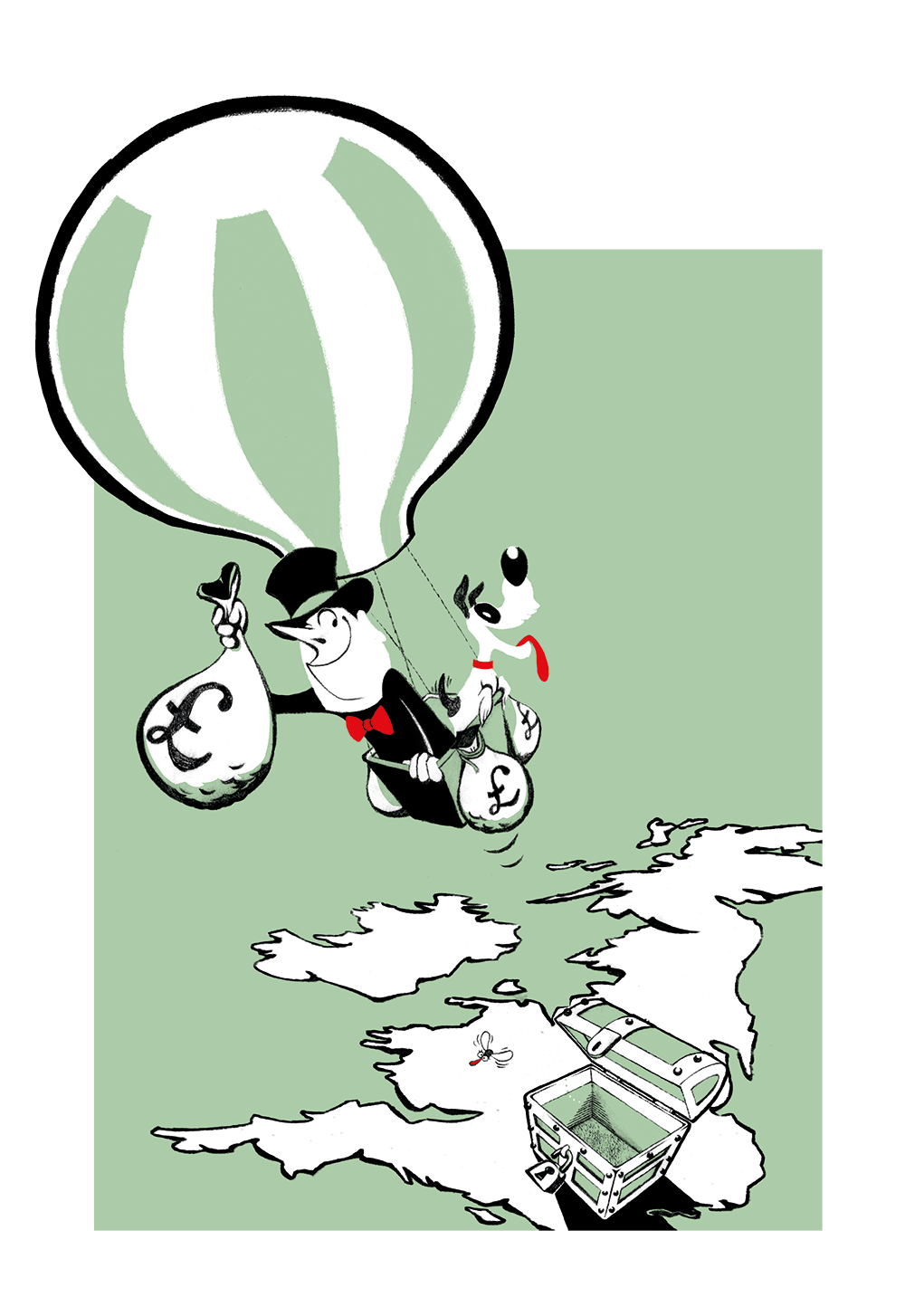
Behind the scenes of The Spectator’s wealth tax debate this month there were lots of nervous whispers. ‘Wealthy people we work with are absolutely terrified about an exit tax,’ one Westminster figure remarked. The economist Arthur Laffer, one of the debate’s speakers, couldn’t believe a wealth tax was even being considered. Britain is already near the top of his famous curve – the point beyond which taxation reduces the Treasury’s take – and seems determined to push things to destruction.
The latest fiscal rumour – that we might seize millions on a wealthy migrant’s departure – is a dangerous one. According to reports, it’s also the reason Chris Rokos, the third-highest taxpayer on the Sunday Times tax list, has decided to leave for Greece. He’s worth £330 million to HMRC – the equivalent of 38,000 average taxpayers. But he’s far from the only golden goose heading for a new nest.
Official figures on Britain’s wealth exodus are limited. An upcoming report by New World Wealth will predict a net outflow of more than 45,000 millionaires between 2020 and the end of this year. Analysis by Rathbones shows nearly 6,000 high-growth business owners left the UK in the past two years. HMRC, meanwhile, records around 8,600 newly arrived non-dom taxpayers in 2024-25 – down from 10,000 the year before.

These estimates are controversial and will be disputed. The government’s slow pace of data collection (we won’t know the true effects of the non-dom changes until at least the end of next year) makes it easy for campaigners to pick holes. But even if you don’t trust the estimates, you can speak to any wealth adviser and the anecdotal evidence is clear: many of Britain’s richest are considering a flight to more inviting climes.
As one wealth adviser explains: ‘We have genuinely self-made clients whose views were always, “I’m a product of the system. I want to pay more in for better public services.”’ They’ve since U-turned. ‘They feel hated. They feel it’s gone too far. Individual taxes haven’t really gone up. It’s the change in sentiment.’
But what’s more important than how full the departure lounge may be is how empty the arrivals hall has become. If you’re a foreign millionaire, why move to Britain if you will be hated for your wealth?
Other countries welcome the rich with open arms and a kiss on each cheek. Rokos, for instance, contrary to assumptions often made about his surname, has no real connection to Greece. The nation’s shop window is attractive enough. Tax on foreign income is fixed at just €100,000 for the first 15 years. Further up the Med, Italy will ask €300,000 from you. But crucially – in contrast to how Britain now deals with tax – the Italians employ grandfathering, i.e. where no tax changes are retrospective. The €300,000 price tag has increased twice, but you pay the fee that was agreed in the year you entered. It’s an attractive offer which seems to work. Egyptian businessman Nassef Sawiris closed the London office of his investment firm after making Italy his home and top banker Richard Gnodde reportedly now lives in Milan.
Familiar favourites for the generationally wealthy remain popular too. When money is moved to Switzerland it tends to stay there thanks to a lenient tax regime, political stability and an entire industry devoted to protecting family wealth, as well as inheritance tax exemptions. And it’s a regime backed by the public. Last November, Swiss voters rejected a proposed 50 per cent federal tax on inheritances and gifts above £45 million.

In May last year, when I first reported on the rich fleeing Britain, I revealed that staff of the billionaire hedge-funder Alan Howard were looking for Swiss flats ahead of their boss’s move. By the end of the year he had relocated and many followed. That identifies another problem: if funds and family offices move, the bankers and brokers serving them are incentivised to go too. One such departure, already growing sick of melted cheese, says he nevertheless doesn’t regret his decision to leave the UK. ‘The UK is communist,’ he says, flatly.
Further afield, the UAE is becoming a leading destination for the uber-wealthy. One of Britain’s richest home-grown billionaires, the hedge-funder Michael Platt, is currently registered on Companies House as a resident of the UAE. It’s an attractive place, if you can stand the heat and barren landscape, given it has no income tax. It also has a near-zero crime rate. Singapore has similar appeal, along with access to Asian markets.
Increasingly, it’s the aspirational, rather than the already rich, choosing these places. They want to start companies or make their next investments in places where their economic contribution might actually be valued.
Get the destination wrong, however, and your relocation can become costly. Tax regimes can change in the political wind. Spain is a frightening example. The country’s ‘Beckham law’ offered qualifying newcomers a 24 per cent rate on their first €600,000 of annual employment income for up to six tax years. But when the socialist party got into power, it attempted to claw the tax back. There are reports of some wealthy expats effectively held hostage in the country until they pay back taxes Spanish tax collectors have now decreed are due.
If just one of the richest leaves, we need to create 1,000 median taxpayers to replace them
Britain is becoming a lot more like Spain. Uncertainty is rife. Tax speculation is endless and the Chancellor never seems to have raised taxes quite enough. But more than anything, the message to wealth creators seems to be ‘you ain’t welcome’.
Whether we like the uber-rich or not, we need them. We have – through conscious design and policy accident – ended up with one of the most ‘progressive’ and top-heavy tax systems in the world. The result is a tax code that relies on the top 1 per cent of taxpayers for more than a quarter of all income tax. The further up the scale the more extreme it gets: around 4,000 of the richest individuals account for roughly 5 per cent of all income tax. If just one of them leaves, we need to create 1,000 median taxpayers to replace them. Even the IMF now warns we’re nearing the top of the Laffer curve.
In his firm’s draft blueprint for Britain, Laffer calls for taxes that fund government ‘while doing the least damage to the economy’. That ought to be the test for the next Budget. Britain needs to give people a reason to build their fortunes here and enough certainty to make them stay. Do that and we might start filling the arrivals halls again. For now, as one wealth adviser says of conversations with private-client lawyers: ‘No one’s coming in any more. We’re just really helping people go out.’
A Migration Map: Limited edition prints available at spectator.com/map






Comments