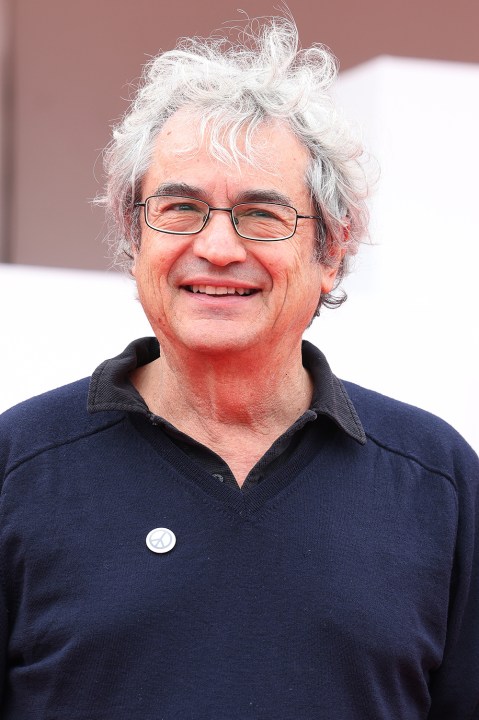

Carlo Rovelli, the Italian theoretical physicist, is one of the great scientific explicators of our time. His wafer-thin essay collection, Seven Brief Lessons on Physics (2015), managed to clarify the unsettling uncertainties of Einsteinian relativity, quantum theory and other physical exotica. It sold more than a million copies in English translation alone. Not since Stephen Hawking’s A Brief History of Time had there been such a consensual success in the science book market. In later bestsellers such as The Order of Time and White Holes, Rovelli continued a tradition of popular scientific writing from Galileo to Darwin that disappeared in the academic specialisations of the past century. The French call it haute vulgarisation – high-class popularisation. Rovelli excels at it.
On the Equality of All Things is an essay collection on the infinitude of matter, Einsteinian ‘spacetime’ and other tentative physics. It grew out of a series of lectures Rovelli gave in 2024 to philosophy students at Princeton University. A restlessly enquiring thinker, Rovelli sees no incompatibility between physics and philosophy – only mutual attraction. Physics is said to interrogate the mystery of existence more profoundly than other sciences. The laws of physics – gravity, energy, motion and time – underlie those of chemistry, astrophysics and meteorology alike. So to understand how the world works, says Rovelli, we need at least some grasp of physics; philosophy, in turn, helps us make sense of what physics reveals.

The six essays (‘lessons’, Rovelli calls them) repudiate the idea that science is ever settled. The search for knowledge is not nourished by certainty; it is nourished by a ‘radical distrust of certainty’. In his essay on quantum mechanics, Rovelli goes as far as to say that certainty is ‘uninteresting’. Before Einstein, scientists had imagined a predictable, deterministic universe that ran like clockwork. Newton’s notion of absolute ‘true time’ ticking evenly across the cosmos gave way to Einstein’s shattering claim that there is no single ‘now’, but, rather, many ‘nows’. Werner Heisenberg and his followers, more radical even than Einstein, argued that the world can only be known through models of uncertainty and probability. Rovelli concedes that such ideas may ultimately exceed our tentative, Earth-bound understanding; but Newtonian mechanics, though hardly obsolete, can no longer explain every feature of life as we know it.
Readers of Helgoland, Rovelli’s wonderful book on Heisenberg, will remember that it was on the North Sea island of Helgoland in 1925 that the young German physicist overturned the certainties of classical physics when he conceived of the ‘strangely beautiful interior’ of an atom’s mathematical structure. The old Newtonian picture of atoms as tiny electrons mechanically circling heavier protons, like planets round the sun, was suddenly gone. Heisenberg intuited that electrons moved in diffuse, cloudlike waves and he went on to devise mathematical tables (matrices) to predict their wave mechanics.
Quantum theory was sired out of Heisenberg’s observations of light patterns emitted by atoms and Einstein’s earlier relativity theory. In Lesson Two (‘From Inside the Circle’), Rovelli invites us to see the world as a giant cat’s cradle of relations, where objects exist only in terms of their interaction with one another. Ultimately, Heisenberg’s is a theory of how all things ‘influence’ each other, says Rovelli. It forms the basis of our modern technologies, from computers to nuclear power, lasers, transistors and MRI scanners. Rovelli, like Heisenberg before him, understands the world to be non-deterministic and essentially unpredictable.
Inevitably, the book is hard going at times. Rovelli describes it as a ‘long flight’ through the limits of our understanding, and often asks the reader if he is still on board (‘you can skip to the end of this section, if you like’). Fortified with reflections on Vedanta Hinduism (Rovelli has a hippyish past in 1970s Italy when he listened to the Grateful Dead and smoked quantities of weed), the essays ask what is real and what exists. ‘Reality,’ Rovelli insists, ‘is more complex and varied than we think.’ He applies quantum theory to philosophy to show that humans exist by virtue of their continuous interactions with one another – so, too, do atoms and electrons. ‘It makes no sense to ask where something is, except in relation to other things,’ Rovelli writes.

Throughout, he quotes pertinently from Rilke, Dostoevsky and Kierkegaard, but he never talks down to the reader. As a lapsed Catholic, he is commendably open-minded in his views on religion. Scientists such as Richard Dawkins who pretend to atheistic omniscience are no less prejudiced than American Bible-belt fanatics; the world is not necessarily as Dawkins and company say it is. On the Equality of All Things, a lapidary amalgam of philosophy and physics, is an altogether charming book.






Comments