
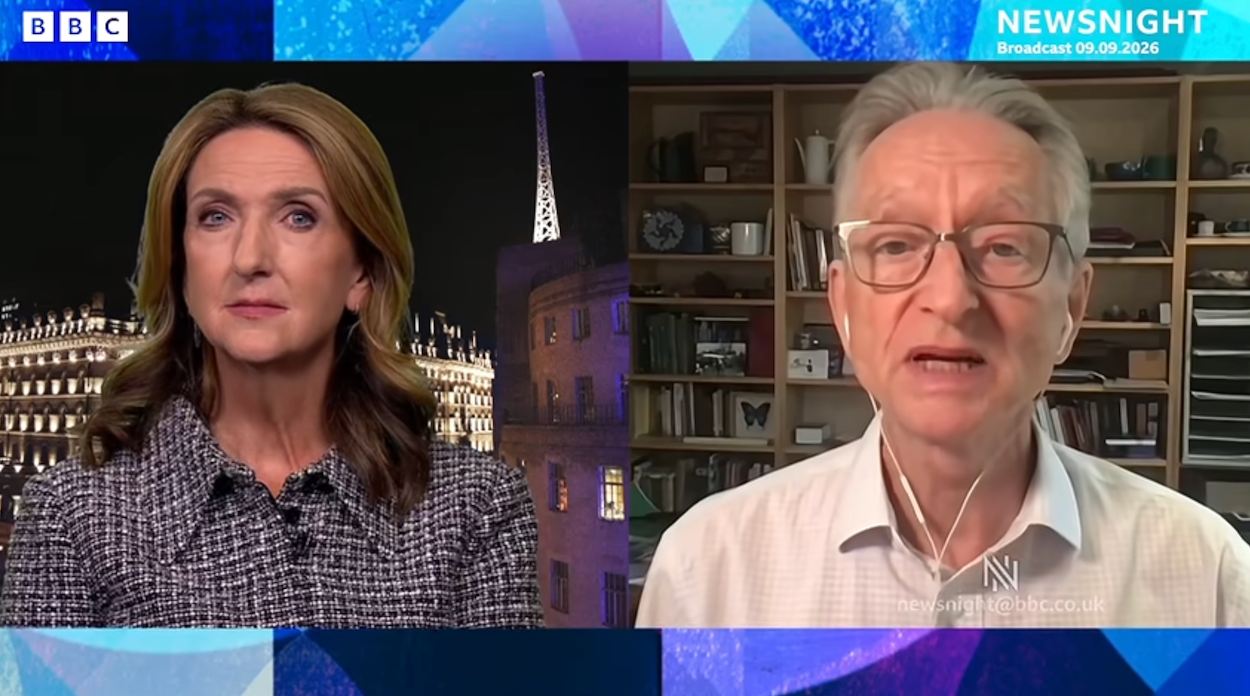
A somewhat bemusing interview took place between Victoria Derbyshire and Geoffrey Hinton last week on Newsnight. Hinton, an eminent computer scientist who has won both a Nobel prize and a Turing award, told Derbyshire that a ten per cent chance of human extinction at the hands of AI by the end of this decade ‘seems not an unreasonable estimate to me’, leaving Derbyshire almost speechless.
It is strange that a senior broadcaster could have made it as late as September 2026 without encountering Hinton’s perspective, which is not particularly controversial among either AI researchers or safety advocates. Hinton even quit his position with Google in 2023 so that he could voice his concerns about AI risk publicly. Why has it taken three years for Derbyshire – who is paid over £250,000 by the BBC – to notice?
Here is one way that Derbyshire could have pushed back on Hinton, if she’d been doing her job properly: ask him about some of his previous bold predictions. In 2016, Hinton famously stated that ‘people should stop training radiologists now’, on the grounds that ‘it’s just completely obvious that within five years, deep learning [AI] is going to do better’. Ten years on, the NHS is suffering from a chronic shortage of radiologists. As of May, the UK has 32 per cent fewer radiologists than it needs to meet demand. If you had, as an 18-year-old in 2016, chosen to ignore Hinton’s warning and went on to train as a radiologist, you could now be making very decent money working overtime shifts.
In retrospect, a lot of career advice that tech overlords gave young people in the 2010s was bunkum. Take, for example, the insistence that self-driving technology would automate driving. Elon Musk predicted that there would be one million self-driving cars on the road by 2019 – a goal which we have yet to meet. Indeed, Waymo, the market leader in autonomous driving, had fewer than 4,000 robotaxis on the road as of June this year.

A few of my peers put off getting a driving license because of these predictions (or so they say). But what is more amusing in retrospect was the prediction that truck driving would become obsolete. In 2017, Tesla rolled out a fully electric semi-truck which was equipped with autonomous driving capabilities. At the time this was feted as the end of the lorry driver. The Guardian even ran a mournful piece by a trucker with the headline ‘Truck drivers like me will soon be replaced by automation’. Three years later, as supply chains came under strain post-Covid, lorry drivers were suddenly earning upwards of £78,000 a year, more than most doctors years after they finish medical school.
The preoccupation which tech figures seem to have with the obsolescence of human beings in certain professions predates the TedTalk era of technology evangelism. Way back in 1965 Herbert Simon, a computing pioneer, predicted that within 20 years machines would be capable of ‘doing any work a man can do’. And specifically, talking up the potential of artificial intelligence has a long history too. In 1970, as an example, Marvin Minsky – another famous AI pioneer – said that there would be a machine with the same intelligence as a human being within 3-8 years, and that its power would then become ‘incalculable’.
When scepticism is expressed about the potential of AI, evangelists will often point to predictions that the internet would amount to nothing in the 1990s as a cautionary tale, when people like Robert Metcalfe, who founded a telecoms manufacturer, predicted that the internet would ‘catastrophically collapse’ in 1996. But there are also many technological promises in recent history which have come to very little. Virtual reality headsets failed to become a mass consumer item. Very few people still own 3D televisions or Playstation Moves.
Many billions of pounds were raised to pursue these technological revolutions by plausible-looking nerdy young men with hoodies and enticing stories about ‘the future’, which has a habit of surprising us all.






Comments