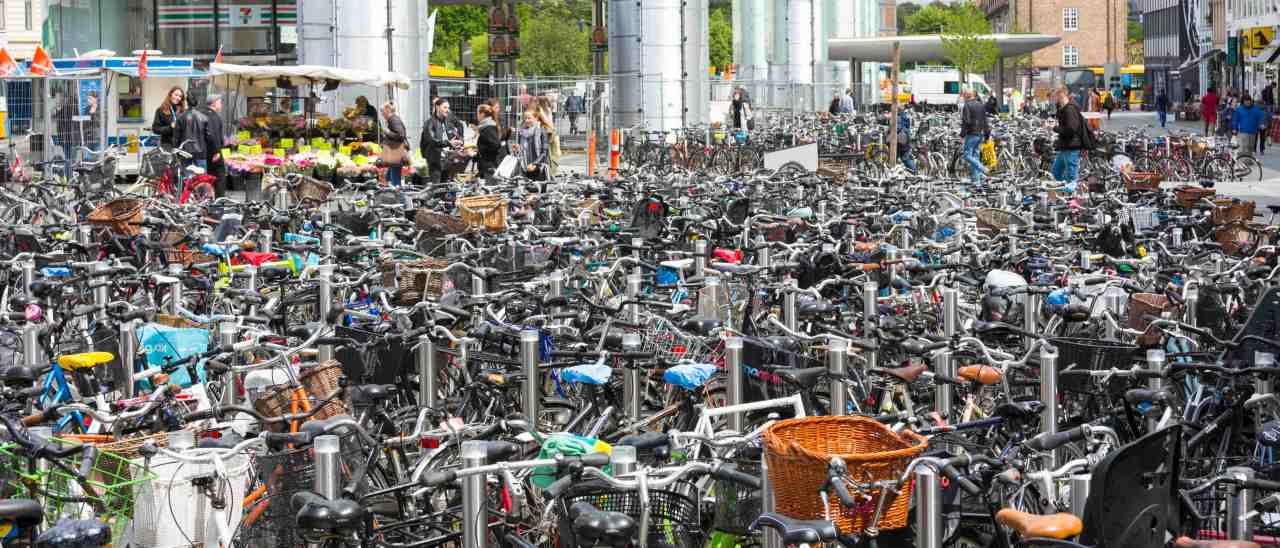
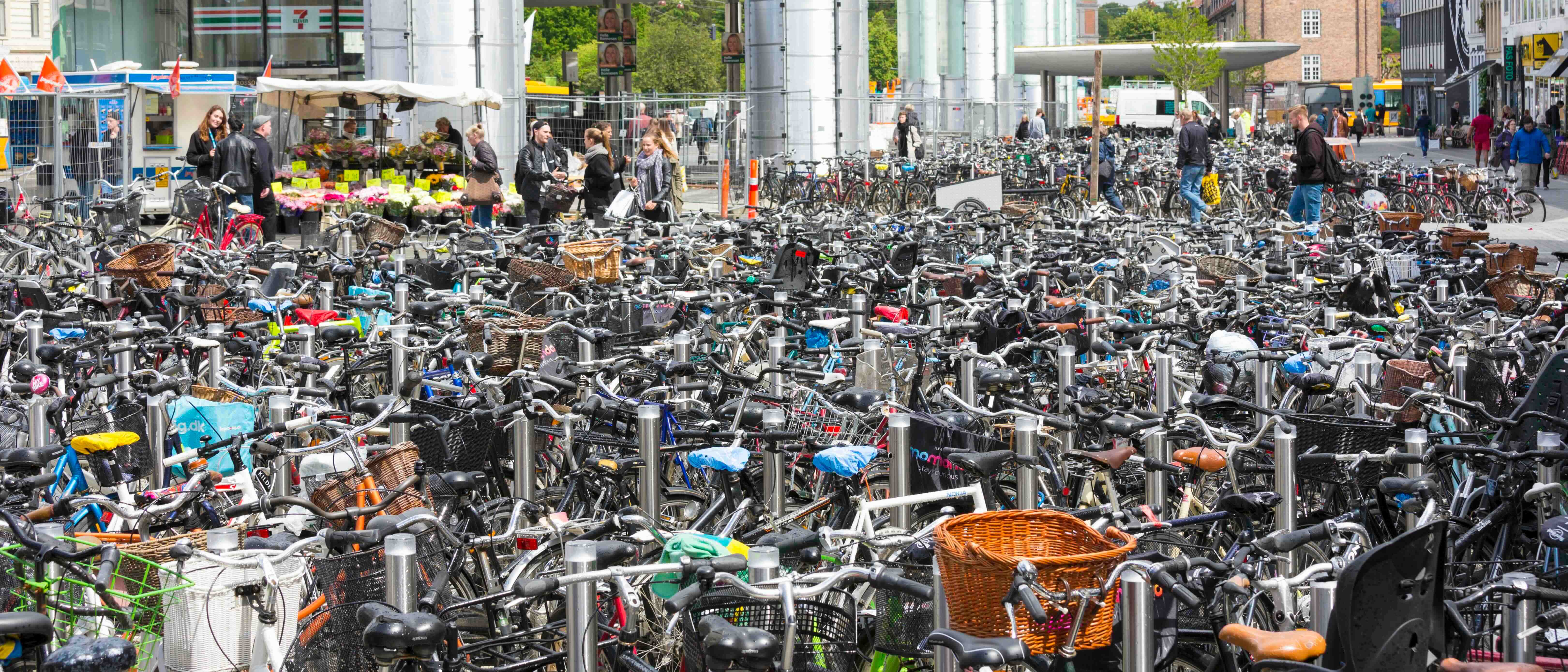
Copenhagen’s obsession with cycling is evident from the moment you arrive. Walking out of the cavernous Central Station, on my first visit to the Danish capital a couple of weeks ago, the first thing I saw was bikes – hundreds of the things parked in a tangled mass of metal and rubber. The closer to the centre I got, two-wheelers started appearing with greater frequency, driven at high speed alongside roads largely denuded of four-wheelers. Clearly, this was a city designed for and ruled over by cyclists. I couldn’t wait to get out and join them.

The statistics about Copenhagen’s cycling culture are insane. The Danish capital is home to around 745,000 bikes, meaning that two-wheelers outnumber the human population of 670,000 and exceed the number of cars (around 125,000) by five to one. If a malicious AI bot ever wanted to take over this beautiful city, all it would have to do is weaponise the bikes: humans wouldn’t stand a chance.
Around 50 per cent of all commutes, both to school and work, are done by bike in Copenhagen, and every weekday, over 2.7 million kilometres are cycled on the city’s 400 kilometres of bike paths. That is equivalent to 67 times around the Earth. The ranking of the world’s best cycling cities is aptly called the Copenhagenize Index – although Utrecht currently occupies Europe’s top spot, just ahead of the Danish capital.
The best way for visitors to participate in Copenhagen’s cycling culture is to download the Donkey Republic app. The company’s orange bikes are easily recognisable and parked at stations all over the city. There are various pricing structures. I opted for a three hour pass that cost 89 Danish kroner (just under €12, or £10.30). If you want to park up to admire a building or enjoy a pint of Tuborg – much nicer than its more famous but blander rival, Carlsberg – you can lock and unlock your bike using the app, leaving it unattended for as long as you want. And do park up if you want to look at something properly.
Enlisting in Copenhagen’s two-wheeled armies is wonderful fun, but no way to see the sights. Traffic on the bike lanes moves at tremendous speed, requiring you to keep pace to avoid being entangled in the cyclists behind you. You wouldn’t last five minutes if you pootled along, rubberknecking at the elegant buildings and tranquil manmade lakes. In the early 2000s, city authorities introduced what is known as the ‘Green Wave‘, synchronising traffic lights along central routes so that cyclists travelling at 20kph can glide through several in a row.
Between 2015 and 2025, Copenhagen invested around 160 million Danish kroner (£18.3 million) per year in cycling infrastructure. Last year, city authorities passed the largest ever cycling budget – 600 million Danish kroner (£69 million) just to make the city even more bike-friendly. As a result, the entire Danish capital feels like an F1 track for cyclists. I derived a childlike pleasure from viewing my fellow bikers as competitors. On every straight stretch I’d identify a few to overtake, and try to avoid being overtaken myself. Three hours went past in a flash.
If a malicious AI bot ever wanted to take over this beautiful city, all it would have to do is weaponise the bikes
Despite the speed and volume of Copenhagen’s bike traffic, there are hardly ever serious accidents. A few simple rules keep things flowing safely. Stick to the clearly marked cycle lanes and keep right unless overtaking. Hold one hand up straight if you’re slowing or stopping. Nervous or inexperienced cyclists might want to avoid the twice-daily rush hours, when the cycling traffic forms a beige peloton of cut-throat commuters.
Once you get used to the speed of the bike lanes, though, cycling in Copenhagen is an unforgettable experience – joyful, invigorating and so very healthy. Revel in that twinge of superiority when the occasional car skulks past, emitting its planet-destroying fumes. Cars, I suspect, will soon be to Copenhagen what dinosaurs are to our planet: fantastical, mechanised monsters of a distant era, impossible to imagine actually existing. A study last June found that if every city in the world had as many bike lanes as Copenhagen, total private vehicle emissions would fall by 6 per cent and the health benefits would amount to $435 billion (£322 billion) per year.
In one sense, I was a terrible tourist in Copenhagen. I didn’t look around the Tivoli Gardens or gawp at the Rosenborg Castle. I failed to admire the Christiansborg or Amalienborg Palaces or visit the National Museum. But after just 24 hours in the city, I still came away feeling that I’d tapped into its energy and life. There’s only one way to feel part of Copenhagen – and that’s on two wheels.





Comments