
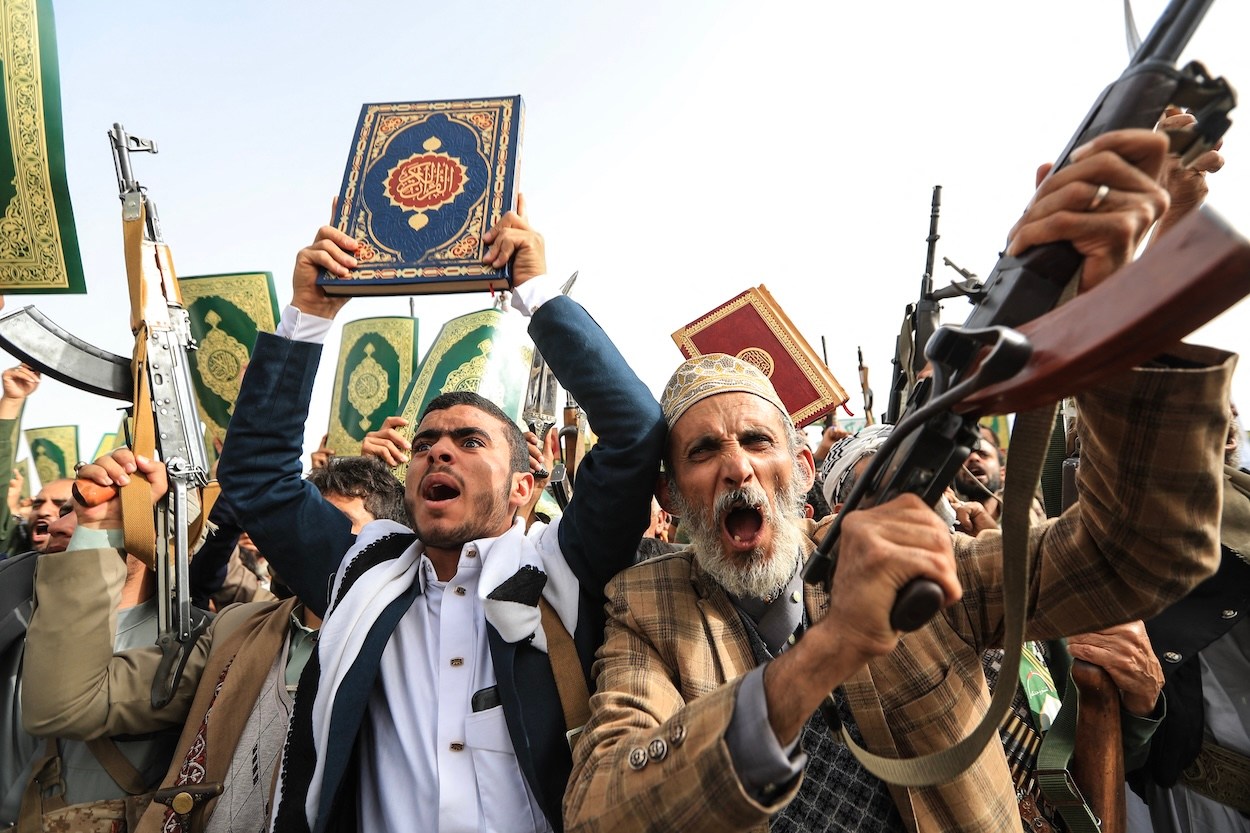
In a lightning series of advances in the past week, the Houthis have captured Hanish and Zuqar Islands, the port of Mocha, and now Perim Island, which effectively divides the aptly named Bab al-Mandab, ‘The Gate of Tears’ or ‘Grief’, in two. They now control the whole of the Yemeni side of the Red Sea. Their partial blockade of the Red Sea, which they have maintained on and off since 2023, is set to become even more effective. Not content with that, the Houthis have in the last 24 hours launched missile attacks against the Saudis’ King Khalid Air Force Base and other military targets, and possibly also been involved in a drone and missile attack on the main east-west pipeline that brings oil from Saudi oilfields which bypass the heavily contested Strait of Hormuz.

The impact of this has been immediately felt in rising oil prices but, if continued, is likely to bring further disruption to the world economy, which relies on Red Sea passage for some 10 per cent of trade, and some 6-7 per cent of oil shipments. What provoked this escalation? What can be done about it?
While the Houthis – trained, mentored and supplied by Iran, as part of its proxy forces strategy to confront America and Israel – have intervened in the post-October 2023 conflict through missile attacks on Israeli and shipping in and around the Red Sea, the conflict with Saudi Arabia and the internationally recognised Yemeni Presidential Leadership Council go back far further. In origin, Royal Yemen, what is now the Houthi-controlled area, was distinct from the remainder of the country. It had its own loose government structure, held together by the British until 1968, and then went through various iterations, including a spell as the hard-line, Marxist, People’s Democratic Republic of Yemen (PDRY), when it harboured both international terror groups and tried to undermine its neighbour, Oman.
The fall of communism saw the collapse of the PDRY, but attempts to unify the two parts of Yemen have been largely unsuccessful. Since 2014, there has been an ongoing civil war with intermittent ceasefires. The Houthis have consistently sought to involve outside actors to garner support, or to grab their attention, and Saudi Arabia has been involved throughout, supporting the legitimate government which had been ousted from the capital of Sanaa, which is now firmly under Houthi control. Concomitantly, and in response, Iran has appealed to its Shia Houthi brethren for support against its principal rival for control of the Muslim world, and as part of its battle against the ‘Great Satan’ and ‘Little Satan’.
But the immediate cause of the uptick in violence and the Houthis’ dramatic escalation appears to be the activation, on 14 August, of a Saudi initiative to establish a ‘Multinational Maritime Defense Coalition’, headquartered in Jeddah. It has some 15 countries signed up so far, with another 13 waiting. It is not entirely clear how this relates to the ‘Muslim Nato’ which was announced with such fanfare last month, but the intent of this coalition is quite clear. According to Arab News: “[To] focus on maritime security in the Red Sea, Bab al-Mandeb strait and Gulf of Aden, key waterways connecting Asia, the Middle East and Europe.” This is precisely the area threatened by the Houthis, hence their pre-emptive move.
How quickly the new coalition can join the action is unclear, but its existence perhaps partially explains the rather muted response that the US offered. It is widely reported that Crown Prince Mohammed Bin Salman (MBS) called President Trump twice last Thursday asking for US help and was rebuffed with an offer of intelligence and targeting support only, but the US military’s assets are even more stretched. It is able to escort some vessels through the Straits of Hormuz but only at night, and within a tight and proscribed window. It might want to do more in the Red Sea, from its base in Djibouti and elsewhere, but is currently hard pushed to do so.
1,500 soldiers turned out to be ‘ghost soldiers’
This could be an area where Britain could step up to help. We’ve shown ourselves willing to confront the Houthis over their attacks on shipping, and we support the PLC government. We’ve deployed training teams to improve their capability. It’s help they desperately need. One of the more depressing reports suggested that a government counter-offensive failed because the 1,500 soldiers ordered to attack turned out to be ‘ghost soldiers’. They existed only on paper; their commanders pocketed the salaries and allowances.
The struggle in Yemen is the nexus of three separate conflicts: an internal civil war, the Iran-Israeli (and US) conflict, and the wider struggle for dominance in the Middle East. This mess will not be easy to disentangle, but it may not be intractable. Primarily, the Houthis want recognition of their separate identity. They have it already, de facto, but can the PLC government recognise – as the Sudanese government eventually did in South Sudan – that the cost and consequences of a forced and increasingly unlikely unification are just not worth the candle? If politics doesn’t work, the Saudi-led coalition, with some US and British support, may at least be able to contain the Houthis and push them back. We’ll see.




Comments