


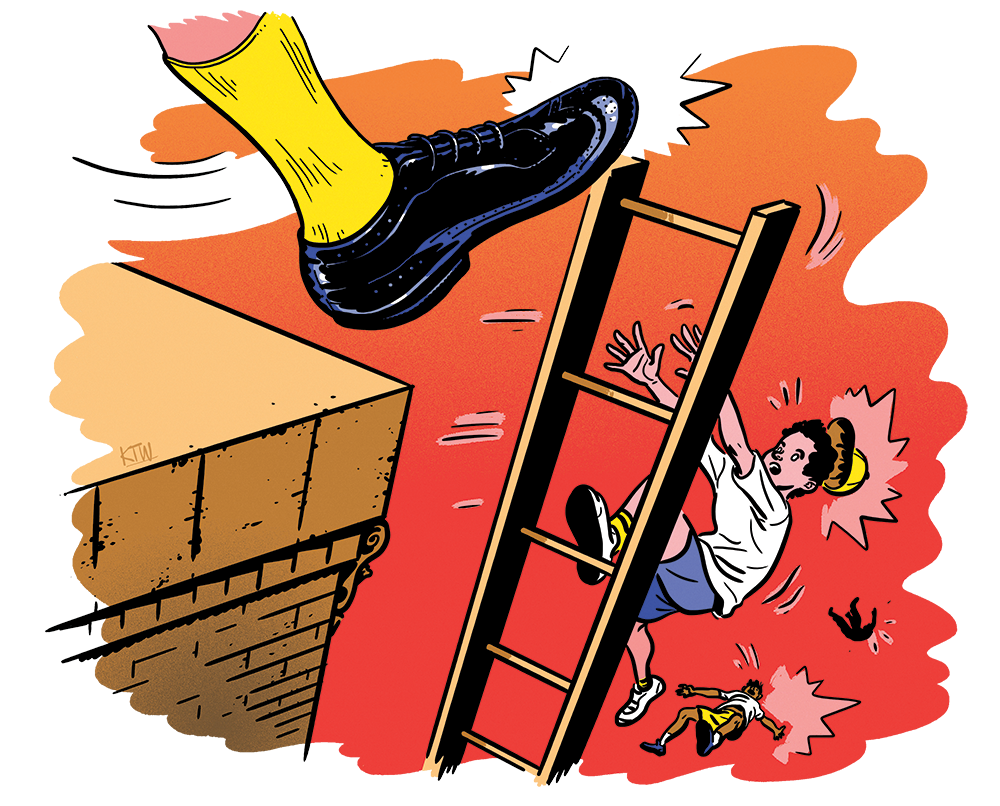
The socioeconomic duty (SED) might not sound sexy but bear with me: this is the tool the Labour party plans to use to ramp up its attack on the middle classes. The SED was described by its Labour ministerial creators in 2009 as ‘socialism in one clause’. It would, they promised, create ‘a new social order’. It was also described as Harman’s Law after Harriet Harman, who introduced it in the dying days of Gordon Brown’s premiership but never got around to putting it into practice.
Well, this Labour government is about to finish the job – Section 1 of the Equality Act 2010 is go, and it may earn itself a new name: Middle England’s end.
The duty requires public services ‘when making decisions of a strategic nature’ to give ‘due regard’ to doing so in a way that is ‘designed to reduce the inequalities of outcome which result from socioeconomic disadvantage’. The SED would force public services to consider things like postcodes and parental backgrounds in their decision-making. That could shape individuals’ access to education, health and housing. As one official who worked on its consultation tells me, it could even contradict the legislation it sits within: ‘The Equality Act attempts to have equality of opportunity, not equality of outcome. Trying to socially engineer equality of outcome goes against the Equality Act.’
What the SED would do is put identity politics into law, importing the American-style idea of ‘equity’ and forcing the public sector to treat people and their access to services differently on the basis of their social background.
The 2024 manifesto, which Andy Burnham inherited, pledged to enact the duty – and it is under the watch of his cabinet that statutory guidance is now being drafted across government to see it implemented. Issues were raised with Labour ministers after the election about the SED, and how exactly you define disadvantage and for how long it applies. ‘I think it is a terrible idea,’ one former official who worked on the SED consultation tells me. ‘I don’t like it one bit.’
The SED is the mechanism to bring in socialism via the back door, which suits this government just fine
The SED is the mechanism to bring in socialism via the back door, which suits this Labour government just fine. ‘I’m happy to call myself a socialist,’ Burnham said in an interview last year. ‘This is an era not to shy away from what we are, but to lean into it more’. He is surrounded by people only too happy to help. His Foreign Secretary, Ed Miliband: ‘Yes, I’m a socialist.’ His Housing Secretary, Angela Rayner: ‘I am definitely a socialist.’ His Defence Secretary, Wes Streeting: ‘I am left-wing. I am a socialist.’ The new Downing Street chief of staff James Purnell even sat in Brown’s cabinet while Harman was drafting the clause, and is now back in the building to push it through.
The coalition took over the legislation and saw it for what it was, hence why we have yet to suffer its consequences (although the Conservatives mistakenly never removed it from the statute book). Theresa May, then equalities minister, scrapped its implementation in 2010, branding it ‘social engineering’ and warning that it could mean ‘public spending permanently skewed towards certain parts of the country’.
‘I do not believe in a world where every-body gets the same out of life, regardless of what they put in,’ she said. ‘That is why no government should try to ensure equal outcomes for everyone.’ Quite. It was the Guardian columnist Polly Toynbee, who was all for it, who put the case most accurately and honestly: ‘This new duty to narrow the gap would permeate every aspect of government policy. Its possible ramifications are mind-bogglingly immense.’
Prepare to be boggled.
Public bodies must consider how their decisions will reduce the inequalities of those ‘living in less favourable social and economic circumstances than others in the same society’. It would break the oldest bargain the British taxpayers have with the state: you pay in, and in return you are treated fairly with (supposedly) good services. If that deal starts to depend on your postcode or parents’ occupation, it crumbles.
Take council funding. Middle England could see cuts to bin collections, library services reduced and potholes left unfilled because the money has been diverted to produce better outcomes elsewhere. Decisions will be made not on practical need but towards political targets, which are unlikely to be in the suburbs or the shires. The Explanatory Notes to the 2010 Act say so plainly: a body ‘when reviewing its funding programmes, could decide to amend the selection criteria… to encourage more successful bids from deprived areas’. Resources would by law be tilted towards poorer neighbourhoods even within a council area. With public spending already constrained, that would mean real cuts to services in the nicer areas of a council.
It would see every decision put in the context of what it means for communities that aren’t the middle (or upper) classes. Some councils have taken on the duty voluntarily, like Wigan Council, which covers part of Burnham’s Makerfield constituency. They are open about the influence it has on its policies: ‘Every time a new policy is developed, we are required to consider the impact it will have on those from lower-income households.’ Every time. So when it comes to house-building, you can’t just consider that it might be good for the middle classes and go ahead.
‘We have got a modern welfare state with highly progressive funding that tends to put anybody with a disadvantaged label up the queue already,’ one former civil servant who worked alongside the consultation tells me. ‘We’re already seeing massive problems in this country from prioritising disadvantage in everything – benefits, council housing, and a lot of the political problems we’ve got at the moment come from large and growing resentment that there is a class of people who claim disadvantage labels and can use those to get better treatment.’ This is just one way to make it worse.
Funding to local NHS trusts and GP surgeries could be distorted too, with middle England’s patients deemed low priority, falling to the back of waiting line, as social value judgments push against medical need. Already there have been attempts within trusts to push the NHS into using social value judgments to prioritise queues. This would further the cause and hand its advocates a target list.
What’s more, the new duty would likely fuel a fresh wave of judicial reviews, diverting time and money from frontline public services to a growing army of equality penpushers and new class-impact assessments. Its sister legislation, the existing public sector equality duty (PSED) has already fuelled judicial reviews by left-wing NGOs against public bodies. ‘The PSED has resulted in organisations overegging the pudding and going further than they need to and essentially ignoring merit,’ the official who worked on the SED consultation tells me – and SED takes it a step further, dividing the public and creating new political targets.
Despite one section in the Equality Act attempting to prevent claims for private damages from being brought, the explanatory notes state that ‘this section does not prevent an individual from bringing judicial review proceedings against a public body which is covered by the duty, if he or she believes the public body has not considered socioeconomic disadvantage when taking decisions of a strategic nature’. You can already picture the left-wing lawyers celebrating about the bonanza caseload that will be coming their way.
Its sinister application will likely spread into schools and universities. By putting identity politics into law, children could be discriminated against based on their postcode. State school allocations are currently heavily influenced by the child’s distance from home to school, but in a new postcode selection system, social classification of an area and how affluent it is could be prioritised over normal distance, so middle England’s children become less likely to get their first choice of school.
These arguments over socioeconomic background are part of a wider problem in the education system, one former Department for Education official tells me: ‘People are trying to prove their virtue, nailing their colours to the mast, saying that there should be no differences in outcomes. The tragic consequence of this is a massive waste of money and resource … schools are put under tremendous pressure to have no gaps in outcome at all. What it actually means is trying to get much higher progress out of poorer children than out of richer children.’
By putting identity politics into law, children could be discriminated against based on their postcode
The ‘equality of outcome’ logic could even change how schools are assessed, with arguments for academic outcomes to be ‘contextualised’ by deprivation. It could see a school in a less affluent area given a better inspection outcome than a similar school in a more affluent one. It could price in the assumption that poorer children always do worse, entrenching low expectations for capable pupils, and effectively marking down good schools in affluent areas in the process, discouraging academic success.
Ofsted’s chief inspector claims he would ‘never acquiesce to the quiet curse of low expectations that would see Ofsted prioritise context over outcomes’. But what happens if the statutory guidance demands otherwise? ‘Instead of lowering your standards, you want to maintain your standards but build up everyone,’ the official who worked on SED’s consultation says. Labour has so far taken the advice of the Nuffield Foundation, including its research proposal to remove tax relief on private schools. The next step could be following its argument to get universities to offer more strongly weighted preferential admissions.
We have seen the prototype. The civil service summer internship is now restricted to ‘working-class’ applicants, defined on the Office for National Statistics and Social Mobility Commission model by what your parents did when you were 14. It would mean that despite Angela Rayner’s so-called ‘properly working-class’ background, her eldest child would have been barred, as Rayner was a middle-class professional at the time. ‘Government recruitment is completely screwed up by the desire to equalise outcomes,’ one former Whitehall official says, calling it ‘toxic’. Other public bodies go further. The MI5 and SIS summer internships have started requiring you to be both working class and an ethnic minority.
This magazine warned in June 2016 of knocking people down when Whitehall began asking applicants about their parents’ jobs and the type of school they went to. ‘Purge of the posh’, we called it. That was just the beginning. Ten years on and Labour is pushing the agenda further. It should instead focus again on providing equal opportunity, not taking away or barring the opportunity of others.
As the former Whitehall official says: ‘This could intensify protests and demonstrations over unfairness in public services and give Labour a much bigger governing challenge. They are sleepwalking into catastrophe.’






Comments