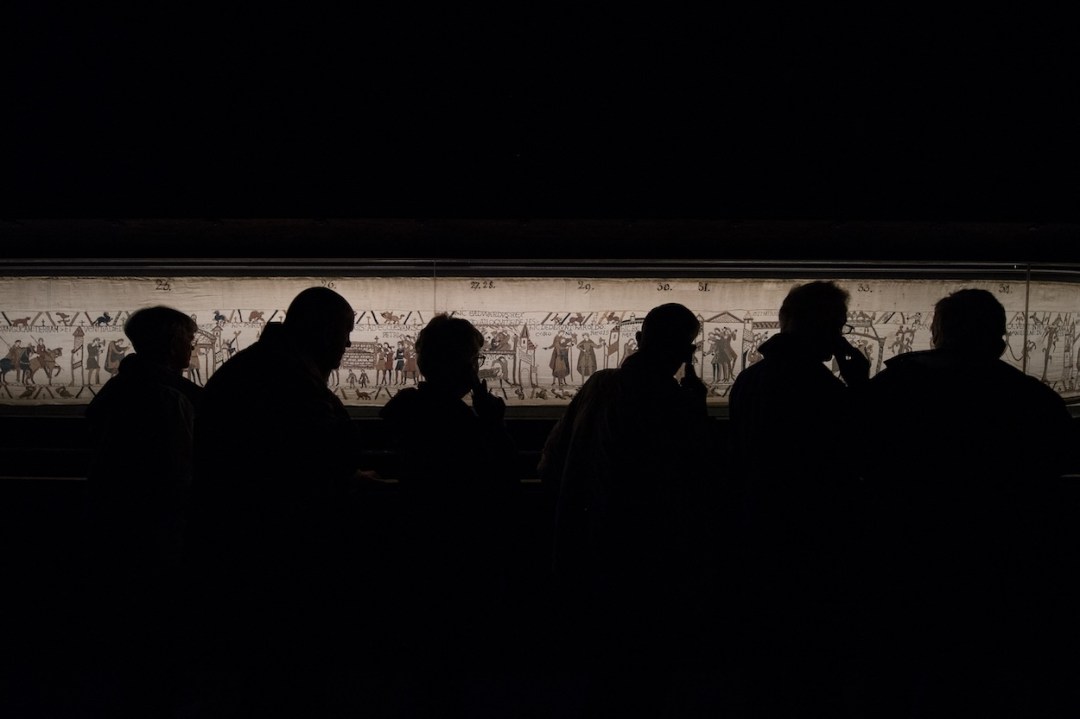
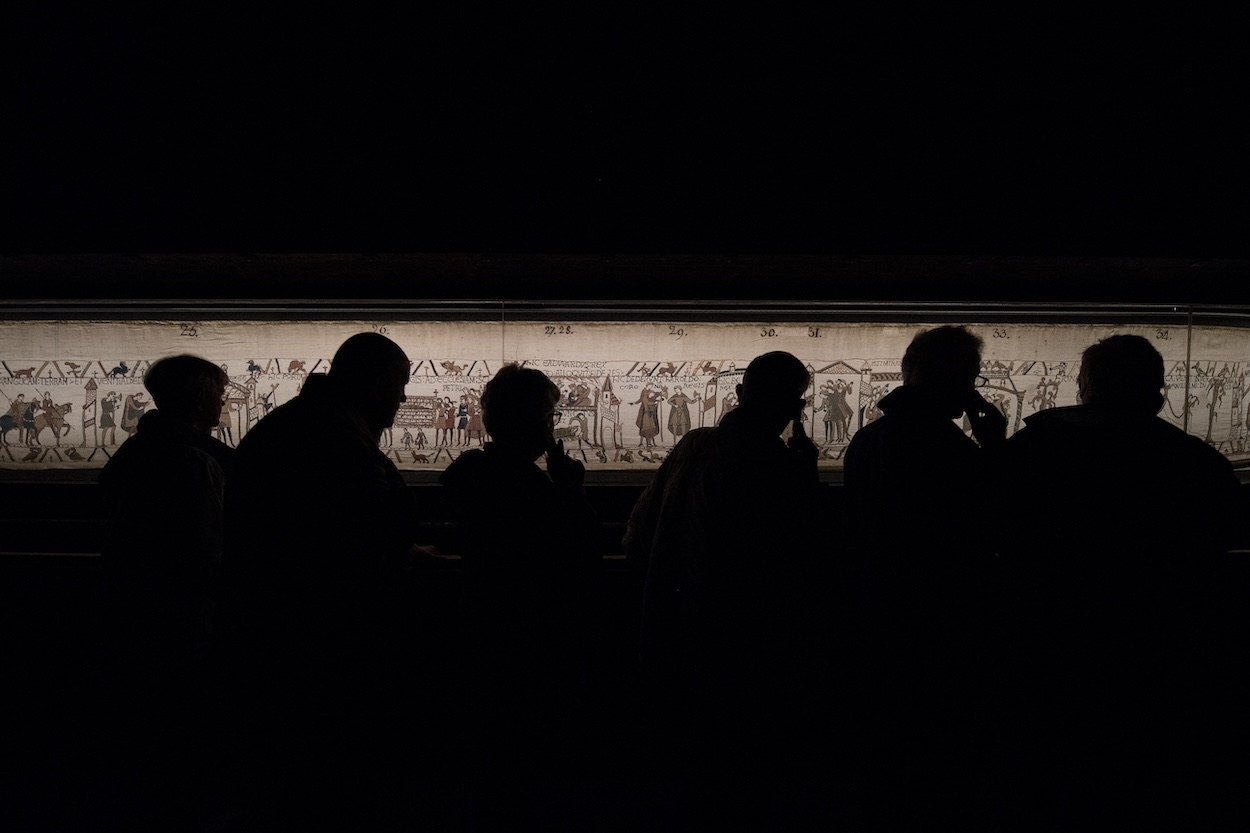
Laid out in the British Museum like a ruler, the Bayeux Tapestry tells its story with relentless, graphic mastery. Harold sails to Normandy and back. He breaks his promise to support William’s claim to the English throne. The Norman duke invades England. Trees are hewed into ships. Weapons are loaded. Armies meet near Hastings. Horses circle, then gallop, then fall (the artistry in those horses!). Men are massacred. King Harold dies. And so…
The tapestry’s last bit is missing. Even the fleeing English look suspiciously like recent patching. It’s a let down that would have frustrated the great work’s creators, who, one guesses, sealed their narrative with a victory feast and a coronation. King William in state, just as the story opened with King Edward.
Instead, the museum offers its own climax.
If you are able to see the tapestry, turn round when you reach the end, and look at a lone, tall case. Inside, shining out of the darkness, is a pile of silver coins. So many – 2,584, weighing 3.4 kg – that when they were assessed in 2024, the collection became the highest-value find ever recorded under the Treasure Act: £4.3 million.
The hoard, found by a group of friends with metal detectors in the Chew Valley, Somerset, was buried a year or so after 1066. One of the coins was minted by King Edward, he who opens the tapestry. All the others feature Harold or William, gathered up as booty oblivious to defeat or victory. These coins tell a different story from the tapestry’s. Not of simple conquest, but of rivalries and insurrections, of houses burned down and earls murdered, of battles and rebellions. Of an unknown person or people who felt, in the circumstances, that the only safe place for their wealth was underground.

The hoard’s successful reporting and recording, and its conservation and study at the British Museum, all happened because of the Portable Antiquities Scheme. Based at the museum, the scheme fields local officers across England and Wales who identify and record detectorists’ finds. It so happens that for nearly two decades, Michael Lewis, lead curator of the Bayeux Tapestry exhibition, has been its deputy head, and then head – he’s currently on exhibition secondment. He has overseen the growth of an entirely new source of insights into events around 1066.
There are quite a few coin hoards of this era, particularly in parts of England where battles occurred. In Yorkshire, where encounters at Fulford and Stamford Bridge occupied English forces weeks before their final defeat at Hastings, a recent find echoes the Somerset hoard. All 179 silver pennies feature Harold, one shared with Edward. Research continues, but it may be these coins were hidden in direct response to the Battle of Fulford, fought not far from the hoard site.
What of the battlefields themselves? Intensive and systematic metal detecting in Leicestershire identified the site of the Battle of Bosworth, where Richard III died in 1485, three kilometres from the traditional historic location. No such result has yet been achieved for Fulford or Stamford Bridge, notwithstanding unverified claims for the latter. Battle Abbey in East Sussex is convincingly documented as the Hastings site: William ordered the abbey built where Harold died. Ironically, archaeological search there failed to identify the conflict. As the tapestry shows in gruesome detail, scavengers scoured the field even while bodies were warm, leaving only small items. The construction of the abbey on a hillslope and later activity seem to have effectively bulldozed anything that remained.
However, archaeology has confidently identified another significant 1066 location: Harold’s lordly residence in Bosham, West Sussex. Bosham is one of only four English places named in the tapestry, beside Pevensey (where William landed his fleet), Hastings and Westminster. In the opening sequence, Harold rides to Bosham, attends church, feasts in a hall, and sails from the harbour to Normandy.
The present Holy Trinity Church has significant Anglo-Saxon features, but where or what the hall was had long been a puzzle. Last year a team of archaeologists from Exeter and Newcastle universities revealed the solution. Re-examination of evidence from excavations in 2006 identified a former latrine inside a large timber building, a combination at the time found only in elite homes. A small ruin in the garden of Bosham Manor House helped convince the archaeologists that this had been the site of Harold’s aristocratic complex as seen in the tapestry. Further evidence came from detecting finds, with what the archaeologists describe as a ‘halo’ of Anglo-Saxon coins, ornaments and horse stirrups in adjacent fields.
The Portable Antiquities Scheme, founded in 1997, has been documenting detectorists’ finds nationally since 2003. Rob Webley, who worked with the scheme for many years, recently completed a doctoral thesis looking at all the metalwork recorded from a century or so either side of 1066. The quantities are huge: over 10,000 dress fittings, pieces of horse equipment, scrappy hints at knives, daggers and swords. Stirrup-strap mounts are very common, notes Lewis, indication that after the conquest you did not have to be very wealthy to ride a horse.
The English language contains many words of French origin, introduced after 1066. They are completely assimilated, occasionally spotted only, perhaps, if you study French at school. Another unseen echo of the changes the invasion set in train continues down the centuries: bent and corroded metal fragments scattered in the soil, where we grow our food, walk, run and ride, and contemplate the landscapes shaped by millennia of history.






Comments