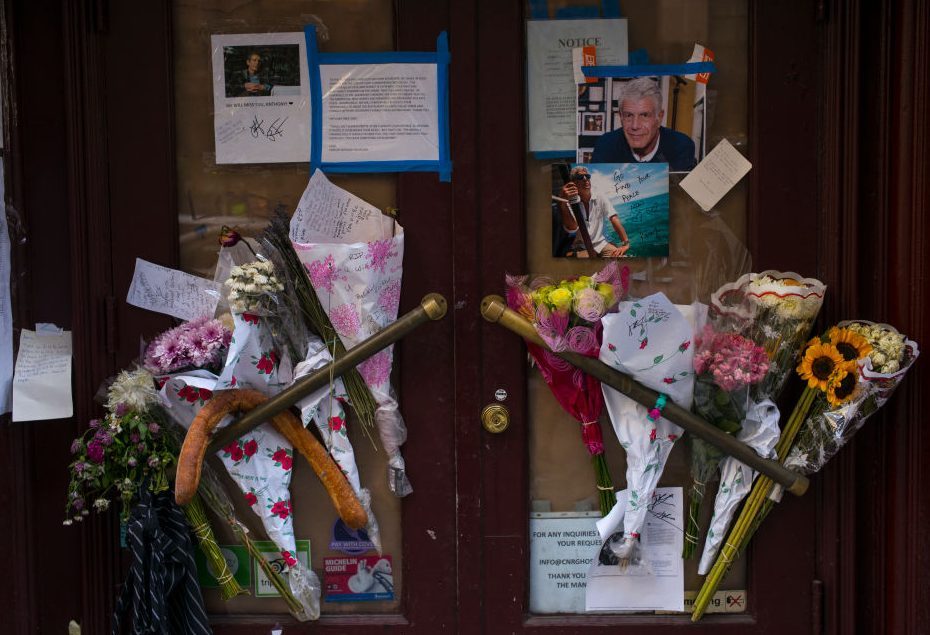
To experience the Big Apple properly, you don’t just take a bite: you take a carbohydrate-laced mouthful. Think smoked salmon bagels thick with cream cheese or $2 pizza slices dripping with grease. Think warm, salted pretzels, or frankfurters from a street kiosk, or steaks as big as the genetically modified cows from whence they came. Even so, for the full I <3 NYC gastronomic voyage, there’s only one restaurateur whose bagel-crumb trail is worth following: Anthony Bourdain, of course.
The “bad boy” Big Apple he represented is a city long devoured and spat out
Why, eight years after his death, are we still feasting on our obsession with “Tony” (as last month’s biopic would have us call him)? He was, by his own admission, “a spoiled, miserable, narcissistic, self-destructive and thoughtless young lout” who saw his body as a theme park rather than a temple. When I first read Bourdain’s memoir Kitchen Confidential as a calorie-counting twenty-something, I found him grotesque, foul-mouthed, debauched, testosterone-soaked… and utterly irresistible.
He was raw. Unpretentious. The swaggering antithesis to the wellness-obsessed influencers making up today’s food scene. Visiting New York this summer, then, what better way to explore the city than through the eyes of Chef Bourdain himself?
Where to begin? Les Halles, the Manhattan brasserie he led from 1998 until 2016, has long been shuttered. But Bourdain’s ghost still lingers in the dive bars, delis and Michelin-starred restaurants he visited in his home city. We could start with Barney Greengrass, perhaps, whose scrambled eggs with browned onion and lox were described by Bourdain as the “best breakfast in the universe.” Or the hot dog outlet Gray’s Papaya, which Bourdain joked was his “second home.”
This being New York, however, it would require me to sell my one useful asset (in this case, my stomach) to be even remotely affordable. I’m not staying within walking distance of either option in Manhattan. Instead, I’m sleeping on a friend’s couch a bridge away, amongst the thrift shops and coffee roasters of Brooklyn.
We begin with Diner, which he visited in a 2009 episode of No Reservations, a Williamsburg brasserie inside a vintage train carriage. Great Western Railway fare this is not; the menu changes so regularly, Diner doesn’t even have one. It writes the day’s offerings on your tablecloth instead. I have a glass (or three) of a chilled red from the Loire Valley, with the burger and thick, hand-cut fries. As a first meal, it sets a high, cholesterol-laden bar.
But then comes the problem. I expect many of Bourdain’s restaurants to have shut since he visited almost two decades ago. What I don’t expect is just how many. Blanca, which offered a Michelin-starred tasting menu, closed last year, as did the oyster-and-Muscadet stopover Marlow and Sons. Cafe Glechik, Pok Pok, Primorski – gone, gone, gone. Back in 2009, Bourdain devoted a No Reservations episode to “disappearing Manhattan.” Seventeen years on, he could well have covered his own disappearing New York.
And so, it’s back to Manhattan to track down the survivors. First up is Russ and Daughters, a couple of doors down from Katz’s, the city’s oldest deli, in the East Village. This is kosher comfort food at its best: scallion cream cheese, crisp potato latkes and doughy plumes of chocolate babka.
From there, it’s on to Hop Kee in a basement in Chinatown. “Did you say Bourdain liked to come here?” asks my friend, pointing at a wall of photos of the chef mid-meal. Yep, we can understand why. Even shared amongst three of us, the portions are gargantuan: shrimp-fried rice, beef chow fun, chicken in a tangy sweet-and-sour sauce and steamed broccoli to appease our already-groaning intestines. All for less than $30 in cash each.
There’s little fiber to be found over the next 48 hours. We wangle a reservation at the 146-year-old Keen’s Steakhouse for filet mignon and cabernet sauvignon in its vast, wood-paneled dining room. We’re given free, mustard-drizzled hot dogs with our pints of Sloop Juice Bomb at Rudi’s dive bar in Hell’s Kitchen. When we’re peckish come 2 a.m., after several cocktails and cigarettes, we perch in the West Village’s Corner Bistro for another greasy burger and a bowl of tater tots. This is New York as old-school New Yorkers would like: gritty, red-blooded and carnivorous. A city in which, if you’re too scared to indulge in the slaughter, you probably won’t survive. As Les Halles itself learned.
On my last morning, I visit the burial ground of Bourdain’s beloved restaurant on Park Avenue South. In 2023, it reopened as Chez Francis, operating for just two years before it, again, stopped service. Today, it looks eerily untouched. The “Chez Francis” logo remains plastered above the door. Even in the morning sun, the electric lamps continue to blaze outside. The floor inside has been swept clean, the tables and chairs neatly piled to one side. Were it not for the “for lease” sign on the door, you’d assume that, somewhere in the city, the chef is starching his whites, planning the specials for the day’s lunch.
But who would dare to disturb the ghost of Chez Francis? To its right sits a construction site, to its left a barber shop. Further along the street is a nail bar, an empty coffee shop and, across from the subway station, a McDonald’s and a Pret A Manger. This, then, is New York in 2026: convenient, sanitized and increasingly corporate. Perhaps the reason we’re still obsessed with Tony, then, is because the “bad boy” Big Apple he represented is a city long devoured and spat out. A city in which our bodies are no longer temples or theme parks, just spluttering machines, running on whatever fuel is left behind.






Comments