Lately, for reasons that are far too baroque to go into, my wife and I have been looking at farm tenancy agreements from 1983. In a way they are deeply dull (all those drains and clauses about fence maintenance) but they are also fascinating in that they reveal how farming has changed.
If you were after a few fields for your sheep or cattle, back when Culture Club’s ‘Karma Chameleon’ was riding high at no. 1, you had to really fork out. Ten pounds an acre, for pretty marginal land, was the going rate, and rent rises year on year were the order of the day. Fast forward 40 years and a lot of grazing is worth almost nothing. The most recent tenant on the patch of land we were researching was paying £1 an acre in 2017 and needless to say ten bob in the 1980s went a lot further than it does now.
So what changed? Well in a way, everything did. Back then, you were paid money by Brussels just for having livestock, and the beef and sheep price was solid, not least because supermarkets hadn’t yet become the price-setting monsters they are today. For those in cereals, things were also rosy in the early 1980s. Prices were high and because of post-war modernisation – including fertiliser and pesticide use – harvests were plentiful.
Last month, the Tenant Farmers’ Association urged its members to demand lower rents from their landlords. Graziers paying just a couple of quid an acre are set to call for things to go lower still. That’s a kick in the teeth for those lucky few with big estates, but tenant farmers are just trying to stay afloat. This year’s harvest has been chronic. Barley, wheat and oilseed rape are expected to amount to a total yield of 18.5 million tons – the most meagre since records began in 1984. Tom Bradshaw, president of the National Farmers’ Union, said things are woeful: ‘We are suffering a huge crisis of cashflow and confidence. The summer we’ve had followed inflation driven by the Iran crisis, and the relentless heat and drought resulted in a brutal harvest.’
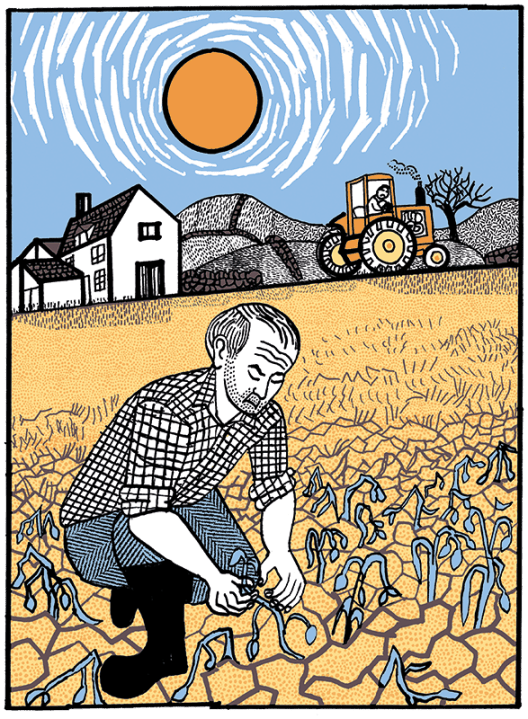
On the ground, the picture has been fascinating and worrying. Potatoes, which stop growing when it gets to 30˚C, have been tiny, and peas, according to my Norfolk neighbour, Jimmy Goodley, ‘are as hard as bullets’. In a normal year peas can be a big earner, but this year, rather than being hoovered up by Birds Eye, lots are only fit for animal feed. At the moment there is a dark irony in that lots of farmers, like Clive Bailye in Staffordshire, who organised the tractor protests last year outside Westminster, are wondering whether they should bother planting crops in the coming weeks. He’s lost money this year and he doesn’t fancy doing so again. That said, Bailye notes that his fields are still so dry he can’t plough up his land ahead of sowing next year’s crop anyway.
There used to be a joke beef and sheep farmers liked telling. It went: ‘What’s a classic arable farmer’s rotation?’ The response goes: ‘One year of barley, one year of wheat, and a year in the south of France.’ Doubtless, there was a time when the going was good for grain barons. But at the moment they are on their knees. It’s not just that the harvest was poor; as Bradshaw alluded to, fertiliser, much of which comes through the Strait of Hormuz, has gone up in price by some 30 per cent. The costs of farming have soared, the harvest was dire, and to top it off, the prices being paid for cereals are unexciting. Wheat is now around £200 per ton (in recent memory it was almost £265).
The paradox is that lots of other farming regions around the world are having a fine time of it while we flounder. North and South American arable farmers are sitting pretty and the cereals market is a global one.
For once, it seemed that the tables had turned and those paupers with their sheep were in a comparatively favourable position. The lamb price, due to a declining national herd, hit a record high of almost £10 per kg in the summer. But then blue tongue, a potentially fatal ovine disease, broke out across the country. Blue tongue is spread by midges, which have done well because of the heat.
This agri-economic shitshow is set against the backdrop of Labour’s family farm tax. It’s not just that Steve Reed, the former secretary of state for Environment, Food and Rural Affairs, promised, when Labour was on the campaign trail in 2024, that they wouldn’t whack inheritance tax on land; it’s also that it will raise £500 million a year. This is a rounding error for the Treasury but it is catastrophic for farmers. The latest madness is that people aren’t building the reservoirs they need for irrigation because they don’t want to increase the value of their farm businesses and therefore the tax liability for their children.
Bailye’s fields are still so dry that he can’t plough up his land ahead of sowing next year’s crop
As Gavin Lane, the president of the Country Land and Business Association, puts it, the sensible thing to do would be to charge people capital gains on selling farmland, but then again that wouldn’t make landowners sweat. Clearly, for Labour, that’s no fun.
One consequence of farming being in the doldrums and the need to generate cash to pay Treasury invoices is the proliferation of diversification. My neighbour Jimmy, of hard peas sorrow, has built three padel courts. Just down the road at Walsingham, my father-in-law has turned to drink. Seven years ago, when he planted nine acres of vines, people suggested that his pinot noir grapes wouldn’t get enough sun in Norfolk. No such worries this year. Elsewhere, chicken farming is going great guns. Every year our poultry consumption increases by around 3 per cent. That said, guided broiler-unit visits probably aren’t going to work quite as well as those vineyard tours everyone seems to be doing.
Michael Landale, a young farmer who lives near me, has started doing pick-your-own sunflowers. He is a tenant farmer, so in theory he could just hand back his 350 acres if he wanted to, but he’s reflective about why he won’t be doing that. ‘You come off the back of a year like this and part of you thinks what’s the point?’ he says. ‘But I get to live where I live on the north Norfolk coast, five miles from the sea, and there’s a huge sense of pride in producing food. That’s why I farm.’ Landale makes no bones about it. Because of the drought, his barley was down 50 per cent this year and the quality was so poor that it couldn’t go for beer. The maltsters wouldn’t take it. ‘It’s a sucker punch,’ he says. But he adds with notable optimism: ‘Next year I could have a bumper harvest. It could be completely different.’
Farming is brutal but it’s been brutal before – some of my wife’s family went to the wall after taking a wrong turn with cattle in the 1880s, and post-war, you couldn’t give farm tenancies away. People kept at it though, in part because, as Landale suggests, there’s a lot of love for the game. Perhaps that’s why Starmer’s government took so much issue with farmers – too much pride, too much passion, and far too much entrepreneurial grit.





Comments