Ever since Brideshead Revisited, both the book and two television series, there has been a fascination with what some of us thought of as the last knockings of the country house, as once splendid aristocratic mansions sank beneath Nissen huts, mistreatment by the armed forces and lack of maintenance during the second world war. But what could this new book tell us? John Martin Robinson alone has published twice on the subject in recent years, and when I read that Judith Lewis’s was a gendered account, my heart sank.
But I was wrong. Scholars have tended to overlook the tragedy that requisitioning put on the women for whom a country house was not just an ancestral possession, an expression of power or a grand accumulation of works of art, but a home. If their husbands or sons died serving their country and the laws of primogeniture meant that the estate passed to a cousin, those who may have been staunchly doing their bit in surreal circumstances found themselves out on their ear.

Lady Braybrooke’s annus horribilis was 1941, when her husband died and the requisitioners demanded her instant removal from Audley End, the vast Jacobean house she’d been living in since 1917. Both her sons were then killed in action. One might have thought she had suffered enough, but the childhood home to which she retreated on the south coast of Devon was next to a beach very like one in Normandy. Field Marshal Montgomery needed both it and the house to rehearse the D-Day invasion. So she was on the move again, accompanied by two dispossessed sisters and a flock of poultry. They came to roost on the edge of the Audley End estate, living among the agricultural workers over whom, in the nicest way, she had previously held sway. Today, English Heritage displays a plaque to the Polish airmen who were stationed in the house, but its infinitely suffering former chatelaine goes unremembered.
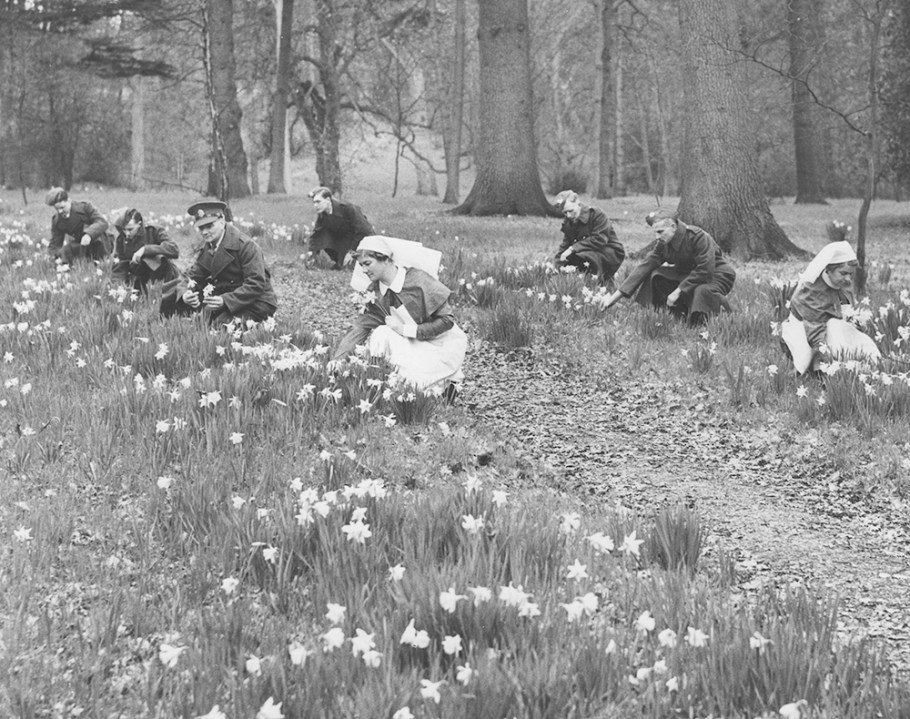
Ironically, many upper-class young women jumped at the chance to join up at the start of the war, expecting a much livelier time in the First Aid Nursing Yeomanry (FANY), the smartest of the voluntary services, than they would have had with their parents at home. Equally, the more prescient owners, such as the Marquess of Salisbury at Hatfield House, offered their property to the government before it was taken, leaving them in a stronger position to dictate terms, affecting the state in which the house would be handed back. This meant they could charge for every room to be cleaned, and even missing loo-roll holders to be replaced.
But the wise owls were greatly outnumbered by those who let history take its course. Lord Verulam’s insistence that 90 people could not occupy Gorhambury because it had only two bathrooms went unheeded. Wilton House, where Southern Command was too busy planning D-Day to notice the fungus on the cornice of the Double Cube Room, was one of many houses to suffer rampant dry rot. To Lady Iliffe, the word ‘derelict’ was hardly sufficient to describe the appalling state in which Basildon was left following its use as a barracks, tank-training ground and POW camp.
But Lewis’s book is not all gloom and doom. The misery of the times is balanced by many good stories culled from the half dozen or so family archives that form the core of the author’s research. ‘Boys. Olive is here,’ wrote a scullery maid on the walls of the West Wycombe kitchen where the Royal Artillery was stationed.
The main heroine of the book is Rosemary Howard, known appropriately by her middle name, Christian (she was studying theology when the war began). The eldest of her siblings, she had charge of Castle Howard after the early deaths of her parents, which left her to ‘deal with things like the housemaid getting pregnant by the footman’ at a time when she ‘was not quite sure how one got pregnant’ by a footman or anyone else. Christian was living in the gatehouse when fire destroyed the dome of Castle Howard in 1943. Her brother having returned to the front, where he was killed, she organised the recovery effort. Three girls from the school then occupying the house were not picked up by their parents, so she took them into her home. In due course she was made a Dame for services to the Church of England, where her preaching made even bishops shake in their shoes.
I’m pleased to say that my old magazine Country Life, unsurprisingly an important source for the author, comes out well, despite a sometimes loftily Arcadian attitude. Its photographic library supplied the prints from which the dome was eventually restored – another Beethoven-like story of darkness giving way to light.



Comments