
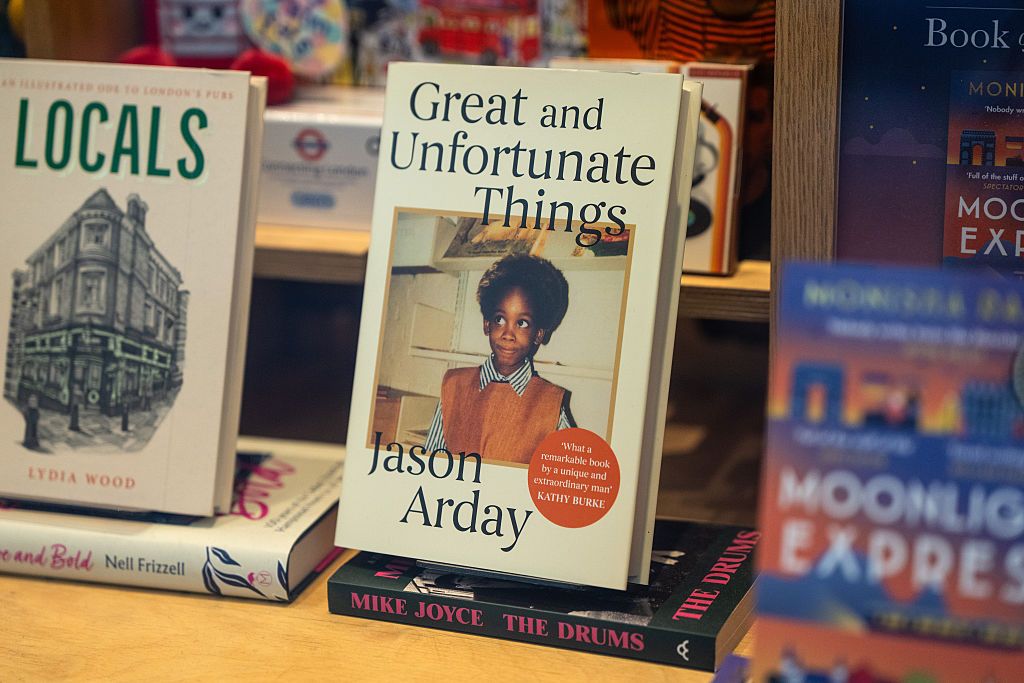
Bloomsbury’s former editor-in-chief Alexandra Pringle popped up on British television this week to argue that the late Jason Arday’s publisher could not have been expected to fact-check his book Great and Unfortunate Things. The argument she made raised a lot of eyebrows and has precipitated a lot of self-righteous ridicule online.
The problem with Arday’s book is that a great deal of what he says in it seems to have been codswallop
“I think questions of truth and accuracy in memoir are very, very blurred because they are subjective accounts of a bit of someone’s life,” she told listeners. “A memoir is not an autobiography, and it’s important to make the distinction between the two. If you’re thinking of, for example, John Major or Mrs Thatcher’s autobiography you would expect that to be absolutely true. But a memoir is a work of literature which is verging on fiction, and you cannot necessarily expect a memoir to be a factual day-by-day or year-by-year account of someone’s life.”
By way of a disclaimer, I should say I know Alexandra Pringle a little and like her very much. But I find myself in disagreement with her here. The primary distinction between memoir and autobiography seems to me one of scope, not factuality. If you pick up an autobiography, you expect to read the story of someone’s whole life. A memoir will be the account of a slice, or a few slices, from a life; or the author’s perspective on a slice of someone else’s life. You can write lots of volumes of memoir, but unless you’re Barry Humphries or a soccer player it’s usually considered seemly to limit yourself to one autobiography. (Confusingly, though, when someone talks about writing “my memoirs” that usually simply indicates an autobiography that nobody sane is going to want to read.)

It is true, as Alexandra says, that memoir is usually a more literary form. A formal, which is to say a literary, decision has been made as to what to put in and what to keep out. There’s selection in autobiography too – lives are long and we can’t be Tristam-Shandying our way in prose through every moment on earth – but the reader expects something that will cover the ground from childhood to spitting distance of publication date.
There is something in her suggestion, too, that memoir might be more loosey-goosey with detail. Our memories play a very long game of Chinese whispers with us all, and the emphasis on memory and its unreliability is right there in the title of the genre. Readers know this. The details of the weather, the order of events, the phrases and lines of dialog – we expect all these to be to some extent reimagined and reconstructed. I can’t imagine most readers imagine that the diaries of David Sedaris, as presented for publication, is a documentary accounts of his life. That much funny stuff doesn’t happen to anyone, even professional humorists. Polish has plainly been applied, to the benefit of all.
The English playwright Alan Bennett’s diaries and Michael Palin’s diaries both contain an account of the same dinner in a restaurant with Maggie Smith, for instance, in which a bit of broken glass is found in the mixed salad. Bennett has Dame Maggie deliver the fabulously tart and Dame Maggie-ish remark: “Very mixed.” Palin’s account, much more humdrum, omits that killer line. And how many oncologists can be expected to tell a patient that his tumor is the size of something so Alan Bennettish as an “ordinary rock bun”? And what are the chances that that happens to be the oncologist treating Alan Bennett?
So the reader doesn’t sweat the small stuff in a memoir. That’s part of the implicit contract. But, equally, the reader of Alan Bennett would be entitled to be annoyed if he discovered that this dinner with Mike Palin and Maggie Smith never took place; or that Bennett had never had cancer of any sort. Gesturing at the impossibility of ever perfectly knowing the truth is not the same thing as proving there’s no such thing. Some things – marathons run, wars fought, life-threatening illnesses suffered, books published, children born and marriages contracted – are verifiable features of the historical record. If you buy a book billing itself as either a memoir or an autobiography, you expect those features to be reliable.
Both memoir and autobiography, however imperfectly they’re defined, have in common that they sit in the nonfiction section of the bookshop. Vulgar as it may sound to us snooty literary types with our eyes on Higher Truths, the idea that this stuff actually happened is their main selling point to readers and therefore driver of profits for publishers. As I pointed out when I wrote about The Salt Path, a bestselling memoir that turned out to contain a number of confabulations, there’s a reason publishers are more interested in badly written celebrity memoirs than in badly written celebrity novels. I added that it was “telling that one of the most notorious frauds in the genre, James Frey, tried and failed to sell his A Million Little Pieces as a novel before hitting the jackpot by packaging it as a memoir.” The problem with Arday’s book, whether you call it a memoir or an autobiography, is that a great deal of what he says in it about those verifiable features of the historical record seems to have been codswallop.
Where I do agree wholeheartedly with Alexandra, though, is that turning the culture-wars flamethrower on his publisher for not fact-checking his manuscript line by line is silly. Publishing houses don’t employ whole fact-checking departments, and it’d be a crippling waste of resources for them to do so. It’s just not how the industry works, nor should it be. Imagine if this standard were applied, say, to one of Frank Dikotter’s books about Mao’s China: would his publisher be expected to send teams of researchers to replicate Dikotter’s decades of work in the archives before they were able to put his findings into print? Nobody sensible would suggest so. And if you aren’t expected to fact-check books making claims about the world-historical record, why would you apply a higher standard of scrutiny to the lower-stakes issue of a memoir by a minor academic celebrity?
A fastidious editor could and should be on the lookout for internal inconsistencies or obvious howlers. They might be hoped to apply a bit of a smell test to some stories (as Simon & Schuster plainly and to their shame failed to do in the case of Arday) – and a legal read for libel is standard practice. But they’re not in the business of digging up old medical records, comparing timelines, investigating charity filings or tracking down former schoolmates for interview – which was the sort of investigative work that put the lie to Arday’s fabrications.
Responsibility for the accuracy of an autobiography, just like any other nonfiction book, rests finally with the author. Whether Simon & Schuster should be plowing ahead with publication as if nothing has happened, that said, is a matter for another day.





Comments