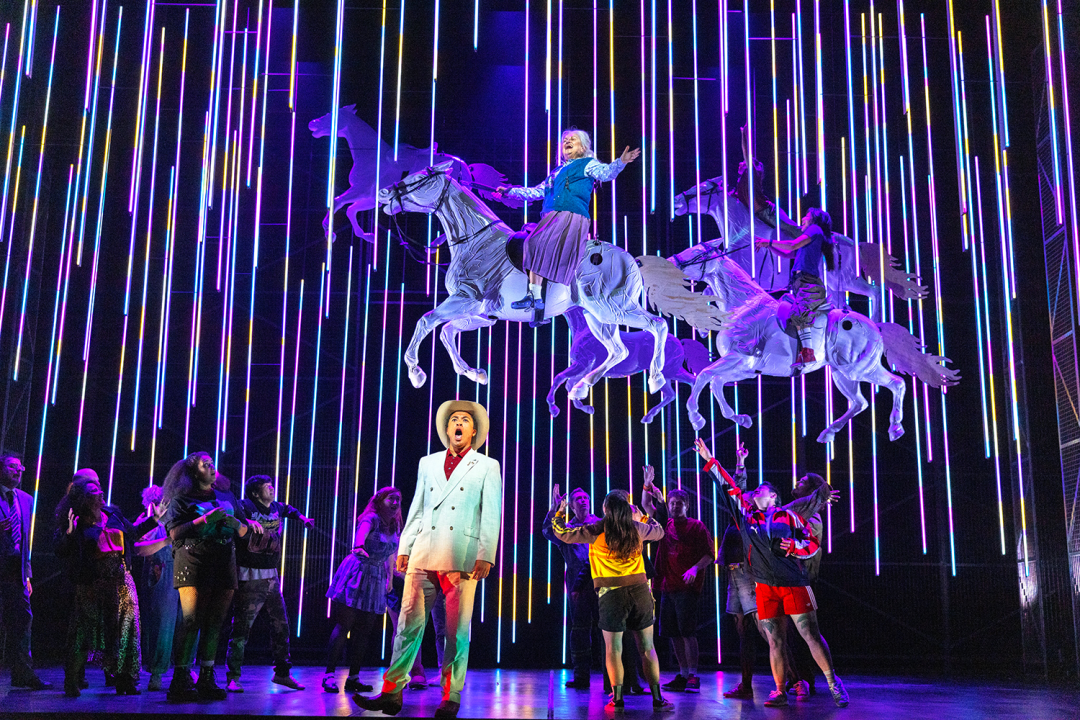
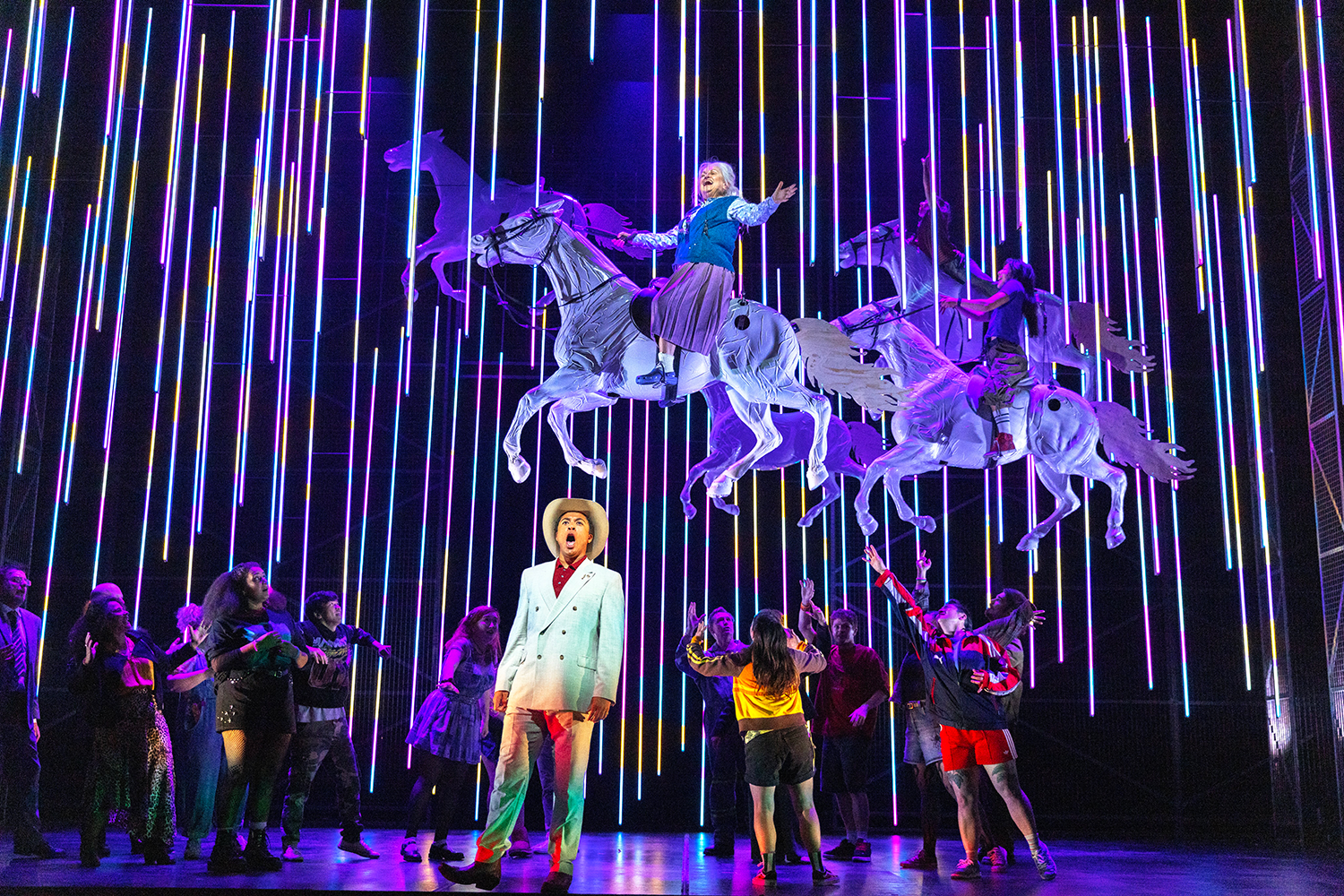
Those lights! Thinking back on The Galloping Cure, Missy Mazzoli’s new opera for the Edinburgh International Festival, that’s what lingers: cascades of lights, shimmering and flickering in every hue that modern LED technology can supply. At first the effect is almost Zen – soothing washes of pinks and blues and ochres, with carousel horses rising and weaving among them. Then, as the action intensifies and the characters succumb to collective mania, they’re brighter, faster, more aggressive: a frantic sensory overload, flashing to the rave-derived backbeat of Mazzoli’s score. Lucy Carter’s lighting designs are meant to transfix you, and they really do.
Hardly the point of an opera, you might say. Nonsense: in this of all arts, visual spectacle is as necessary as music; and has been ever since Monteverdi first dazzled Venetian audiences with fireballs and heavenly chariots. I went to the second performance, and word was already out that the world première the previous night had been cheered to the rafters. According to one headline, I was about to see one of the greatest operas of the 21st century, though admittedly the bar is not high. In the era of Balfe, a Meyerbeer will always seem exceptional.

But no question, in Tom Morris’s staging The Galloping Cure was a vivid, engrossing experience, though I wonder how much of the audience enthusiasm was simply relief at having something to look at. You don’t expect much, as a rule, from a new opera production. The art has become so visually impoverished that it’s genuinely disarming to be presented with colours and wonders and high emotional stakes, instead of lounge suits moping in a white box. Mazzoli is very fashionable in the US, and we’d been briefed that this was an opera about the opioid crisis. It was only natural to expect the worst.
In truth, it was much more interesting. The Galloping Cure is a fantasy, rooted in Kafka and the all-American musical myths of Carousel and The Music Man. The Mephistophelean charmer Lucky Mack (Justin Austin) brings his wondrous carousel to a struggling rural community. A single spin provides escape from cares; further rides promise ecstasy and transcendence. The idealistic town doctor (Daniela Mack) is sceptical, but she’s persuaded to endorse the new craze. Anything that promotes mental wellness must surely be good for the community.
Then her daughter Noy (Gabrielle Turgeon) succumbs, and Royce Vavrek’s libretto makes an unexpected swerve. We were all set for a stock feminist victory over capitalist evil (go sisters!). Instead, the magical lights fritzed out and the mood turned macabre, with a grisly, E.T.A. Hoffmann-like fixation on eye-gouging. Susan Bullock, playing a deluded old dear, happily and bloodily parted company with her vile jelly, and she wasn’t the last. Gore and horse-guts spattered the stage and the bleak final moral was only slightly offset by a chorus of idiot sheep and a pair of singing dogs (complete with surtitles in doggy-speak) played with goofy, arse-dragging glee by Catriona Hewitson and Edward Jowle.
Sounds daft? Sure, but that cocktail of the fantastic, the humorous and the horrifying is what gives The Galloping Cure the authentic atmosphere of a fairy tale – a story capable of infinite retellings rather than another worthy, disposable Issues Opera. This première production was excellently sung and played (Stuart Stratford conducted the orchestra of Scottish Opera) and Mazzoli’s score was perfectly effective, with beefy post-minimalist orchestration, big singing lines (if no significant melodies), and some pleasingly snobbish details (it’s practically subversive, these days, to use pop music as a shorthand for moral corruption). English National Opera could do worse than schedule a London production, and it probably will.
The Galloping Cure was just one novelty in a Festival-wide focus on the music of the US and the following night Wynton Marsalis – in residence with his Jazz at Lincoln Center Orchestra – played two sets at the Usher Hall with Yuja Wang.
When an eminent classical musician attempts to swing or (worse) improvise, the results are invariably gruesome. Wang, shrewdly, made no attempt at either. Instead, she did her own thing, and Marsalis and his all-stars did theirs. Wang brought crystalline, diamond-studded precision, high-stepping through Tiger Rag and Blue Rondo à la Turk like a supermodel on a catwalk made of brushed cymbals.
The JLCO, meanwhile, darted around her; playing off the contrast, and reminding us how rare and thrilling it is, in 2026, to hear a truly whip-smart big band – that easy, instinctive dialogue between virtuoso players, and those shining walls of saxes and trombones. In the end, it was what it was; namely, the kind of one-off, wildly improbable artistic encounter that could only happen in August in Edinburgh. Five years after Covid, and four years into Nicola Benedetti’s artistic leadership, the EIF might just have regained its mojo.




Comments