Universities’ challenge
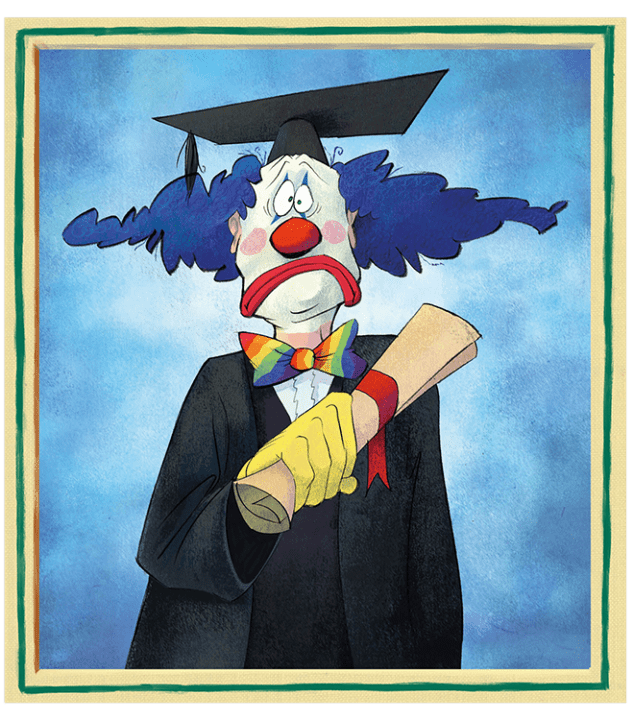
Sir: I have spent more than three decades in academia and so Lara Brown (‘Alma madder’, 15 August) struck a chord. The craziness is not a new phenomenon. In the mid-1990s my employer, Thames Valley University, offered a half-module in kite-flying. Students spent half a day each week on Hampstead Heath, learning how to fly their silk and bamboo contraptions. I have often wondered how the students used the transferable skills they gained in later life.
More recently, I was taken to task by a bureaucrat for not stating my preferred pronouns in my email signature block. When informed it was ‘university policy’, I capitulated. Thereafter, my preferred pronoun was ‘Dr’. I assumed this was acceptable, as I was troubled no further.
Dr Alf Crossman
Rudgwick, West Sussex
Show of hands
Sir: I was delighted to see the article by James Dixon on writing by hand (‘Pen pals’, 15 August). As a writer, poet and librettist, I produce all my work in longhand and then either type it up or dictate it and then cut and paste it into Word for editing. I find my thoughts flow better than when typing – especially for poetry and libretti. I differ from James in that I usually use pencils to aid the flow of thoughts.
Neil Russell-Jones
East Coker, Somerset
Hashed pipes
Sir: I fear both Bojan Pancevski (Letters, 15 August) and Peter Hitchens (‘Murky waters’, 25 July) have got it wrong about the Nord Stream explosions, but the former is more wrong than the latter. As a former North Sea diver, I can attest that landing a heavy weight on a precise spot on the seabed is difficult, even from a specialist diving support vessel. Doing it several times from a yacht is, to my mind, impossible.
Scuba-diving at 220ft gives about seven minutes to get the job done, and would require a helium oxygen mixture, instead of air, to avoid nitrogen narcosis. Why the alleged bombers chose a spot in line of sight from Bornholm island, when they could have chosen a more discreet location, is a mystery.
The published photographs do not suggest a shaped charge, which makes a clean cut. As Hitchens says, you need a lot of bomb to get through six inches of concrete and over an inch of steel. Blowing up the pipe from the inside is relatively easy.
Conspiracy, cock up or just spite? The value of gas lost was about $1.5 billion and I would hesitate to exclude the possibility of a theft that went wrong. Repairing the damage in the early days would have been a straightforward hyperbaric welding job. The longer the pipelines remain unrepaired the more they corrode, however.
Hitchens may not be right to blame America for the sabotage, but he is surely right that the US has forbidden Germany from making any efforts at repair.
James Harries
London SE11
Grave reservations
Sir: I greatly enjoyed Douglas Murray’s brilliant piece on the Dobby’s ‘grave’ phenomenon (‘Britain is falling into a mawkish fantasy’, 15 August). Alas, this kind of thing is not entirely new. Victorian readers of The Old Curiosity Shop came in their hundreds to visit the equally non-existent grave of the equally fictional Little Nell in the churchyard of St Bartholomew, Tong, in Shropshire. An enterprising verger had inscribed a suitable gravestone for her, and even faked an entry in the church register for her burial. But at least Little Nell wasn’t a house-elf.
Nigel Andrew
Lichfield, Staffs
Elf deception
Sir: When one has nothing in which to believe, one has to believe in something. The mawkish sentimentality displayed by Dobby’s ‘grave’ and other similar manifestations are indicative of a nation that has lost its soul. Why take on the challenges of the gospels when, instead, you can ribbon-tie a teddy bear to a fence, stop for a moment (to be alone with your thoughts, no doubt), then move on and have lunch?
Liturgy and ritual have disappeared because faith has disappeared. Yet humanity needs such outward expressions of inward reflection. Thus, what we are left with is a faithless generation looking for meaning – and finding it in piles of stones.
Fr Terry Martin
Eastbourne, East Sussex
Penny pinchers
Sir: Is Matthew Parris still a Conservative (‘What’s so wrong about a “dementia tax”?’, 8 August)? There is surely nothing wrong with wealth cascading down the generations. To me it is entirely natural that parents would want to give what they have accrued in their lifetime to family. There is also nothing ‘disgusting’ or ‘sly’ about parents being comforted by the thought of passing wealth to their offspring. One of my concerns about the assisted dying bill is that the high cost of care would pressurise vulnerable people into ending their own lives, so saving money to give their children and grandchildren a better life. The PM is right in seeking a balanced and fair arrangement to pay for social care. As ever, the devil will be in the detail.
David Kenny
Tredunnock, Monmouthshire
Bowled over
Sir: I don’t know if Lord Biggar of Castle Douglas is a Scotsman who likes the English summer game; if he is, has he heard of bowling a chinaman (‘War of the words’, 15 August)? I understand it refers to left-arm wrist spin. Should Beijing show the same appetite for cricket as it is beginning to for football, this might necessitate a change of vocabulary.
Tom Stubbs
Surbiton, Surrey
Rod’s spirit
Sir: Among the many fine tributes to Rod Liddle was this from Michael Gove (8 August): ‘Rod believed in cutting through the cant, hypocrisy, double-speak, euphemism, evasion and empty pieties with which those in authority and those who shape our culture seek to evade proper scrutiny.’ Having recently been clocked speeding in the 20mph motoring utopia that is Wales, I thought of those words as I filled in my driving details which I was instructed to send to the laughably named ‘Safety Camera Unit’. I made sure my letter was addressed to the Speed Camera Unit. A small act of defiance, but I felt I was helping to keep Rod’s spirit alive.
James Potts
Cardiff
Dog’s chance
Sir: My wife knows how to deal with a dog that won’t let go (No Life, 15 August), and she used it on Hampstead Heath to rescue a much smaller dog: you shove a stick up the aggressor’s backside, or if there’s no stick handy, your finger. She’s not in a hurry to repeat the experience, but it worked instantly. In Africa I was shown how to see off potentially rabid dogs: bend down smartly to grab a rock. It works even if you can’t spot a rock, because the dog won’t know that, and isn’t going to take the chance.
Mike Wells
Ickwell, Beds
Write to us letters@spectator.co.uk





Comments