Last month, two State Department officials were set to make what they called a routine visit to Brazil, ahead of October’s presidential election. Their stated objective was an assessment of election integrity, religious freedom and freedom of expression in Latin America’s largest democracy. Brazil was not convinced. It slammed the door in their faces and denied their visas.
Washington insists its diplomats were simply sent to ask questions. Brasília cries foreign interference from a nation that has a history of meddling in Latin American politics. Tensions between the two largest democracies in the Americas have not run this high in decades.
Unfortunately for the Brazilian right, the son of Jair Bolsonaro carries baggage
Since returning to office, Donald Trump has not shied away from making aggressive interventions in Brazil. He declared a national emergency last year, citing social media censorship by Brazil’s Supreme Court as an “unusual and extraordinary threat” to the US economy and national security. Trump has designated Brazil’s cartels as terrorist organizations and imposed 37.5 percent tariffs on Brazilian goods. His provocations also include nominating Florida Republican Daniel Perez as ambassador to Brazil, who walked away from reporters who asked whether he even speaks Portuguese.
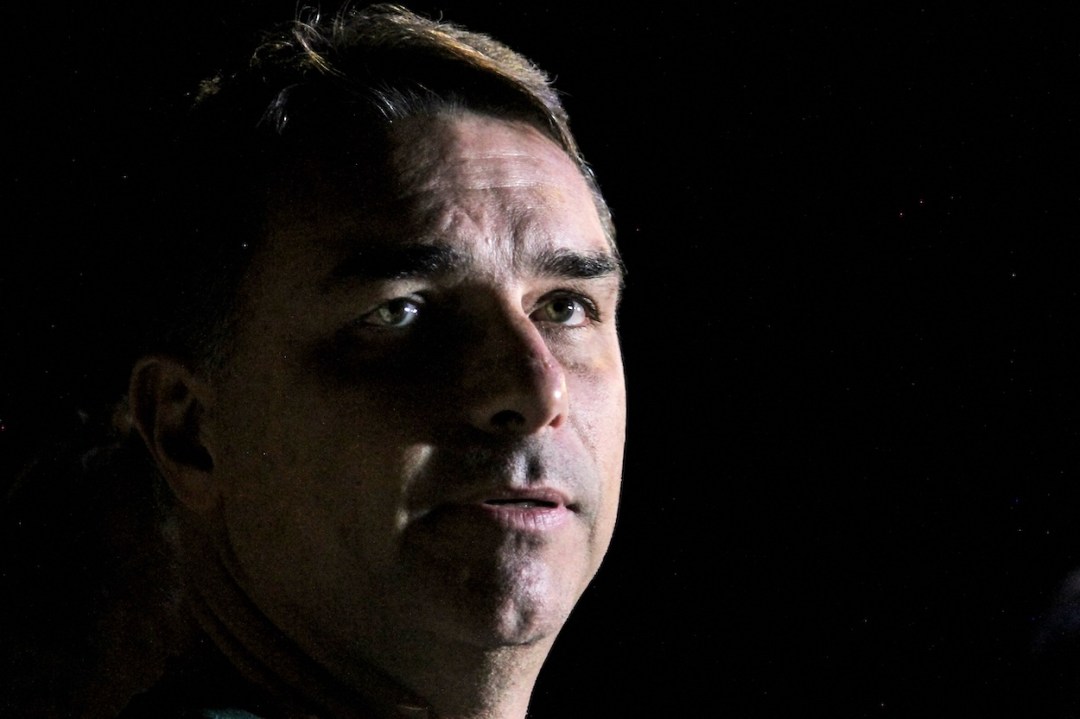
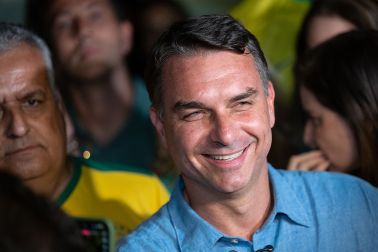
Trump further goaded Brazil when he received Flávio Bolsonaro, the anointed son of jailed ex-president Jair, and his brother Eduardo at the White House. Like his father, Flávio enjoys the affection of the international right, from Donald Trump to Javier Milei to Benjamin Netanyahu. Lately, he has raised concerns over Brazil’s electoral system, telling foreign diplomats that the country’s voting machines were made by a Venezuelan company linked to allegations of fraud.
Flávio launched his official campaign for president on a beach in Rio this weekend. Unfortunately for the Brazilian right, the son of Jair Bolsonaro carries baggage. His nomination event in July, at the Liberal party’s convention in São Paulo, drew modest crowds. Michelle Bolsonaro, Jair’s wife and stepmother to Flávio, skipped the event, though she has since voiced her support for her stepson. Loyalists of the right’s other heavyweight, São Paulo governor Tarcísio de Freitas, still grumble at Flávio’s ascension.
In the other corner stands President Luiz Inácio Lula da Silva, the 80-year-old incumbent from the Workers’ party, seeking yet another term. Despite Lula’s status as one of the more unpopular leaders in the Americas, Flávio trails him in the polls. Is Bolsonaro’s heir truly the candidate the right needs to take back the nation, or a placeholder for his father’s grievance?
Paulo Bilynskyj, a federal deputy from Bolsonaro’s Liberal party and a former São Paulo police chief, rejects those who doubt Flávio. “There’s only hard work and sacrifice in our minds,” he told me when we met at the Heritage Foundation’s inaugural Miami Security Forum. He insists the family drama is overblown: “Tarcísio has been very loyal and is fully committed to the campaign, and not a week ago Michelle also expressed her support for Flávio.” The real obstacle to the right, he says, is a court order barring the jailed patriarch from communicating with his sons – silencing, in his words, “the biggest political leader in the country.”
Yet even Bilynskyj concedes that Washington’s pressure campaign cuts both ways. “Lula has been able to spin the tariffs in a very smart way,” he admits. “He has played the sovereignty card, painting the US and Trump as colonialists looking to harm our economy.” The White House needs sharper messaging: “The American government should have a Portuguese-speaking official explaining the reasoning behind the tariffs.” On the cartel designations, the former homicide investigator sees genuine promise rather than a threat to his country’s sovereignty. Around 80 percent of Brazilian police budgets are spent on salaries, so if the designations bring American technology and training, “we have a chance to get ahead of a multibillion-dollar terrorist budget,” Bilynskyj believes.
“We know that if Lula gets another term, Brazil will not survive,” he says. Yet for all Lula’s unpopularity, his numbers rose during the last tariff fight while his opponent campaigns beside the President of Argentina, Brazil’s historic rival. Trump’s newest spat may simply feed Lula’s machine, transforming the election from a referendum on governance into a fight to keep the Yankees out. Brazil’s left may feel further emboldened after watching American involvement in Colombia’s recent election, in which Trump endorsed Abelardo de la Espriella and US Republicans such as Bernie Moreno helped his campaign.
So far, the pan-American right has won out in Latin America: Milei in Argentina, Bukele in El Salvador, de la Espriella in Colombia. These elections are proof that MAGA has designs on the whole hemisphere, but whether it can succeed in Brazil is another question.




Comments