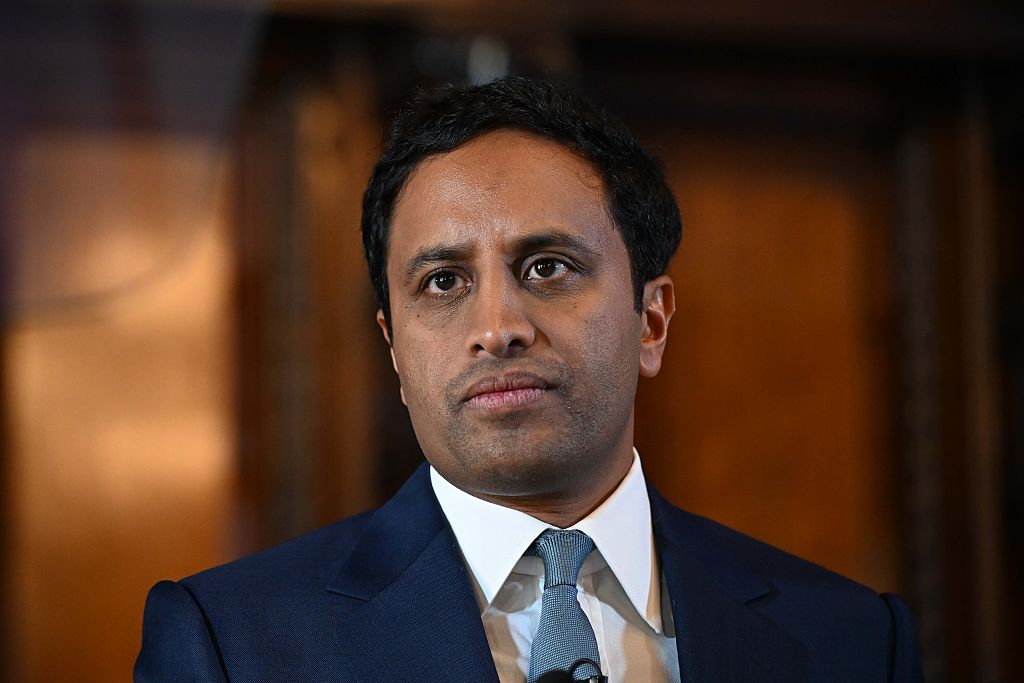
Zia Yusuf is a man of remarkable and rare gifts. His parents are immigrants from Sri Lanka who worked in the NHS. Yusuf himself has had a hugely successful business career, becoming an executive director at Goldman Sachs and then founding a luxury concierge company, Velocity Black, which was sold for a reported £233 million.
Basic common courtesy appears to Yusuf to be a sign of depravity – a stance which he might be wealthy enough to pull-off in his private life, but which marks him down as a liability in public life
But Yusuf is also the latest example of the truism that business success is no indicator of political acumen, let alone political success. Having been chair of Reform for 11 months, he is now the party’s home affairs spokesman. It sometimes seems as if every time he opens his mouth it is an embarrassment either for Yusuf or Reform.
On Monday, Yusuf posted on X that the Conservative former defence secretary Ben Wallace was a ‘traitor to Britain’ He then added a poll asking if Wallace should be prosecuted for treason. Some traitor: Wallace served in the Scots Guards in Northern Ireland during the Troubles. To call a man who risked his life in service a traitor says far more about Yusuf than it does about Wallace.
Yusuf has a habit of making inflammatory accusations which are bad enough in themselves but are especially inappropriate at a time when politicians of all stripes have been subject to violent attack. You might think that as a senior member of Ann Widdecombe’s party, he would be aware of this.
When Nigel Farage was asked about Yusuf’s comments he said, quite rightly, that they were ‘too strong’ and that he would give Yusuf a ‘ticking off’. It must have been a pretty limp ticking off, because as of writing Yusuf’s posts remain online.

The more one sees and hears from Yusuf, the more obvious it becomes that he is a liability for Reform. Last March, for example, Rupert Lowe – at the time a Reform MP – was suspended and reported to the police over alleged threats against Yusuf, days after Lowe had criticised Farage. According to Lowe (another example of a successful businessman who has turned to politics) the ‘untrue and false’ allegations were part of Yusuf’s determination to force him out of Reform. In May 2025 the CPS said it had not found sufficient evidence against Lowe to bring any charges.
The following month Yusuf criticised as ‘dumb’ his fellow Reform MP Sarah Pochin’s question at PMQs on banning the burqa. Forty-eight hours later he did a complete volte face, saying he would after all ‘probably’ vote for a burqa ban himself. But those 48 hours were remarkable for an even greater U-turn. Just hours after he had criticised Pochin, he resigned as Reform chairman, saying that working to get Reform elected was no longer a good use of his time – then two days later he un-resigned. Farage said Yusuf had, ‘made a mistake, he got it wrong. It plunged us for a few hours into a difficult place. He expressed his regret to me, I forgave him. I did say “don’t do it again”, but I forgave him.’
Given his subsequent antics, it might have been better for Reform had Yusuf stuck to his guns.
For one thing, Yusuf has a habit of making basic errors. In April, he listed 17 countries that would be denied visas under a Reform government unless they dropped reparations demands, one of which was Montserrat – a British Overseas Territory, whose citizens are British and need no visa. Just last week he announced a ‘new law’ that already exists – making directors criminally liable for employing illegal workers, with up to five years in prison.
Sometimes those errors take the form of unwarranted accusations. On BBC Breakfast last September, Yusuf asserted that Sir Keir Starmer had called voters who backed Reform’s immigration policy racist. The presenter, Jon Kay, interrupted and pointed out that Starmer had said the exact opposite, calling the policy racist but explicitly saying voters weren’t.
Yusuf behaves as if anyone who disagrees with him is not only wrong – a not unreasonable stance for a politician – but despicable for being wrong because they are morally bad people. In January, for example, he wrote on X that he found the way political opponents are often friendly with each other behind the scenes before TV interviews ‘sickening’ – a sentiment he enlarged on in May when he posted: ‘Recent events demonstrate why I view the Tory and Labour politicians who created the burning injustice of modern Britain as traitors to their country. A reckoning is coming.’
Basic common courtesy appears to Yusuf to be a sign of depravity – a stance which he might be wealthy enough to pull-off in his private life, but which marks him down as a liability in public life.
The more the public sees of Yusuf, I am convinced, the more difficult it will become for Reform to convert a poll lead into government.






Comments