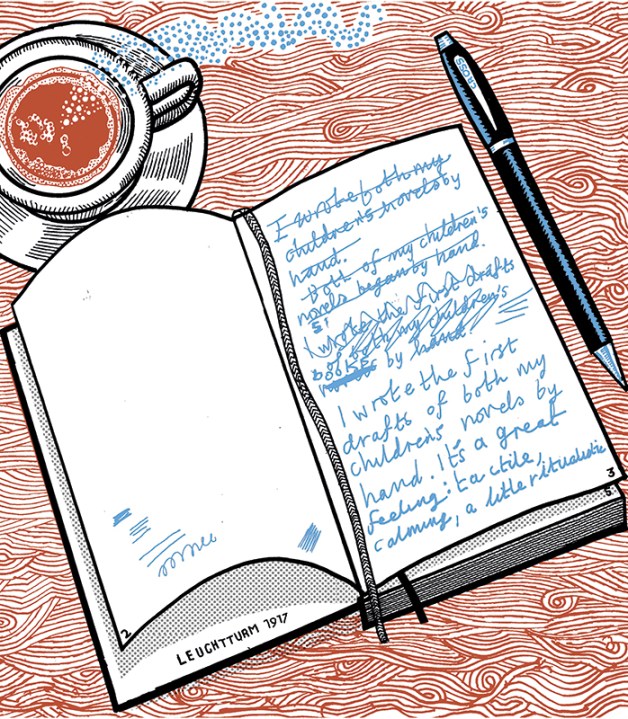
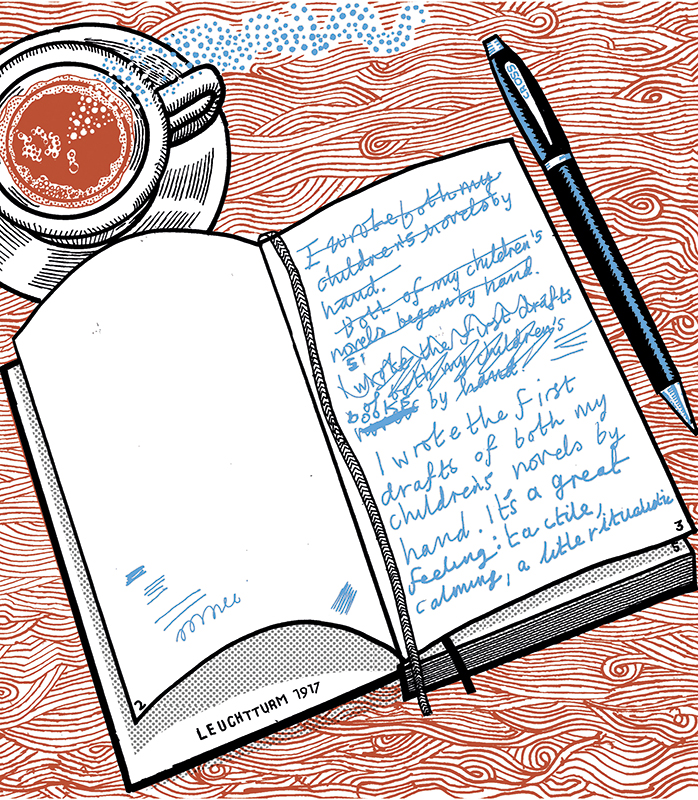
I wrote the first drafts of both of my children’s novels by hand. It’s a great feeling: tactile, calming, a little ritualistic. I crack open a brand new Leuchtturm notebook, bought from the artsy place round the corner, pour myself an espresso, and set to work with the Cross ballpoint my nan gave me as a graduation present.
It’s a slow and painstaking process, but one that is hugely rewarding. As a journalist and novelist, I can touch-type 100-odd words per minute, which is great when I’ve got a deadline for an article. It’s not what I’m after in a novel’s first draft manuscript, however. Time needs to be taken, the narrative voice discovered, pacing slowed a bit. Because my pen cannot keep up with the speed of my thoughts, especially after a few espressos, every sentence is weighed and measured before it goes down. I’m far less inclined to overwrite this way, too.
The slow work of pen on paper demands complete attention, which it’s rare to give to anything these days. I stop and start, pausing at times to stare into the middle distance, rather than having my eyeballs bulging at a screen with podcasts or music playing in the background and YouTube shorts forever on tap.
This all points to the many benefits to be had from picking up pen and paper. A surprisingly robust body of evidence, amassed over the past 15 years or so, has shown us that writing by hand is good for you. Studies have found that students doing so consistently outperformed their keyboard-addicted peers, especially on conceptual questions. The slower pace forced them to process and summarise information before putting it down, rather than simply unthinkingly transcribing it.
More recently, a Norwegian EEG study found stronger connectivity between brain regions associated with memory and learning produced by handwriting compared with typing. Other studies have suggested that writing by hand can activate a broader network of regions within the brain, including those responsible for movement, vision, language and memory, than typing does. In some studies, participants have reported a more positive mood when writing by hand (which chimes with my own experience).
Writing by hand is a human endeavour. This is, of course, vital as Silicon Valley seeks increasingly to rob us of our humanity. AI can give us polished, soulless prose in a matter of seconds. It almost makes my untidy notebooks seem subversive, with their messy scrawls, their smudges, their crossed-out paragraphs and notes to self which show, to me, that a human mind and a human hand worked bloody hard together to wrestle each sentence into being.
Handwritten artefacts once perfectly detailed ordinary human lives. I’m re-reading Middlemarch at the moment and hankering after the kinds of handwritten notes and letters through which each character lives. What I wouldn’t give for a missive from Dorothea Casaubon or a fresh copy of one of Will Ladislaw’s articles for the Pioneer in his own hand.
My mum wrote me a letter a few years ago, just as a spur-of-the moment catch-up. I was living in Edinburgh; she was in London. I still have the letter in a box in my office, and I re-read it now and then. A time will come (hopefully a long way off) when my mum will be gone, but I’ll have a very human reminder of her in that letter, with her unique and beautiful penmanship (which she unfortunately failed to pass on to me).
The scribbles we leave behind are important and often illuminating. My sister-in-law is a medievalist lecturing at St Andrews. Large parts of her PhD were to do with medieval marginalia. The notes, doodles, complaints, asides and outright insults left in the margins of manuscripts from centuries ago tell us so much about how and who people were at the time.
Time needs to be taken with the first draft, the narrative voice discovered, the pacing slowed a bit
One extensive piece of marginalia she shared with me concerns Highland funeral rites. A Mr R. Campbell, for example, tells us that after a person dies, people ‘sit up with the corpse singing, smoking, drinking, playing cards & courting all night’. In the same manuscript, insults are scrawled over the pages in different hands – ‘a blockhead like you should hold your tongue,’ one reads.
It’s the kind of sordid stuff you wouldn’t get in the official textbooks. Again, gloriously, filthily human: compare it with modern in-text comments and track changes that disappear with each iteration and software update and you can see the soul we are losing by typing everything.
Handwriting is an extension of the self, as any graphologist will tell you. Two people may write the same sentence, but each will leave a different mark on the page, with a difference between them far more remarkable than whether they chose to go with Times New Roman or Garamond.
I’ll still type up every manuscript eventually. Editors quite reasonably expect Word documents, not a pile of dog-eared notebooks, and typing my handwritten manuscripts up is an excellent proving process that leaves me with a solid draft. But that first draft will always be written in a fresh Leuchtturm with that same Cross pen. It will still be human, very much my own; very much the result of a human mind and a human hand working hard together.
It will still contain a piece of my soul, thank you very much.



Comments