
The Edinburgh Fringe is getting bigger. Last year’s total of 3,893 shows is surpassed this year by 4,206 productions. More people are coming to Edinburgh in search of fame but the pressure of numbers doesn’t guarantee quality. Rival events are treading on Scotland’s turf. London produces two festivals in August that appear to challenge Edinburgh directly. The Camden Fringe offers 450 shows covering theatre, comedy, opera and dance, while the Greenwich and Docklands International Festival stages a mix of theatre, circus and street art.
The Edinburgh Fringe used to hold a unique place in the world of British entertainment as an informal talent contest where newcomers were spotted, nurtured and launched as stars. That route has become less attractive to producers who can find new performers online and measure their popularity by checking their viewership. Why spend three weeks watching unfunny comedians in dank pub theatres when you can discover rising stars on your laptop? And the flood of talent appears to have stalled. The top comedy award has been won by an amazing sequence of celebrities including Sean Hughes, Frank Skinner, Steve Coogan, Lee Evans, Jenny Eclair and Al Murray. But since 2000, the list of comics has become less distinguished. Few are well known outside the club circuit.
And the fringe’s theatrical repertoire has registered only sporadic hits in the past 25 years. Black Watch premièred in 2006 and became the first National Theatre of Scotland play to tour internationally. The fringe claims that Fleabag (2013) was one of its successes but the show held its world première at the Soho Theatre earlier in the same year. The raucous musical Six opened at Edinburgh in 2017 and turned into an unexpected worldwide hit while Baby Reindeer, from 2019, never became a theatre production at all. It went straight to Netflix. These are slim pickings from a festival that launched Beyond the Fringe in 1960 and the Cambridge Footlights Revue of 1981 which included Emma Thompson, Stephen Fry and Hugh Laurie.
Even the joke of the fringe prize ground to a halt last year, when its sponsor deserted it. This year the winning gag will be chosen by the US crisp firm Cheeze-It, the ‘Official Snack Partner of the Fringe’.
What the Fringe remains unrivalled at is its obsession with the culture wars
What the Fringe remains unrivalled at, however, is its obsession with the culture wars. Edinburgh was the ideological Mecca for the era many are now calling Woke 1. And it seems incapable of moving on.
This year, the war against the patriarchy is being fought by Lucy Stevens (An Audience with Virginia Woolf: Writing One’s Mind) who impersonates the pioneering feminist and reads passages from her novels as well as work by other celebrated women. The performance includes gobbets of Aphra Behn’s poetry sung by Stevens in a piercing soprano. The singing starts randomly and without trigger warnings so the show is full of surprises. Virginia Woolf, born in 1882, seems blissfully unaware of her good fortune as an upper-middle-class woman living in the world’s wealthiest city. Having to choose between the ‘servility’ of domestic life and the inconvenience of a professional career strikes her as a massive chore. In need of a husband to support her financially, she selects Leonard Woolf whom she finds physically repulsive. Never mind. All she wants is to write, write, write. Her fiction is filled with gorgeous sunsets, crashing seascapes and heroically beautiful lovers, and it all sounds a bit Barbara Cartland but without the discipline of a decent plot. And Woolf’s observations lack depth. She suggests that if Tolstoy had been an impoverished milkmaid and not a land-owning army officer, he might have written shorter novels. This is true but hardly worth saying. The same goes for Behn’s opinion, alluded to by Woolf, that the world would be nicer if it contained more peace and beauty.
The patriarchy gets another kicking from Elizabeth Taylor in Call Me Elizabeth: from Lassie To Cleopatra where she reveals the truth about her first marriage. Nicky Hilton was a violent, philandering drunkard who attacked Taylor when she was pregnant and caused her to lose her first child. The actor, Kayla Boye, has no trouble impersonating ‘the world’s most beautiful woman’ and she plays the role with louche elegance while sipping champagne and swallowing pills from a silver jewellery box. Taylor hated the foul-mouthed moguls who ran Hollywood and once she became a powerful star she misbehaved on set as a form of revenge.
This is a superb portrait of a fascinating character but it arrives at the wrong moment
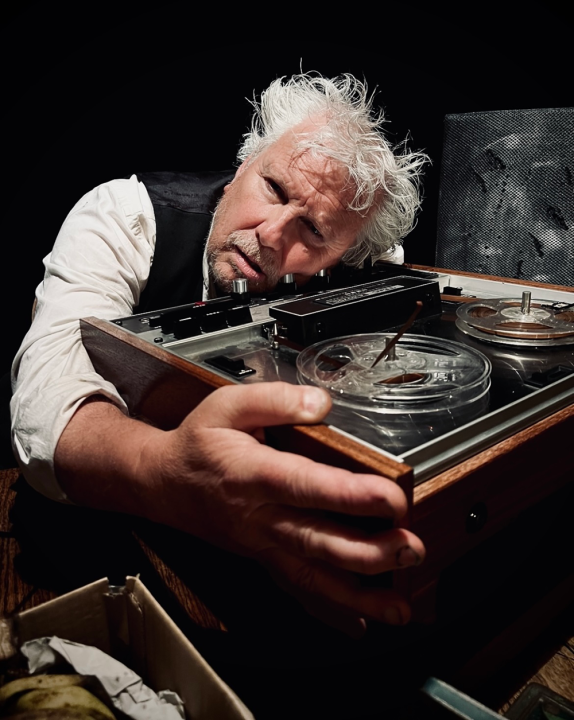
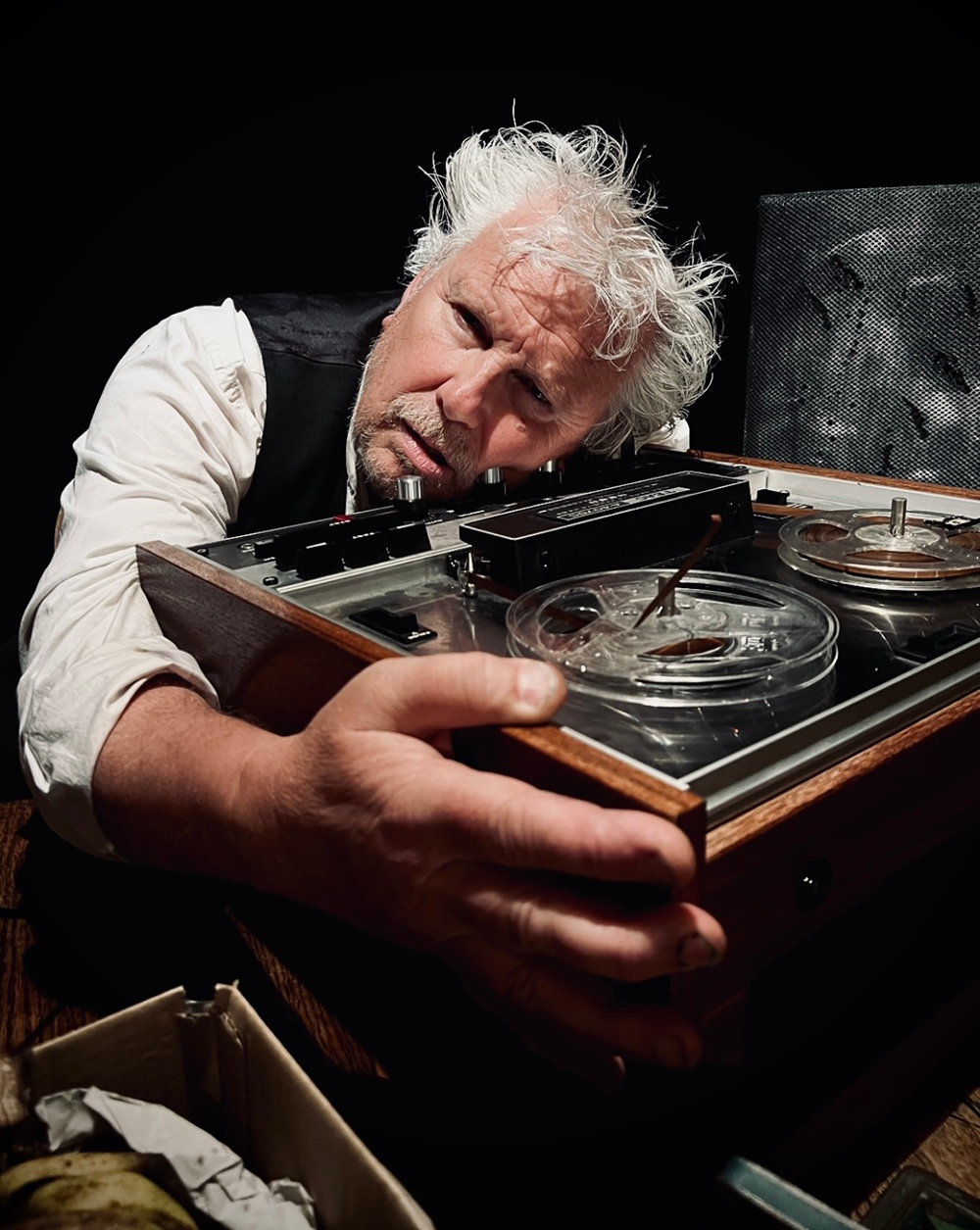
The fringe is always good for ‘high art’ even if it’s out of date. Krapp’s Last Tape is a Beckett play from 1958 that includes a stunning evocation of a romance that goes wrong during a punting trip. Beckett always punishes his fans for the sin of wishing to appreciate his writing and he conceals this literary gem inside a thick layer of artifice and pretension. The play’s narrator, Krapp, is a decrepit pensioner who records his memories on an archive of reel-to-reel tapes. As a birthday treat, he selects a random tape and amuses himself by listening to a half-forgotten recording from his youth. This daft and unlikely set-up is explained by Krapp himself, who sits at a desk surrounded by garbage. (The play is deliberately unpleasant to look at.) When not talking about his eccentricities, Krapp devours bananas and repeats the word ‘spool’ obsessively.
Could any living actor make this funny? Rowan Atkinson perhaps. David Westhead, as Krapp, does what he can to turn the wittering recluse into an attractive figure. After the first performance, Westhead stood up, took a bow and introduced the director, Stockard Channing, for a discussion about the play. This was much more fun than Beckett’s silly and intractable script. Someone in the crowd told us that the tape machine stands for Krapp’s mother and that the spools represent her breasts. Westhead pointed to his size 10 shoes (white with pointed toes) which conform exactly to the stage directions. ‘I take size eight and a half,’ he said, ‘but these are stuffed with paper.’ He didn’t dare to deviate from the script in case Beckett’s representatives, ‘the estate police’, as he called them, showed up and cancelled the production.
The fringe has not kept abreast of recent political events and the name Andy Burnham appears nowhere on the listing sites. However, Peter Mandelson has arrived. Mandy: Prince of Darkness is performed by Richard Stirling who bears an uncanny resemblance to his subject. His face and his head are exactly the right shape, and he brilliantly captures Mandy’s secretive and elusive personality. He’s camp, nervy, irascible, self-righteous and only superficially likeable. As a boy, Mandelson won an election at school which taught him three lessons about spin. ‘Be factual, don’t overclaim and never arrive at a briefing without a story.’
In 1992, when Neil Kinnock quit the Labour leadership, Mandelson backed Tony Blair rather than John Smith or Gordon Brown. Smith won the contest and Mandelson immediately planted a pro-Blair piece in a Sunday supplement promoting him as ‘the leader Labour missed’. This contradicts the traditional story that Mandelson supported Brown until 1994 and then switched to Blair. Mandelson’s social ambitions never matched his income and he began to court the company of millionaires. Jeffrey Epstein assured him that his 2008 conviction for sex offences was based on false information, and Mandelson believed him even though Epstein pleaded guilty in court. Despite his legendary reputation as a publicist, he never kept his personal record clean. Only a clueless spin doctor would allow the nickname ‘Prince of Darkness’ to be circulated widely. Perhaps he loved his bad-boy image.
This is a superb portrait of a fascinating character but it arrives at the wrong moment. Mandelson’s downfall is too recent to count as history and too dated to count as topical news. But its time will come. For political wonks, this show is unmissable.



Comments