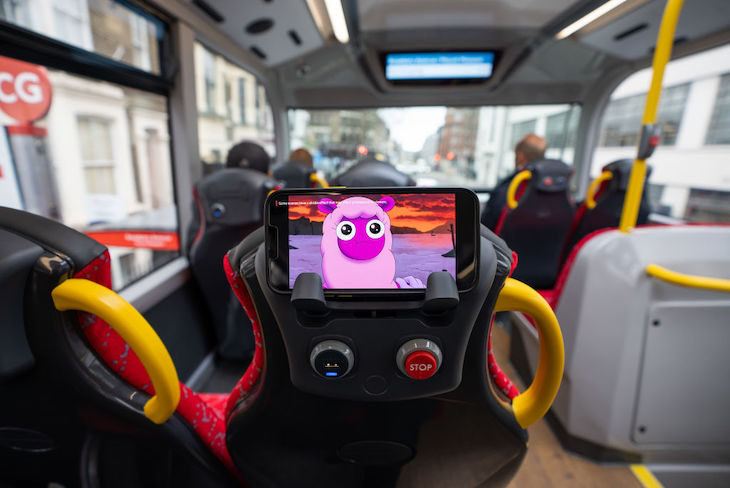
British commuters seeking a thrill could do worse than asking fellow passengers whether they would mind turning their terrible music off. While chatting to strangers on public transport remains taboo, open season has been declared when it comes to pumping out tinny tunes, brain-deadening TikToks, or the musings of a mumbling halfwit on the other end of the phone.
One regular route of mine features passengers who like to start their day and mine by listening to evangelical preachers
That so-called ‘loudcasting’ continues despite widespread revulsion is a classic tragedy of the commons. A Transport for London (TfL) survey last year reported that 70 per cent of respondents found sounds emitted from fellow passengers’ devices to be a nuisance, the remaining 30 per cent presumably angling for deportation under Rupert Lowe’s ever-expanding remit.
In some ways it is just another entry in the list of things that the British don’t like about their country that our rulers have surrendered to as an inevitable fact, alongside death, taxes and mass migration. And naturally there is a ready supply of experts happy to excuse it, and even present it as a social good.
Challenging the British public’s wrongthink in this instance is a lengthy report from the BBC featuring a slate of international boffins. Far from decrying loudcasting as a sign that society is too permissive, the general attitude is that it’s a ‘fascinating human phenomenon of marking social territory’, in the words of the University of Sussex’s Harry Witchel – though the comparison to a dog urinating on a lamppost is telling in other ways.
Bus passengers will have already noticed that loudcasting has been led by teenagers. Ofcom data from 2022 cited by the Beeb suggests that two-thirds of those aged 13 to 17 think it’s acceptable to make video calls without headphones in a public place, with 73 per cent saying the same of listening to music out loud and 83 per cent for videos.

That this is interpreted as mere self-expression makes sense coming from the industry that brought you Jason Arday. Rachael Kent of King’s College, London, called it ‘performative’ and ‘a way to rebel’, though rebels without a cause have not previously sought to emulate the Ludovico Technique from A Clockwork Orange by monging out on the backseat of the 194 scrolling Instagram.
Some of the academics even claim that such behaviour encourages social connection. Orla Muldoon of Queen’s University Belfast says it’s ‘quintessentially social to play music and hope your peers appreciate’, a view that would be rather more persuasive if said symphonies weren’t a mix of capitalist onanism and racial slurs.
Muldoon would have made a better point had she focused on the strange phenomenon of people taking calls on speaker phone like they’d just been fired from The Apprentice. In cases where the goss is hot this is a blessing, indiscreet public phone calls having previously left eavesdroppers wondering just how much of a slag Tracy really is.
Other interruptions can also add intrigue to mundane journeys. One regular route of mine features passengers who like to start their day and mine by listening to evangelical preachers. Men of dubious migration status can likewise be found making video conference calls to their mums and half the population of Islamabad, and the rest of the bus is welcome to join.
Like a landlord skimping on the damp-proofing, the boffins’ hope appears to be that you will eventually accept the encroaching mould. Rich Ling, formerly of Singapore’s Nanyang Technological University, told the BBC that loudcasting will soon be no more gauche than taking a call in a restaurant. Actually, one of the few benefits of the mobile phone is it lets callers skulk outside like a smoker while they explain to their partner where they left the baby powder.
Were this sufficiently unconvincing, Ling follows this by noting that loudcasting is much less of a problem in Japan, a country where tech adoption is so rapid that the Japanese are already shagging their robots. Nuisance public noise is not an inevitable feature of the smartphone, but the result of a society that permits it.
Even so, calls for enforcement of the existing law, which apparently can entail a £1,000 for disruptive passengers, are futile. Even if you could drag the police away from hassling investigative journalists, no force could muster the numbers to tackle what has become an unstoppable social contagion.
So I have an alternative. With phone theft basically already legal in London, why not give passengers a free hand to apprehend loudcasters? As with the privateers of old, the government can issue a charter authorising members of the public to confiscate offending devices and dispose of them out of the nearest window.
Carnage would ensue in the early weeks, I’ll grant, but like The Purge it would allow commuters a release valve for the inevitable stress of being trapped in a sardine can with a gaggle of headphone refusers. Should the boffins veto it on ethical grounds, they can at least stop making excuses for people who really warrant the designation of ‘bus wanker’.






Comments