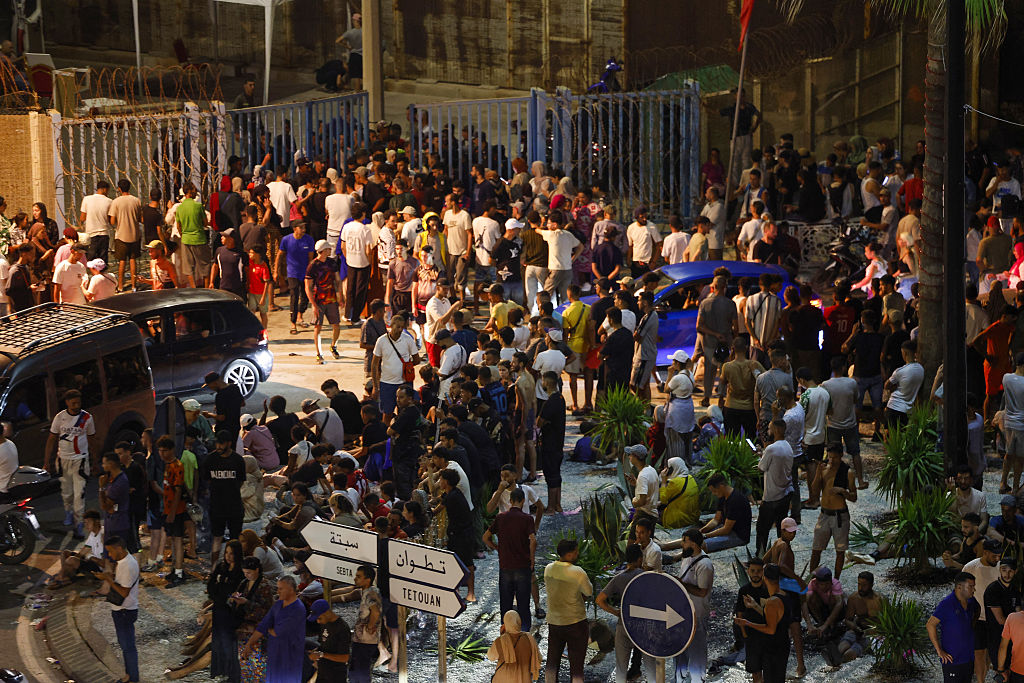
Europe risks learning precisely the wrong lessons from the latest crisis in Ceuta.What unfolded on Spain’s North African border was not one crisis but two. They are closely connected, yet fundamentally different. Failing to distinguish between them risks misunderstanding both, and, ultimately, repeating them.
The first concerns Morocco’s long-established use of migration as an instrument of political coercion against Spain. The second concerns the Spanish government’s own approach to immigration and the wider consequences that approach may have for the European Union. Only by separating these two issues can Europe hope to address either successfully.
Cueta was a warning about Europe’s willingness to defend the foundations upon which its freedom depends
Morocco’s latest operation should not be mistaken for a conventional migration crisis. It was, above all, an act of strategic coercion. For decades, Rabat has understood that migration can serve purposes extending far beyond humanitarian need. Properly controlled – or deliberately left uncontrolled – migration becomes a remarkably effective instrument of statecraft.
The pattern is well established. In 1975, the Green March enabled Morocco to seize control of Spanish Sahara by exploiting Spain’s political paralysis during the final days of Franco’s regime. In 2021, Morocco deliberately relaxed border controls after Madrid admitted Polisario leader Brahim Ghali for medical treatment, allowing thousands of migrants to enter Ceuta within hours.
The latest events belong to precisely the same strategic tradition. Migration was not the objective; it was the instrument. More than sixty thousand Moroccan civilians crossed into a Spanish city of barely eighty thousand inhabitants while Moroccan security forces looked on without intervening. Such an operation cannot plausibly be described as spontaneous, nor was it driven primarily by economic necessity.
It was a carefully calibrated demonstration of political leverage. The fact that most of those who crossed returned to Morocco shortly afterwards reinforces that conclusion. This was never intended to become another 2015-style migration wave into Europe. It was a limited coercive operation designed to remind Madrid of a simple reality: whenever Rabat chooses to manipulate migration flows, Spain immediately feels the consequences.
This is why Europe should resist the temptation to interpret Ceuta primarily through the prism of immigration policy. The immediate issue was not migration. It was coercion – above all, a bilateral strategic instrument through which Morocco seeks to influence Spanish foreign policy.
Europe should therefore draw its first lesson from Ceuta: migration is no longer merely a humanitarian challenge or an economic phenomenon. It has become an instrument of geopolitical competition. If Morocco’s manipulation of migration is the first lesson of Ceuta, the second lies much closer to home.
Europe cannot concern itself exclusively with external threats while ignoring the political choices made within its own borders. The Spanish government’s immigration policy illustrates precisely why.
Unlike Morocco’s actions, which are intended to exert pressure on a neighbouring state, Madrid’s approach is presented almost exclusively in humanitarian terms. Yet immigration policy is never simply humanitarian. It reflects a particular understanding of the nation, citizenship and the purpose of the state. This is where the European debate has become increasingly confused.
Across much of the political spectrum — and particularly on the contemporary Left — immigration is no longer treated merely as a phenomenon to be managed. It has become a political virtue in itself. Openness is assumed to be morally superior to restraint. Borders are often regarded less as expressions of democratic sovereignty than as obstacles to universal rights. The distinction between legal and illegal migration is progressively blurred beneath a broader language of inclusion.
Whether one shares this vision is, of course, a matter of political conviction. Its strategic consequences, however, are no longer theoretical. A political culture that hesitates to defend the legitimacy of its own borders inevitably weakens one of the essential attributes of sovereignty. Once borders cease to be understood as the physical expression of a political community, they become increasingly difficult to defend – both politically and practically. That is precisely the vulnerability authoritarian neighbours have begun to exploit.
The irony is striking. While Europe invests heavily in strengthening Frontex, expanding surveillance systems and coordinating border management, parts of its own political class continue to question the very legitimacy of robust border control. The result is an uncomfortable contradiction: sophisticated instruments without a shared political purpose.
Spain provides a particularly revealing example. The current government’s repeated proposals for large-scale regularisations and expanded access to Spanish nationality are presented as acts of humanitarian responsibility. Yet they also carry obvious political implications, potentially reshaping the country’s future electorate in ways favourable to those advocating such policies.
That debate belongs, first and foremost, to Spanish democracy. Its consequences do not. Under Schengen, Spain’s external borders are Europe’s external borders. Decisions taken in Madrid inevitably affect every member state. Immigration policy cannot therefore be treated as an exclusively domestic matter when its effects extend across the Union.
But there is an even broader question that Europe has been reluctant to confront. The migration debate has become inseparable from a deeper argument about civilisation itself.
For many on the European Left, large-scale immigration is valued not simply for humanitarian or economic reasons but because it is seen as accelerating the emergence of a more post-national, multicultural society. Traditional ideas of national identity, cultural continuity and historical inheritance are regarded with increasing suspicion, while diversity itself becomes a political objective rather than merely a consequence of freedom.
The European centre-right, meanwhile, cannot escape responsibility either. Too often, it has accepted large-scale immigration for reasons of economic convenience, valuing access to inexpensive labour while gradually surrendering the wider intellectual debate over identity, integration and sovereignty. Different ideological premises have frequently produced remarkably similar policies.
The consequence is that Europe increasingly struggles to articulate why its borders matter beyond administrative necessity. That uncertainty has become one of its greatest strategic weaknesses. Europe should therefore resist the temptation to draw the wrong conclusions from Ceuta. The events on Spain’s southern border were not simply another migration crisis. They exposed two strategic vulnerabilities that Europe can no longer afford to ignore.
The first lies beyond Europe’s borders. Increasingly, authoritarian states have discovered that migration can be weaponised. Instead of deploying troops, they deploy civilians. Instead of threatening invasion, they manufacture instability. Their objective is not territorial conquest but political leverage.
Russia has experimented with similar tactics on the borders of Finland and Poland. Belarus has done the same against Lithuania. Morocco has repeatedly demonstrated that it understands the same logic in the Western Mediterranean. Migration has become an instrument of statecraft. Europe must begin treating it as such.
The second vulnerability is internal. No system of external border protection can remain credible if Europe’s own political elites become uncertain about the legitimacy of the borders they are supposed to defend. That uncertainty is not merely administrative. It is philosophical. It reflects a growing discomfort among some EU elites with the very idea of the nation-state as the primary framework of democratic legitimacy and political loyalty.
Yet democratic government is impossible without a clearly defined political community, and political communities cannot exist indefinitely without borders that distinguish membership from non-membership. For that reason, the debate over migration is ultimately not only about economics. Nor is it simply about humanitarian obligations. It is about the cultural and political foundations upon which democratic societies rest.
Europe should recover a distinction that has become increasingly obscured. A civilisation can be multiracial. History offers countless examples of societies composed of people of different ethnic origins who nevertheless shared a common language, civic culture, historical memory and political identity.
What no civilisation has sustained for long is multiculturalism understood not as diversity within a shared public culture, but as the permanent coexistence of parallel communities with no common civic identity. A democracy requires disagreement. A civilisation requires cohesion.
Without a common civic culture, solidarity gradually weakens, democratic trust erodes and political institutions lose the shared assumptions upon which they depend. This is not an argument against immigration. Nor is it an argument for ethnic homogeneity. It is an argument for cultural integration as the indispensable condition of democratic continuity. Europe’s borders are more than lines on a map. They define the political community that makes democratic self-government possible.
Ceuta was not simply a Spanish border crisis. It was a warning. Not only about Morocco. Not only about migration. But about Europe’s willingness to defend the political and civilisational foundations upon which its freedom ultimately depends.
History rarely punishes nations for lacking good intentions. It punishes those that fail to recognise the nature of the challenges confronting them before it is too late.





Comments