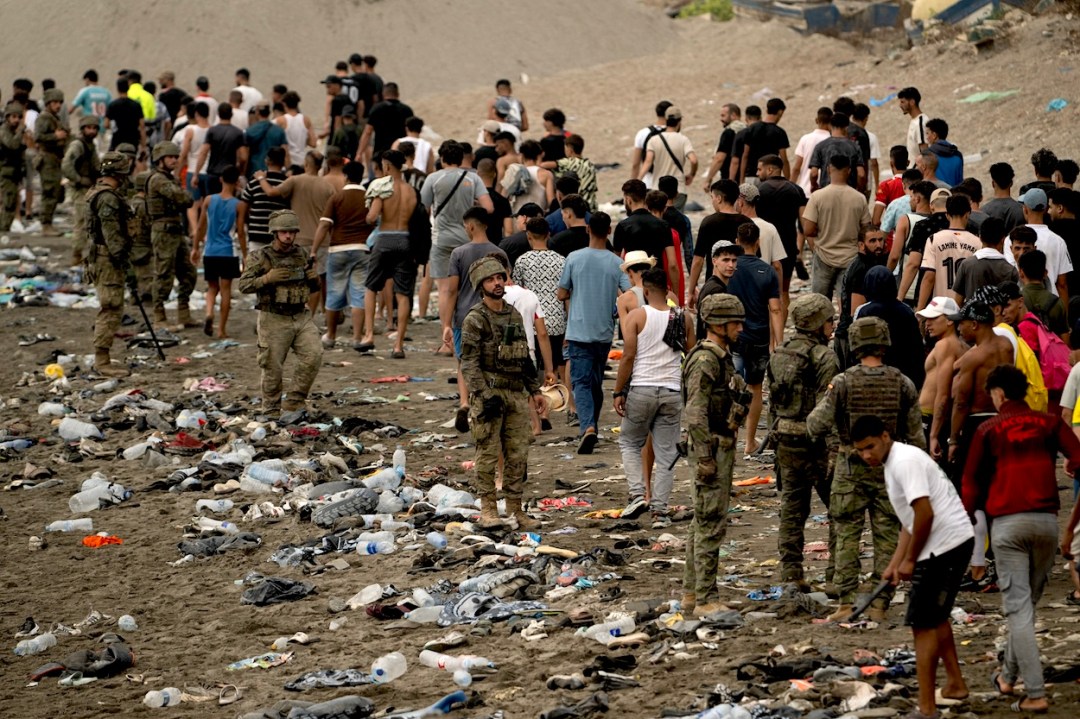
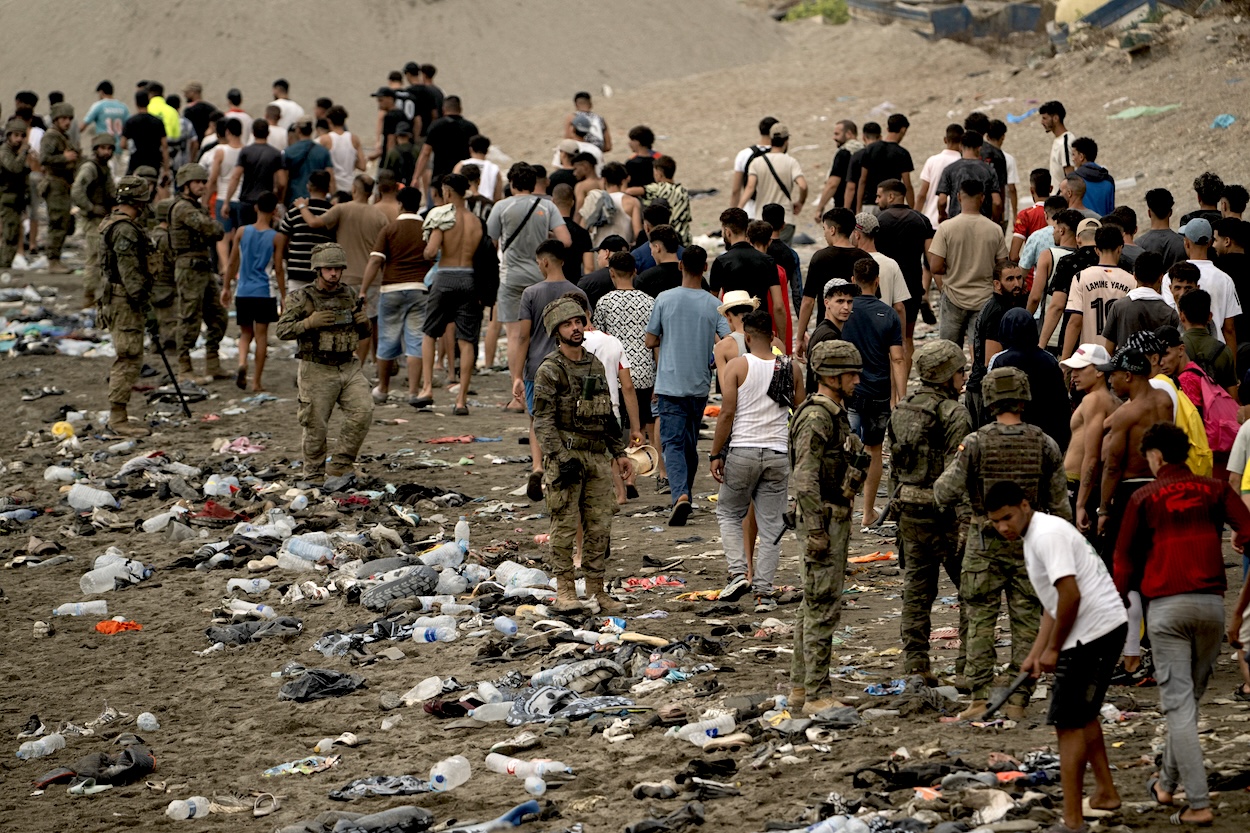
We in Britain should be very worried indeed about the wholesale violation of Spain’s immigration law that has just taken place, with more than 49,000 unlawful migrants entering the Spanish enclave of Ceuta, in North Africa, in a single 24-hour period. This is politically explosive. Italy has already called for the suspension of the Schengen Zone. The British government’s response has been noticeably less robust, with PM Burnham saying this is ‘a matter for the Spanish government first and foremost’ and offering ‘support’. Britain, and other European states, should instead call for Spain to restore order to the EU’s African border, remove those who have entered unlawfully, and prevent them from travelling onward to mainland Europe.

Britain has a national interest in effective European border security. The entry of unlawful migrants into other European states, in violation of their immigration law, is a threat to us, not least since many of them may later cross the Channel in small boats, entering the UK in violation of our immigration law. In any case, we have an interest, as good neighbours, in citizens of other European states being able to decide for themselves who enters and remains amongst them. And insofar as we for now share a common legal framework, by way of the European Convention on Human Rights (ECHR), we have our own interest in making sure that this body of law is non-disastrous.
The backdrop to this latest ‘mass influx’ is no doubt complex, involving the drawcard of Spain’s recent amnesty for unlawful migrants and, especially, tensions between Morocco and Spain, inflamed by the recent visit of the Spanish Prime Minister to Algeria. But one factor is likely to have been the judgment, on 30 June this year, of the Spanish Supreme Court, rejecting the Spanish government’s interpretation of legislation enacted in 2015 to secure the Spanish border in Ceuta (and Melilla, the other Spanish enclave in North Africa, further along the Moroccan coast).
The 2015 legislation provided that ‘Foreign nationals who are detected at the border line of the territorial boundaries of Ceuta or Melilla while attempting to overcome the elements of border-containment in order to cross the border irregularly may be rejected for the purpose of preventing their unlawful entry into Spain.’ That is, the Spanish authorities could intercept would-be migrants at the border and return them immediately to Morocco without considering their claims.
What the Spanish Supreme Court did on 30 June was to rule that this legislation did not apply to those attempting to swim into Ceuta – the legislation only applied to the breach of physical structures, namely fences, erected to prevent irregular entry, but not to a natural barrier like the sea. Nor did the network of drones, thermal-imaging cameras and sensors that had been installed to detect entry by sea, the Court said, count as ‘elements of border-containment’ because their function is surveillance rather than containment.
The sea, a highly effective natural barrier, is turned by this judgment into a legal vulnerability. It seems extraordinary to conclude that a person who swims around the end of a border fence is not attempting to overcome that border barrier. Scaling the barrier with a ladder, tunnelling beneath it or pole-vaulting over it would count, but swimming around it does not.
The Spanish Supreme Court’s narrow interpretation of the legislation relied in part on earlier judgments of the Spanish Constitutional Court, which focused on the background to the legislation, namely repeated attempts by groups of foreigners to storm the fences, overwhelming them by sheer force of numbers. In 2017, the European Court of Human Rights held Spain to have breached the ECHR’s prohibition on ‘mass expulsion’ by immediately returning to Morocco the group of men intercepted having scaled the fence. In 2020, the Grand Chamber reversed this judgment, stressing the fact that the men had used ‘force’ by assembling in large numbers and scaling the fence.
As John Finnis and Simon Murray explain in their magisterial Policy Exchange paper, Immigration, Strasbourg and Judicial Overreach, the 2020 judgment focused on the unmeritorious character of this mode of crossing the border, in a context where those who attempted to enter could have applied for entry as a refugee at border posts on the Moroccan side of the border. While many human rights lawyers were horrified by the 2020 judgment, in fact the judgment was a very limited correction of the excesses of the Strasbourg Court’s asylum and immigration case law.
What can Spain now do about the tens of thousands who have entered in the last day or so?
Spain needs urgently to amend its legislation and to intercept migrants who attempt to swim into Ceuta, returning them immediately to Morocco. The Spanish government should have sought such legislation well before now in view of the risk that the Supreme Court would decide against it. If the legislation is changed and Spanish authorities again intercept migrants in the water, some of them will no doubt apply to the Strasbourg Court, which will then have to decide if the logic of its 2020 judgment applies to those who swim rather than scale or topple a fence. Maybe swimming around the fence is marginally less aggressive than storming it, but neither Spain nor any other European state should have to tolerate tens of thousands of men unlawfully entering in this way.
What can Spain now do about the tens of thousands who have entered in the last day or so? The Strasbourg Court’s 2020 judgment only applied to those rejected at the border. European human rights law, as Policy Exchange’s work shows, may make it very difficult for Spain to remove many, let alone all, of the 49,000. The worst thing Spain could do would be simply to accept their unlawful entry. Instead, it must strive to persuade Morocco now to accept their return and should legislate to enable their expulsion, without having to consider claims for each and every one of them. If or when the Strasbourg Court is invited to wreck any such scheme, as it surely will be, the UK should take the lead in arguing that decisive action is needed to vindicate European border security.
This piece is part of a Policy Exchange double bill from three leading experts. Read David Goodhart’s accompanying piece here.






Comments