You know you are in trouble when Piers Morgan describes your behaviour as ‘outrageous’.
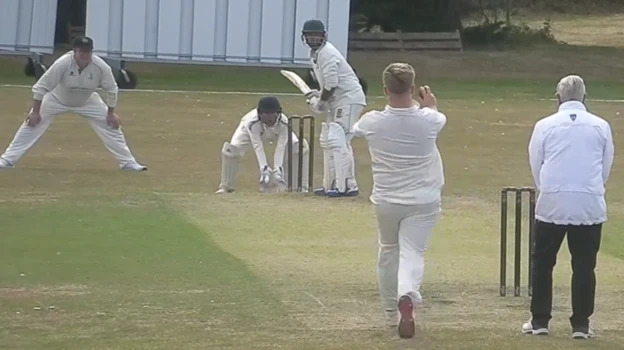
Earlier this week a cricket fan, Ben Mummery, posted footage from a village cricket match between Saltburn’s second XI and Norton. The 15-second clip zoomed in on the fielder at first slip, named online as Brian Devine, who clicks the fingers of his left hand at the same time as the ball passes the outside edge of his opponent’s bat. The ball nestles in the gloves of wicket-keeper Josh Bowes. The umpire assumes the noise comes from an edge and gives the batsman out.
The clip piqued the interest of the online cricket community, who dug up several other clips showing similar behaviour. Further investigations revealed that in the eight matches that Devine and Bowes had played together for Saltburn’s seconds this season, Bowes took 31 catches. In the five matches when neither played, the team managed five. In a game against Shildon Railways, which Saltburn won by 22 runs, Bowes took eight catches. In almost 2,600 men’s Test matches played over 150 years, the highest number of catches a wicketkeeper has ever taken in an innings is seven. The North Yorkshire and South Durham Cricket League has begun an investigation.
Cricket has a long and inglorious history of cheating. The list of those who have made errors of judgment is long. It encompasses the young (Mohammad Amir) and the old (W.G. Grace), figures of probity (Hansie Cronje) and obvious wrong-uns (Lou Vincent). Shane Warne, Rahul Dravid, Steve Smith, Faf du Plessis, Nicolas Pooran and Shahid Afridi; cricketers from every nation have sought to gain an advantage illegally. Even Mike Atherton found dirt in his pocket.
Plainly, it is possible to cheat at cricket. It has become more difficult to do so in the professional game since the advent of multiple TV cameras. It was footage of the tiny yellow square of sandpaper held by Australian batsman Cameron Bancroft that blew open Sandpapergate in 2018. Marcus Trescothick was more discreet in his sucking of Murray mints before applying saliva to the ball in 2005. He only admitted what he had done in retirement.
But until now, village cricket has relied much more on that amorphous idea of the spirit of the game. It is this charter that encourages batsmen to respect opponents, umpires and cricket itself. Every weekend player has faced this moment. A long journey to the match, 50 overs in the field and then a tiny edge on the first ball. Trudging off makes it a miserable day. But how do you feel about the runs you make if you stay, unfairly?
Much like Sandpapergate, the Saltburn case only came to light because some NYSD clubs began filming their games. Without the existence of the footage, it would be extremely unlikely that a pattern of cheating would have been spotted. Being on the end of a rum decision from an umpire is another of those uncomfortable feelings that cricket forces players to confront.
Village cricket is a training ground for players to practice the rules of life
However, the universal negative online reaction to Devine and Bowes hints at something deeper. Atherton made a bad decision under pressure. Amir was coerced by older colleagues with influence. Both men were reckoning with harm to their livelihoods. They were found to be morally weak in moments of high pressure. Village cricket is not that. It is taken seriously – sometimes too seriously – but it is also recreational. It is an escape from that professional pressure. It is also a training ground for players – young and old – to practice the rules of life. This sounds lofty and potentially sanctimonious, but it is also indubitably true.
What lessons should the colts of Saltburn take away from a dreadful week? That the spirit of cricket is alive and well. That cricket remains a test of moral courage. And because it is a test, not everyone will pass.






Comments