Ten months into his detention, Irishman Daniel Tatlow-Devally and his fellow pro Palestine activists have spent 22 hours a day alone in a German cell. Tatlow-Devally, along with UK nationals Zo Hailu and Crow Tricks are on trial for allegedly causing €1million (£860,00) of damage at Israel’s Elbit Systems in Ulm and using symbols of Hamas, a proscribed terrorist organisation in Germany. They are further charged with membership of a criminal organisation under section 129 of the German criminal code.
Germany is not some outlaw state whose courts require Irish parliamentary supervision to function
This week, a cross-party delegation of Irish politicians travelled to Stuttgart to see for themselves what that detention, and the trial behind it, looks like. What they found troubled them enough to call it a show trial. They described a courtroom stripped of dignity, with Tatlow-Devally’s father accusing the German judicial system of treating his son like Hannibal Lecter.
Tatlow-Devally, who comes from a privileged background in Dublin, is a 32-year-old student living in Germany for the past five years. He is not, as his father described him and the other activists on Irish TV ‘a kid.’ Friends of the Tatlow-Devally family set up a GoFundMe to help with travel and accommodation during the trial, with any excess donated to the Irish Palestine Solidarity Group and families in Gaza. It has so far reached €24,000 (£20,469).
Whether the delegation’s findings are vindicated remains to be seen – but their claims are worth setting out plainly before anyone reaches for a verdict on Germany’s handling of the case.
Let us grant them this much: some of what the delegation describes is genuinely uncomfortable to read. Defendants held behind glass, unable to confer freely with counsel, no official transcript of proceedings – a real problem if an appeal ever materialises. If accurate, none of this reflects particularly well on the German judiciary’s handling of a case that, whatever the eventual verdict, involves defendants who have not yet been convicted of anything.

But at the same time, Germany is not some outlaw state whose courts require Irish parliamentary supervision to function. It is a mature liberal democracy, a fellow EU member, and a signatory – like Ireland – to the European Convention on Human Rights, with its own defence bar, its own appellate courts and its own mechanisms for challenging exactly these sorts of procedural complaints. If the Ulm 5’s lawyers believe their clients’ rights under the Convention are being violated, the remedy is Strasbourg, not a delegation of TDs demanding that Berlin ‘observe’ whether an Irish citizen’s rights are being respected, as one senator on the trip rather loftily put it. Germany did not ask for Irish oversight of its criminal code, and there is something faintly colonial about the implication that it needs it.
It is also worth being precise about the charges because the framing back home has been muddled. German prosecutors allege that the group caused seven figures’ worth of damage at an Israeli-owned defence site and have charged them under Section 129 of the German Criminal Code – the provision covering formation, or membership of, a criminal organisation. That is a general-purpose statute prosecutors reach for when they believe a group acted in a coordinated, structured way to commit crimes together. Germany has not proscribed Palestine Action or any equivalent group, and nothing in the case turns on such a designation. The allegation is that these five individuals organised themselves to commit a specific act of property destruction, not that they belong to a banned outfit. Conflating the two only muddies what is a narrow, if serious, charge. The activists themselves have not denied the underlying act; they have described it as civil disobedience against the war in Gaza and deny wrongdoing on that basis. Coverage of the case in Ireland has been largely sympathetic, as though the cause negates the crime. That is a recipe for anarchy. Irish politicians are entitled to sympathise with the defendants but are not entitled to treat sympathy for a cause as licence to attack a foreign judicial process they have observed for, at most, a couple of days.
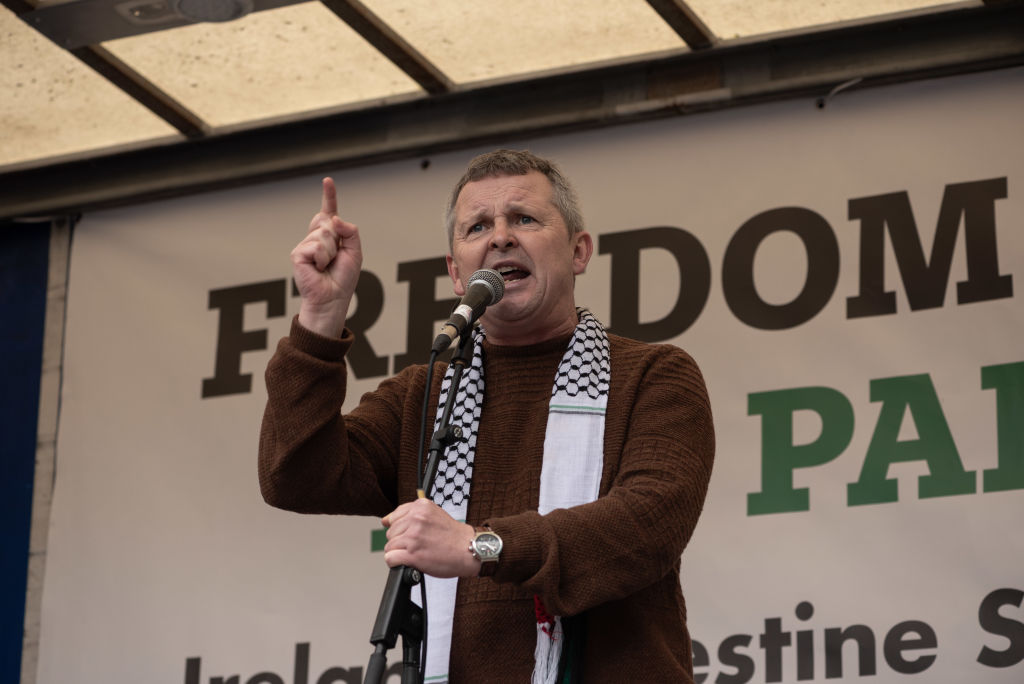
This could have been done in a much better way: with TDs raising specific, verifiable concerns – the glass partition, the missing transcript – through proper diplomatic channels. Instead, there was a press conference in Dublin, with talk of an oppressive regime and disproportionate handling of the case. Foreign politicians publicly impugning a trial’s fairness rarely improves a defendant’s position with the bench hearing it. Six of the seven politicians are vocally anti-Israel. Richard Boyd Barrett – leader of a fringe radical-Left party – frequently calls for ‘intifada’ and has described the Jewish state as ‘filthy, apartheid, racist, colonial-settler regime’ that needs to be dismantled. Hardly a neutral observer then.
The Ulm 5 did not do themselves any favours by shouting ‘Free Palestine’ in the dock. But if they are being mistreated, let the European Court of Human Rights say so. That is precisely the institution built for this. Everything else is grandstanding.
Irish Pro-Palestine activists are now insisting that Ireland sends an observer to cover the trial, even though Tatlow-Devally already has the benefit of consular assistance. The also want Taoiseach Micheal Martin to have a word in German Chancellor Friedrich Merz’s ear when he visits Dublin on Tuesday. The British government, meanwhile, has not commented on the two UK nationals held alongside Tatlow-Devally in a Stuttgart jail.





Comments