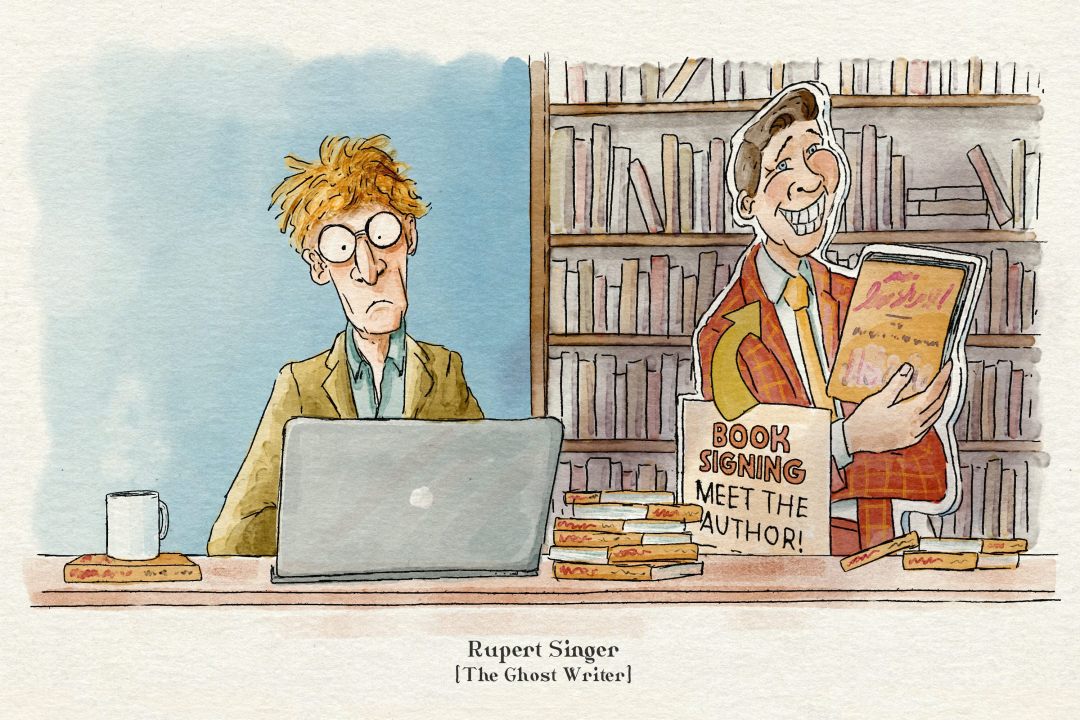
In a pleasant but modest one-and-a-half-bedroom flat in Crouch End, the half bedroom-cum-boxroom boasts a bookshelf that indicates eclectic taste on the part of its owner. Amongst its dozen or so volumes are a score-settling memoir by a disgraced royal lady-in-waiting, petulantly entitled I Also Served, You Know; a revisionist history of WWII written by a television weatherman, called I Wish We Were German; and, most remarkably, a collection of homoerotic sonnets in the Petrarchan style that were privately printed at the behest of the former global finance director at Goldman Sachs.

The only giveaway as to the true creator of these works is the existence of two incongruous-looking books, tucked away at the end of the shelf. The first is a dual biography of Philip Larkin and Andrew Marvell, proudly entitled Hull Raisers, and the second is a squat title that proclaims itself to be The Key to All Mythologies, in a nod to the desiccated pedant Casaubon from Middlemarch. Both were written under the real name of the creator of the volumes on the bookshelf, Rupert Singer, and failed to set the publishing world alight. Hull Raisers at least received faint encouragement in the Literary Review (‘a decent stab at poetic resurrection’) but The Key to All Mythologies sold precisely 74 copies in its first six months on sale, mainly to academic libraries, and was pulped before the year was out.
This was, in truth, not how Rupert had seen his literary career going after he graduated with a double first from Oxford. He had done all the things that he was supposed to while he was a student, including setting up a literary magazine, Tattle, that he sent unsolicited copies of to a hundred publishers, agents and editors in the hope of being noticed. As a result, he was offered representation by an old-school litterateur called Desmond Wansley of Wansley and Wansley Ltd – there was only one Wansley, but the proprietor had long believed that two names made a business sound more successful – and signed to a two-book deal by the respected but ailing publisher Fox & Hare, for a total advance of five thousand pounds. Rupert spent the first tranche on lunch at Scott’s for five university friends and toasted his future success in champagne and oysters.
When this hoped-for success did not materialize, and Rupert was feeling despondent at the prospect of having to obtain what he called ‘a proper job’, Desmond took him aside and, over coffee, asked him ‘Tell me, dear boy, where do you stand on ghostwriting?’ Rupert’s response was not immediately dismissive, and so Desmond – whose business was, by then, wholly propped up on his commission from mass-market titles that sold to the indiscriminate – promptly offered him his first gig interviewing a former Sixties pop idol who wanted to tell the cautionary tale of his slide from musical fame to working as a press officer for the Jehovah’s Witnesses. The eventual book – Rock Me, Jehovah! – was a Sunday Times bestseller, thanks to a combination of the pop idol’s still-doughty fanbase and the public protests helpfully organized by the musician’s successor as the organization’s publicist, and Rupert’s future was assured.
Since then, he has worked on ten books in as many years. All of them have sold decently, if sometimes erratically, and Rupert has established himself as an unerringly professional figure who turns up, does what is expected of him, and produces a clean manuscript at the allotted deadline. If anyone could be bothered to give his work more than a cursory examination, they might spot the odd touch of interpolated mischief – the Goldman Sachs financier’s poetry had a Latin epigraph, omnia pecuniae causa facio, which could be translated as ‘I’m only in it for the money’ – but Rupert would be the first to admit that what he lightly calls his ‘phantom thread’ is itself done purely for financial gain rather than literary glory.
If he was to be pressed, he might admit to jealousy of the giants of his profession, such as J.R. Moehringer, who was paid a million dollars to ghostwrite Prince Harry’s Spare. While his own earnings are respectable enough, Rupert has been known, after a couple of glasses in the evening, to write savage reviews on Amazon of other titles by his imagined rivals, usually drawing attention to their hackneyed literary style, repetition and dearth of originality. ‘This could have been written by AI’, is his favourite insult: ironic, given that his last book, a would-be humorous travelogue of a trip to Provence written by a former Conservative MP, was indeed written with the close collaboration of ChatGPT. This explained the more than usually awkward sentence structures, unfunny jokes and strange geographical errors. Still, the MP was famous enough to merit an appearance on The One Show and this ensured that Rupert scored his seventh bestseller in the process.
Usually, Rupert is quite sanguine about the turn that his literary fortunes have taken. He lives alone, but dotes on his cat, Antigone, and is a regular patron in Crouch End’s cafés, laptop ever-present. When in an optimistic mood, he likes to think that he makes a living by his pen, which is more than most of his contemporaries do. But in the long, dark nights of the soul, when he reflects on the hubris that led him to spend three years writing and researching The Key to All Mythologies, he feels deep self-loathing and vows to get a proper job doing something worthwhile, such as teaching Shakespeare to underprivileged children. Then the next day, he awakes to an email from Desmond, offering him ten grand to write a risqué comic novel in collaboration with a television gardener, and the whole cycle begins afresh.




Comments