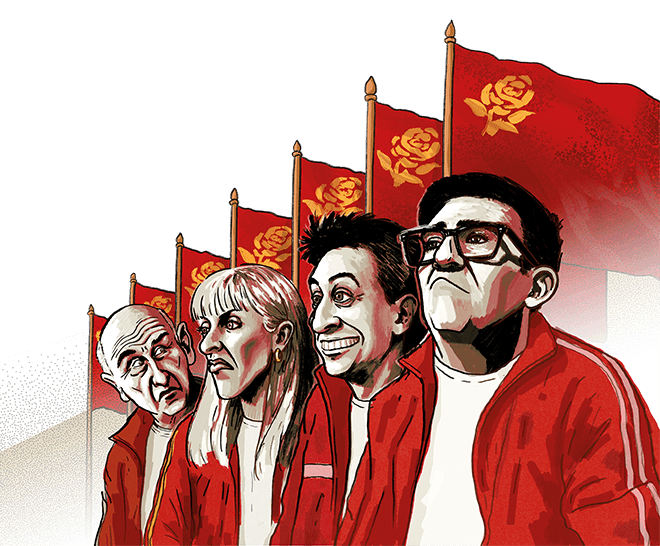


When Ed Miliband and Shabana Mahmood arrived in Downing Street on Monday afternoon, the image of political rivals arm in arm symbolised a new government of differing views taking shape. It might have been more awkward. As they neared the door of No. 10 and the waiting television cameras, Miliband turned to Mahmood and asked: ‘Should we turn around for a photo together?’ Mahmood gave the idea short shrift: ‘We’re not getting married, Ed!’
But in a sense Labour is seeking a new relationship with the British public and everyone around Andy Burnham is alive to the importance of images, symbols and vibes. As Wes Streeting, the new Defence Secretary, put it in cabinet on Tuesday: ‘We have a second chance to make a first impression with the voters.’ It was a line Burnham liked so much he repeated it and No. 10 briefed it to journalists as his own.
Yet after less than a week as Britain’s 59th premier, Burnham is already sending mixed messages to his audience as his vision for the country runs into the reality of the state of the public finances. ‘We need to be a cost-of-living government,’ the PM told his first cabinet meeting. ‘Life’s hard out there, isn’t it, at the moment?’ But having appointed John Healey, rather than Mahmood or Miliband, as Chancellor, he added: ‘We’ve got to show fiscal discipline. We’ve got to show that our commitment to the fiscal rules is real. Boldly Labour, but prudently Labour as well at the same time. That’s the thing we’ve got to pull off.’
Burnham was ‘within inches’ of picking Mahmood as chancellor, but decided Healey was the safer bet
Easier said than done. Burnham has already announced £340 million to tackle rough sleeping, another £850 million to remove VAT from domestic electricity bills and £450 million to cap bus fares at £2 nationwide. The appointment of Healey, who resigned as defence secretary because Starmer refused to back spending 3 per cent of GDP on defence by 2030, implies a commitment to send more money to the MoD – and Burnham has also indicated a desire to raise foreign aid spending back to 0.7 per cent of GDP. A prominent figure on the Labour right observes: ‘0.7 per cent on aid, 3 per cent on defence, not touching the triple lock… energy bills capped, transport fares capped. You get to £50 billion very quickly. And 1p on the basic rate of income tax raises you five to eight billion on a good day, under favourable circumstances, if you squeeze your eyes one way and keep your fingers crossed the other.’
These are eye-watering sums of money, which imply very significant tax rises in the autumn Budget. However you cut it, this is on course to be the most economically left-wing government since the 1970s.
But the details are vague, not least because plans Burnham and his team have openly considered already seem to have run into the buffers. On Tuesday, the Prime Minister’s official spokesman talked down the prospect, floated just days before, that Labour might raise the income tax personal allowance above £12,570. There was also no clarity over whether the Chagos Islands deal has or has not been ditched or if plans to reopen oil and gas extraction in the North Sea will go ahead.
Burnham says the VAT cuts will be paid for by ditching Starmer’s plans for digital ID, a scheme for which the funds had not yet been found – prompting a pointed intervention from Darren Jones, a cabinet minister Burnham had sacked. Some also see the policy as a hostage to fortune, since the VAT cut is only worth £1 a week and bills will probably rise by more than that anyway. ‘It will be lost to the market and potentially unnoticed by voters,’ says a Labour strategist. ‘It’s an ongoing cost that means every chancellor will now have either to find the money for it or be the one who raises taxes on fuel.’
In the Treasury there is nervousness. ‘Officials don’t mind where the money goes as long as you’ve got money coming in,’ says a Whitehall veteran. ‘If you want to put taxes up, fine. If you want to cut spending, fine. What they are anxious about is the level of borrowing and debt. And they are very anxious about it.’
Insiders say Burnham was ‘within inches’ of picking Mahmood as chancellor, but decided on Sunday that Healey was the safer bet. This was seen initially as a fudge, refusing to back either Miliband, the standard bearer of the soft left, or Mahmood, the Queen of Blue Labour. In fact, the decision is best understood as Burnham asserting personal control of economic policy. ‘He came close on Shabana, but she is a great big strong, independent-minded political beast,’ says one strategist. ‘He decided “I need someone who will do what I want.”’

Mahmood was happy to stay at the Home Office. Miliband, however, is distressed that Burnham did not follow through on what he understood was their arrangement (shades of his old boss Gordon Brown’s resentment about his Granita restaurant leadership deal with Tony Blair in 1994). ‘Ed was under the very clear impression that this had been agreed going way back,’ a source says. ‘Andy never said “I promise you the Treasury”, but you can have a conversation in politics and, as Granita demonstrated, the two sides can remember it differently.’
Cabinet colleagues see the appointment of Miatta Fahnbulleh, Miliband’s protégé, as his replacement at the department of energy as ‘Ed’s price for going quietly’, as one put it. A former Labour cabinet minister adds: ‘We need an energy transformation, not a net-zero transition, and she doesn’t grasp the scale of what’s needed.’
Some Labour figures fear that a passive chancellor is not the way to deliver the big changes the new PM wants. ‘Strong prime ministers don’t just need but want strong chancellors,’ a Labour veteran says, pointing out that both Brown and George Osborne were politically pro-active.
No. 10 also refused to commit to a plan for defence spending on Tuesday following the appointment of Streeting, which shocked Westminster since he had previously had very little to say on the subject. Here the private truth is more reassuring than the public vibes. Streeting had actually requested the job. He has developed ideas on how to reform defence procurement and his appointment was not only nailed down more than a week ago – the MoD was aware he was coming and was broadly happy.
More significantly, Streeting and Healey met on Monday afternoon and are understood to have thrashed out an agreement on the future funding of defence. The details are shrouded in mystery, but a defence source says: ‘Everyone is pleased as punch. Wes and John sorted it between them and the MoD thinks it’s getting its money, thinks it’s Christmas. They also like the fact that Streeting is a political big beast.’
The other area where the public and private vibes differ concerns Labour unity. Burnham talked about a united team pulling together and then summarily sacked 11 Starmer loyalists from the cabinet, a cull quickly dubbed ‘the night of the long eyelashes’. Darren Jones’s emergence the next morning to condemn the unfunded VAT cut was seen as the revenge of the dispossessed, who had gathered in Starmer’s local pub to drown their sorrows on Monday. One of their number briefed the Times that Burnham had ‘created a faction’ where one had not existed before.
A senior Labour figure who is more sympathetic to Burnham says: ‘They were clearly a few glasses deep. Telling everyone you now consider yourself a faction and then at the first opportunity wading into the new Prime Minister is just inept.’
The Starmerites are in no real position to complain. ‘We weren’t good enough,’ a close ally of Starmer admits.
No. 10 rejects the idea that the reshuffle was evidence of a leftward lurch, pointing out that Burnham kept Mahmood at the Home Office to pursue her migrant crackdown (loathed by many Labour MPs) and Pat McFadden at welfare, which suggests an effort to reform soaring state handouts.
In cabinet on Tuesday, both Streeting and Heidi Alexander, the Transport Secretary, spoke about the need for a ‘culture change’ to end the briefing against ministers, a feature of the Starmer regime. ‘If you feel like you’re part of a team,’ Alexander said, ‘you’re able to make decisions and govern more effectively without looking over your shoulder.’
Loyalists also claim the chaotic reshuffle, in which Rachel Reeves rejected the post of education secretary and ministerial candidates were stacked up in No. 10 late into Monday evening, is evidence that Burnham is a different beast from Starmer. He spent around 20 minutes with each appointee. ‘Andy likes to chat to people,’ a close aide says. ‘He’s a people person. He wanted to genuinely have a discussion about what each secretary of state wants to achieve in their brief – which Keir certainly never wanted to do. With Keir, you were appointed and then you were out the other door, and that was that.’
‘Miliband, like Iran, rejects US hegemony. He thinks military action never offers a solution’
Then there are the plans for No. 10 North. The outpost will be operating this week and Burnham will visit before the weekend. ‘This is not a gimmick,’ he told cabinet.
Not everyone on the Labour right is full of doom and gloom. ‘If you’d said to me two weeks ago that John Healey, a non-ideological pragmatist, is going to be chancellor and not Ed Miliband, I would have said thank you very much,’ says one well-connected figure. ‘If No. 10 are going to try to run economic policy, that’s no bad thing. We’ve just had a prime minister who was totally uninterested in economic policy, and look what happened. Miliband has been sent into exile, literally told to leave the country – but with Jonathan Powell [the national security adviser] and Varun Chandra [the business adviser] there to make sure he doesn’t fuck up the US relationship too badly.’ Not everyone is so sanguine. Some worry that Miliband’s views are just as ideological on foreign policy as on net zero. A senior figure in the diplomatic world says: ‘He has inherited his father’s susceptibility to Russia. He thinks China has a lot to offer us industrially – renewables and batteries – and that we should not be “rejectionist”. He would argue that Iran is a regional power and should be respected, not confronted. They, like him, reject US hegemony. He thinks military action never offers a solution.’
On a lighter note, Whitehall watchers are wondering if Miliband will take over 1 Carlton Gardens, the grace-and-favour home which is the traditional perk of foreign secretaries, but which has also been occupied by Cabinet Office ministers in recent years. Louise Haigh, the new First Secretary of State, is not planning to use ‘1CG’. The property has two kitchens, and given Miliband’s well-documented arrangements in his north London home, one former cabinet minister notes: ‘That means it will be Ed “four kitchens” Miliband.’
Much, such as the government’s economic policy, remains a mystery. But the gap between vibes and reality can only persist until the Budget. ‘We fundamentally don’t know the direction of this government until there’s a fiscal event,’ a Labour adviser says. ‘There will be a crunch moment in the autumn where we will know. Andy’s got some choices to make.’ Get them wrong and the voters will be suing for divorce from another Labour prime minister.
Comments