
England vs Argentina is a match like no other. It is arguably the most highly-charged confrontation in the world of international soccer – haunted by the ghosts of war, perceived past wrongs on the soccer pitch, and a ready-made roll call of heroes and villains to choose from.
Games between the two sides represent what might be described as a culture clash of ethics and values, an enduring scrap over the way the game should be played and what counts as fair. The match tonight in Atlanta, for the prize of a place in the World Cup final, is destined to be a titanic clash; it cannot be anything else.
History be damned. England simply must win and march on to the final
Time and again, encounters between these two great soccer nations have given fans some of the most extraordinary – and controversial – moments in World Cup history.
In 1966 – the last and only time England won the World Cup (as if anyone can forget) – the Three Lions faced Argentina in the quarter-finals in London. This match marked the real start of the enduring rivalry between the two countries.
Argentina’s captain Antonio Rattin (who passed away earlier this month at the age of 89), was sent off after just 33 minutes for two offenses in the space of three minutes. The match was delayed for almost eight minutes as Rattin refused to leave the pitch. It was an ill-tempered match throughout but the Three Lions held on, winning 1-0, courtesy of a Geoff Hurst goal in the 79th minute.
England manager Sir Alf Ramsey (a gentleman of the old school) was scathing about the Argentinian players, calling them “animals.” He was so incensed that he stopped his players from swapping shirts with their opponents. The scars from that encounter have endured, and to this day the South Americans insist that Hurst’s winning goal was offside.
Move forward to 1986 and the World Cup in Mexico. The match between the two sides – at the quarter-final stages – took place just four years after the Falklands War. The game is perhaps the most notorious and iconic encounter of all, for the role played by Diego Maradona, a soccer genius who ranks as one of the all-time greats.
Maradona scored two unforgettable goals that day. One was a mazing and brilliant solo run that even England fans would have to acknowledge as perhaps one of the greatest World Cup goals ever. But it was his first goal (when the game was still scoreless) – the “Hand of God” goal – that stands tall in the hall of soccer infamy. The diminutive Maradona beat England goalkeeper Peter Shilton to the ball, using his hand to punch it out of Shilton’s reach and into the net. Remarkably, the referee didn’t spot this act of obvious cheating. The protests of the English players fell on deaf ears and the goal stood. Maradona and Argentina went on to win the World Cup that year.
The sense of burning injustice smolders to this day in the hearts of English soccer fans. Years later, Maradona acknowledged that it was an intentional handball. Even more controversially, he said that it was more than a goal that he celebrated, that scoring was symbolic revenge for the fallen Argentina soldiers in the Falklands War. In fact, Argentina fans and players still reference the Falklands conflict in their soccer songs to this day. History, again.
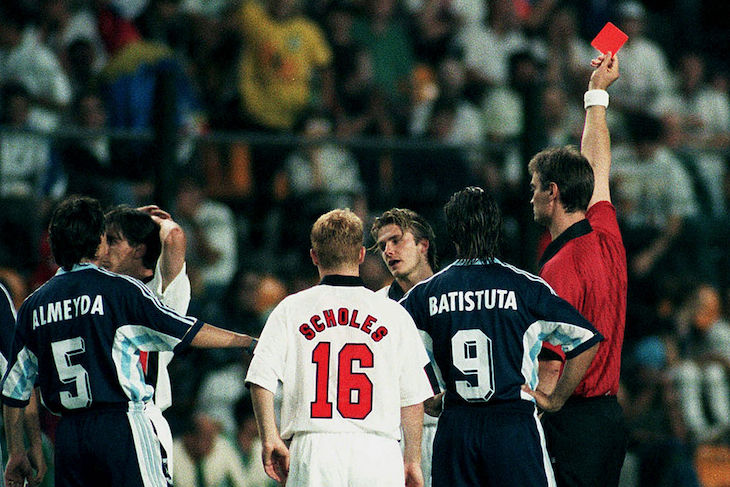
The enmity between the two sides was renewed, 12 years later, in the 1998 World Cup in France. England faced Argentina in the round of 16. David Beckham was England’s stand-out star and targeted for special attention by the Argentinians. Beckham succumbed to a moment of madness when he kicked-out at Diego Simeone. It was a nothing incident, born of frustration, but the wily Simeone milked it for all it was worth. Beckham was given a red card and England went on to lose the match on penalties.
Simeone, speaking about the match a year later, made this admission: “Let’s just say the referee fell into the trap… because I went down well and in moments like that there’s a lot of tension.”
Four years later, in Japan, at the group stage of the 2002 World Cup, Beckham got his own back by scoring a penalty in the win against Argentina. Once more, redemption, revenge and the ghosts of history formed the backdrop to this encounter.
And so we come full circle. This most intense of sporting rivalries plays itself out again for a place in the World Cup final. England’s players will be ready. There are 60 years of failure at the World Cup to remedy. Argentina also happen to be the defending world champions, so putting them to the sword would be sweet revenge indeed. It is the first time that England will have faced the great Argentinian Lionel Messi, the modern-day equivalent of Maradona when it comes to footballing brilliance. History be damned. England simply must win and march on to the final.





Comments