



You may need to do a spot of homework before attending Tilly No-Body at the Arcola. Acted and written by Bella Merlin, the play examines the sufferings and blunders of Tilly Newes, an actress born in 1886, who married the experimental German dramatist Frank Wedekind.
At first sight the show looks like a lesson for newcomers but the content is bound to confuse anyone who lacks a working knowledge of German theatre in the early 20th century. The ideal viewer is a literary expert familiar with the whole of Wedekind’s dramatic output. Numerous lines from his plays are quoted, not always with intelligible citations. ‘Women are natural actors’, runs a typical aphorism, and ‘no woman can keep a man happy by behaving sincerely.’

Wedekind’s theatrical idiom relies on elaborate costumes, large-scale gestures, clowning, mime, folksongs and circus acrobatics. To a modern audience these effects may seem facile and dated. And the play’s structure is hard to grasp without a glance at the programme notes.
The action opens as Tilly takes an overdose of poison which triggers a mental flashback that lasts three days and nights. The play lasts just 70 minutes so there’s a lot to pack in.
The director, Miles Anderson, has turned the monologue into an extravaganza that belongs in a stadium like Wembley Arena rather than a basement venue in east London. Tilly capers around the stage, leaping off platforms, flinging multicoloured scarves into the air, singing songs, and occasionally hitting herself in the face while screaming for no particular reason. Sometimes she does a star jump and shrieks like a speared bison. To bring a scene to a close, she likes to slam down the lid of a metal trunk with all her strength. It’s not an easy show to doze through. In a quieter passage, she re-enacts a marital argument by playing Wedekind as a snarling lion and herself as a hysterical dachshund. The lop-sided script feels like a toxic rant taken from a divorce petition. And, inevitably, one’s sympathies shift towards the accused who is not present to defend himself.
Tilly never loved Wedekind and she married him because she found his wealth and fame impressive. Useful as well, no doubt, although she prefers not to dwell on that significant motive. He built his plays around her talent and organised tours of Germany where she enjoyed great acclaim. But in this show, Tilly treats his tireless promotion of her career as a monstrous abuse of power. The programme notes provide a clue. While writing the script, the author ‘had to navigate her past experience of domestic violence’. It seems that Wedekind has copped the heat for another man’s misconduct. Eventually Tilly suffers a breakdown and withdraws to a padded cell where she recovers noisily. This is a risky ticket to buy. The show may sharpen your appetite for Wedekind’s work or leave it fatally weakened. At press night, the enthusiastic crowd found plenty to applaud.
Much Ado at the Globe includes an unusual sight gag. At the nuptials between Claudio and Hero, the groom shoves the bride’s face into the wedding cake. Dollops of cream spatter all over the costumes and the floorboards – but no one cares. Fun is the show’s only objective. And it succeeds. Ken Nwosu’s amiable Benedick doesn’t look much like a war hero ready to swap the battlefield for domestic bliss. He plays him as a fun-loving buffoon who slobs around in cheap slacks and a spotless cotton shirt. You can imagine him wearing an apron.
The ideal viewer is a literary expert familiar with the whole of Wedekind’s dramatic output
Pippa Nixon gets closer to the mark by portraying Beatrice as a raunchy, embittered seductress with cobra-like tendencies. Her sexually combative performance masks the absence of any real sizzle between her and her tubby suitor.
Richard Katz achieves the near-impossible by making Dogberry funny. The joke is that Dogberry has dyslexia and lacks the emotional skills to lead a team of security guards. ‘Be vigitant,’ he tells his underlings. Katz creates a panicky, over-anxious disciplinarian who senses that something is amiss but can’t see quite what it is. Brilliant work.
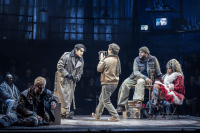
The director Chelsea Walker has resisted the temptation to tinker too much with the Globe’s structure. The two red pillars are sheathed in milky white fabric and the rear elevation has been hidden behind a double staircase, also painted white. It sounds bland but this simple set-up generates numerous opportunities for visual gags and mischief. All the comic effects are skilfully handled. Luckily, the production has no overarching ‘concept’ to weigh things down. The costumes are chic but not showy. The music is present but not insistent or obtrusive. Walker breaks with current orthodoxy by assigning the female roles to actresses and the male roles to actors, in accordance with the scheme set out by the author. It seems to work. This experiment might be worth repeating.





Comments