
The infamous “Memorandum of Understanding” between the United States and Iran has broken down. One of the major points of failure has been the disagreement over which side controls the Strait of Hormuz.
Yesterday, President Donald Trump abruptly declared that his country should now be known as “THE GUARDIAN OF THE HORMUZ STRAIT” and “as such, as a matter of fairness, will be reimbursed at the rate of 20 percent on all cargo shipped.”
“POTUS is absolutely right,” replied Abbas Araghchi, Iran’s foreign minister, on X. “Whoever provides secure and safe passage of commercial vessels through the Strait of Hormuz should be compensated for this service. Iran has always been the GUARDIAN of the Strait and will remain so FOREVER. 20 percent is of course too much. We will be fair.”
These two positions appear irreconcilable, and both sides are now firing at each other again. But there is potentially a bigger question in this war of bombs and words – a question neither negotiating side seems willing to address publicly.
It is this: do Tehran’s official negotiators – chiefly Foreign Minister Abbas Araghchi and Mohammad Bagher Ghalibaf, the speaker of Iran’s parliament – actually represent or control the Islamic Revolutionary Guard Corps?
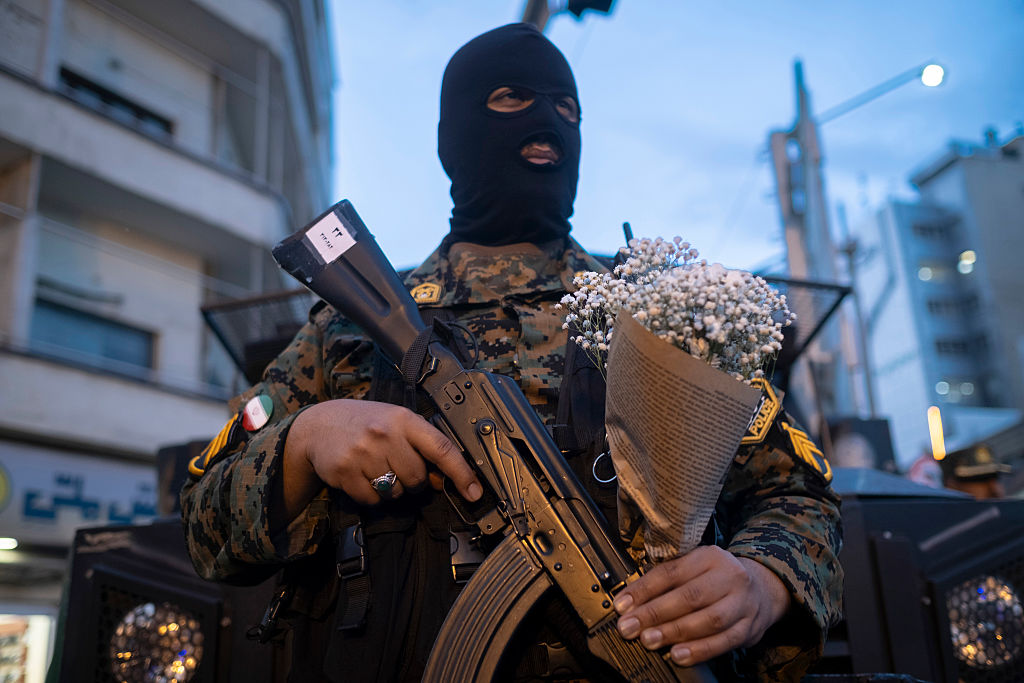
There is an apparent disconnect between what Iran’s diplomats are saying and what the IRGC’s gunboats and missile operators are doing. One interpretation is that the IRGC is a law unto itself, a state within a state with its own priorities and, effectively, its own foreign policy independent of the Supreme National Security Council, Iran’s top security body.
The idea that the IRGC is stabbing Iran’s diplomats in the back doesn’t hold water
Attacks on tankers have repeatedly overridden and literally blown up the fragile ceasefire signed by Trump at Versailles last month. Most recently, technical talks resumed in Doha on July 1 (indirectly, via Qatar and Pakistan), and Vice President J.D. Vance said that negotiations were “going well.” Yet just days later, for no discernible reason, the IRGC struck three tankers on the Oman-coast route, triggering dozens of US strikes on Iran and Iranian attacks on five Gulf states as well as Jordan. The IRGC – not the civilian Iranian government – declared Hormuz closed “until further notice.” In turn Trump announced that “Cease Fire is OVER” and the US Treasury revoked Iran’s license to export oil.
On closer examination, the idea that the IRGC is stabbing Iran’s diplomats in the back doesn’t hold water. Both Araghchi and Ghalibaf have repeatedly defended the IRGC attacks as legitimate enforcement of the MoU, not a violation of it. “Iran has so far kept its word,” Araghchi has claimed, accusing the US of violating the agreement. “Hormuz will only open with Iranian arrangements, not American threats,” wrote Ghalibaf. In other words Iran’s negotiators are advocates for, not controllers of, the IRGC’s Hormuz strategy.
Which leads us to another complication. According to US officials quoted by CNN, as well as analysis by the Institute for the Study of War (ISW) and The Critical Threats Project (CTP) at the American Enterprise Institute, there is considerable disagreement inside the upper echelons of the Iranian state over whether to make peace with the US or continue to escalate. Supreme Leader Mojtaba Khamenei himself said on June 18 that he had authorized the MoU but held “a different opinion in principle.” And CTP-ISW reporting has documented regime efforts to “contain growing factional disputes over… Khamenei’s position.” As a senior US official told reporters on a briefing call over the weekend, “what you see… is the power struggle within Iran playing out in real time. We have a lot of options if the hardliners get the upper hand.” At the same time there is also evidence, according to US officials quoting intercepted Iranian messages, that at least some IRCG attacks were authorized by “an errant part of their system” and admitted “we screwed up.”
What is lost in the noise over Hormuz is the question of how to establish control over Iran’s nuclear program – the original core point of the MoU, and of its predecessor, Barack Obama’s Joint Comprehensive Plan of Action (JCPOA) deal of 2015. But the deal Trump signed at Versailles was in many ways more generous to Tehran than anything offered under Obama. The MoU offers Iran limited control over Hormuz, the lifting of sanctions, the unfreezing of Iranian assets and a $300 billion reconstruction fund in exchange for giving up its supplies of Highly Enriched Uranium and a pinkie-promise to cease and desist from developing nukes.
Objectively, that’s a great deal for Tehran – with control of Hormuz as the cherry on top. Yet for the moment, the International Atomic Energy Agency hasn’t been able to inspect Iran’s nuclear stockpiles since February 28, and Iranian Deputy Foreign Minister Kazem Gharibabadi says any IAEA visit would come “only within the framework of a final agreement.”
So far, all Trump has to show for his reckless attack on Iran and ripping up the JCPOA is deadlock, continued destruction, a strangled shipping lane on which much of the world replies for fuel and a growing grassroots backlash against another pointless foreign war. Much as Trump hates a climbdown, the only practical way out, short of full-scale war, is via diplomacy. As Trump himself said, Iran may never have won a war but it has never lost a negotiation. And that, perhaps more than anything else, is why he is upping the ante once more. Trump is pushing his nation back towards war because peace, quite simply, is not working.


Comments