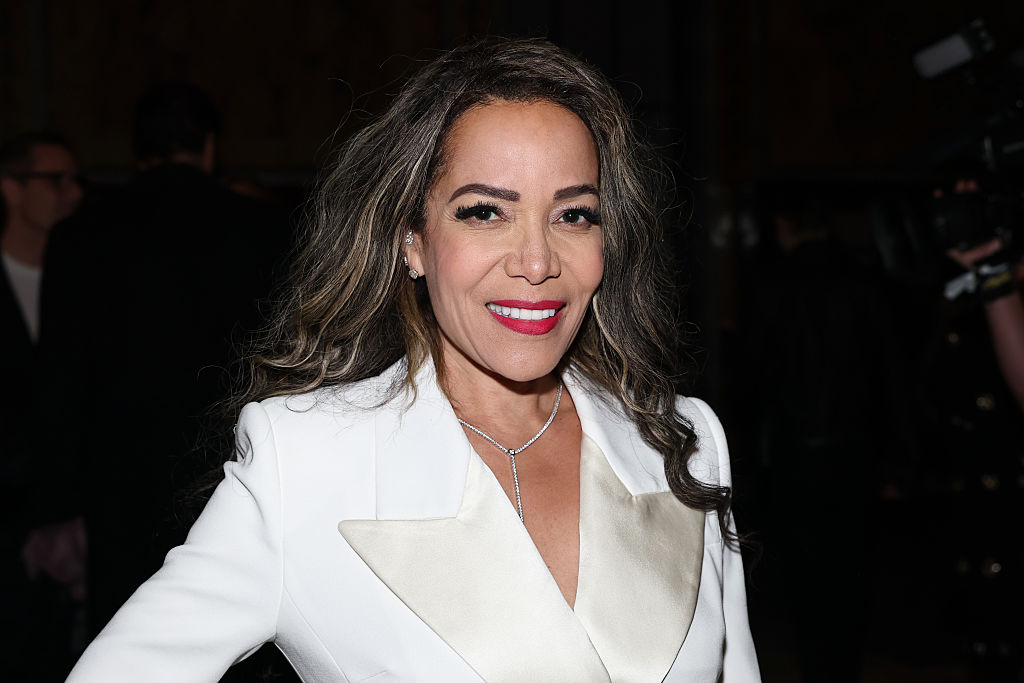
The View’s Sunny Hostin said Monday that when she walks into communities with American flags, she “suddenly feels unsafe.” After receiving a smattering of applause, Hostin hypothesized that some people have changed the flag’s meaning.
“There’s a section of this country that has co-opted the American flag and they equate being an American or an American flag with white supremacy,” she said. “And that should never be the symbol of white supremacy. But they have weaponized [the flag].”
Hostin’s answer came during a segment in which the hosts discussed a viral image of white nationalists riding the DC Metro while a black woman sat in between them. Hostin said that the photo emphasizes the different lived experiences of Americans and said that, as a black woman, she identified with it.
“That, for me, was a defining image of modern America for black Americans,” Hostin said.
The image sparked a conversation between two of the show’s black commentators, Hostin and guest Michelle Buteau, as they reflected on how the picture illustrates what they feel when walking into “many rooms and down the streets” in America.
“When you say it’s the best nation. The best nation for who? Because if we are celebrating 250 years, what are we exactly celebrating, is what I want to know,” Buteau said.
This ultimately set Hostin up to comment on the additional unease she feels when confronted with the American flag. It seems reasonable to wonder: in what neighborhoods is Hostin seeing the flag where she fears it? In the Bronx, where she was born and raised? In Lower Manhattan, where The View is taped? Or does she mean more rurally, such as in Harrison in Westchester County, where she now lives and where the average home costs $1.7 million? Or in Oak Bluffs on Martha’s Vineyard, where she maintains a second home?
Not all Americans seem to agree with Hostin. An AP-NORC poll last month found about half of adults (47 percent) see the American flag as more unifying than divisive, compared with 16 percent who view it as more divisive and 36 percent who say it is neither. The poll also found that 22 percent of black Americans see the American flag as more unifying, while 58 percent see it as neutral and only 19 percent see it as more divisive.
In 2021, Hostin expressed a similar sentiment as she offered support to MSNBC analyst Mara Gay, who said she found it “disturbing” to see “dozens and dozens” of American flags alongside Trump flags and signs criticizing Joe Biden.
“When I drive into a neighborhood, and it’s not July 4, and I’m not in a predominantly military household neighborhood and there are flags, American flags, everywhere, alongside Trump flags, alongside flags with stars in a circle, I feel threatened,” Hostin said at the time. “Because the message is very clear. It’s a message of white supremacy. It’s a message of racism, and it’s a message of their country, not my country. I don’t understand why that would receive backlash. People need to listen when I am saying this is how I feel. This is my experience in this country.”
In 2016, when Hostin started at The View, President Obama urged “all Americans to observe Flag Day and National Flag Week by displaying the flag.”
“Our flag persists as a powerful representation of freedom and opportunity,” Obama said. “Waving high above capitol buildings and courthouses, military bases and embassies across the globe, and on the distant surface of the moon, it calls on each of us to remember our obligations to the Republic for which it stands and to carry forward the unwavering optimism that defines us.”
Was Hostin’s fear of the flag present back then, or did it suddenly manifest when President Trump came to office?





Comments