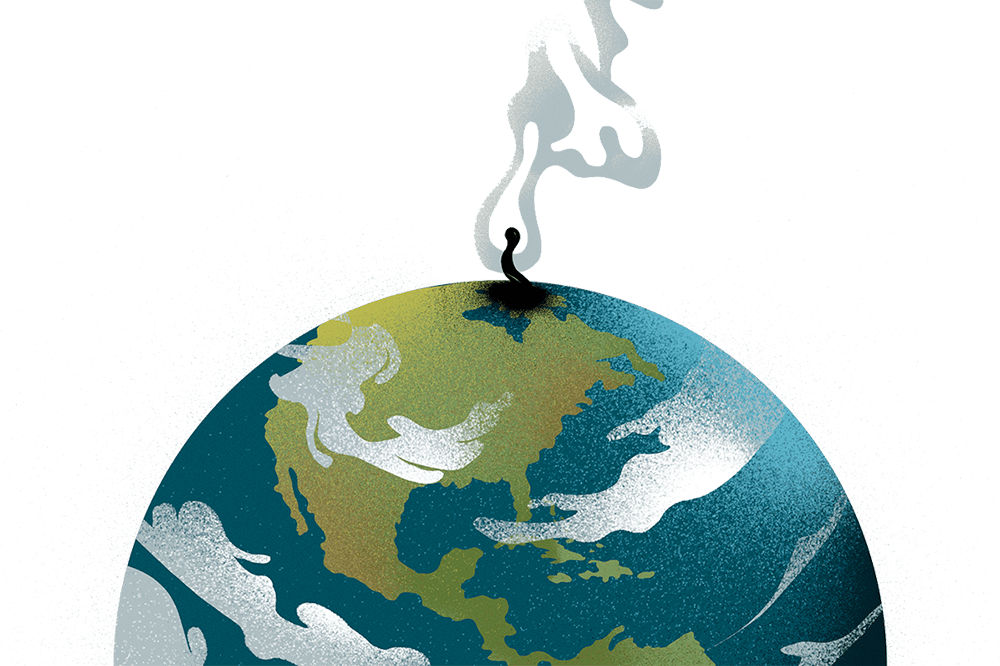


The problem with being a well-known climate sceptic is that whenever there’s a heatwave, you get buttonholed by eco-zealots who think it ‘proves’ they’re right and you’re wrong. The first person to confront me during the current sunny spell was a Guardian journalist at a right-wing conference, which the newspaper had clearly identified as a hotbed of ‘denialism’. It didn’t help that the air conditioning wasn’t working and it was approaching 40°C in the main auditorium.
‘I see you’re sweating profusely,’ he began, shoving a microphone in my face. ‘Still think climate change is a hoax?’ I had to patiently explain that few people on my side of this debate deny that climate change is real. We don’t even maintain that man-made carbon emissions aren’t a contributory factor – not many of us, anyway. The disagreement is about how much of the 1.5°C rise in average global temperatures since the 1850-1900 period is due to these emissions and how much to other factors, such as solar variability, natural ocean cycles and land-use changes.
Yes, we’re fond of pointing out that the 1850-1900 period may have been unusually cold, coming as it did at the end of the Little Ice Age – so may not be a reliable baseline; and that the rise in temperatures since may have been exaggerated by recordings being made in built-up urban areas or near airports. But that isn’t to deny that the climate has changed in the past 125-175 years.
This all matters, I told the journalist, because if the ‘climate emergency’ lobby is wrong about the extent of global warming and its causes, it may not be necessary to immiserate ourselves to achieve net zero by 2050. Even if we allow that there would be some benefits (in the unlikely event of China, America, India and Russia committing to the same target), they would likely be outweighed by the costs, which, as we know from estimates of how many billions we need to spend to decarbonise the UK’s power grid, are eye-watering.
None of this made it into the Guardian article, of course. One of the hallmarks of the climate Jeremiahs is a complete lack of interest in what their opponents have to say. It’s no good quoting J.S. Mill at them – ‘He who knows only his own side of the case, knows little of that’ – or pointing out that a policy of ‘no debate’ will eventually lead to defeat in the court of public opinion, as it has for trans activists. They are as deaf to arguments about why they should listen to the other side as they are to detailed rebuttals of their points. And in this, I’m afraid, they are typical of the progressive left.
Why such a profound absence of curiosity? It’s not as if that has always been true of their tribe – my father, a lifelong socialist, enjoyed dis-agreeing with conservatives far more than he did agreeing with fellow travellers. Arguing with his opponents was meat and drink to him. The drift towards intellectual isolationism is a relatively recent phenomenon. So why the withdrawal from public debate?
One of the hallmarks of the climate Jeremiahs is a complete lack of interest in what their opponents have to say
I have a number of theories. For one, the progressive left are on top and success leads to complacency. Insurgents have to study the enemy in order to win; defenders of the status quo think they don’t need to, because they can’t imagine losing. For another, they rarely stray outside their metropolitan bubble, which means they’re used to being surrounded by people who agree with them. That, in turn, has led to the atrophying of the muscles you need to defend a political position, so it’s easier to sidestep an argument than enter a debate with a match-fit antagonist.
The main reason, I think, is that the holders of the ‘correct’ positions on issues like climate change, immigration, abortion, euthanasia and trans rights are convinced of their moral superiority. They believe their ‘values’ have led inexorably to their political views and any challenge to those views is ipso facto a challenge to those ‘values’. Since their core beliefs are unassailable, there’s no point engaging in any discussion about the positions they’ve led to. Anyone who doesn’t share them is either morally blind or in the pay of an evil corporation – i.e. in league with the devil.
In this respect, the modern left are not very different from pre-modern Christians, except that they’re less willing to debate their quasi-religious beliefs because they have no tradition of biblical scholarship to draw on. In the absence of God or revelation, how can they defend their ‘values’? This, ultimately, is why they’re so unwilling to enter into any kind of dialogue – because deep down they know their convictions are resting on air. It is they who are in denial – in denial about the hollowness of their faith – not us.




Comments