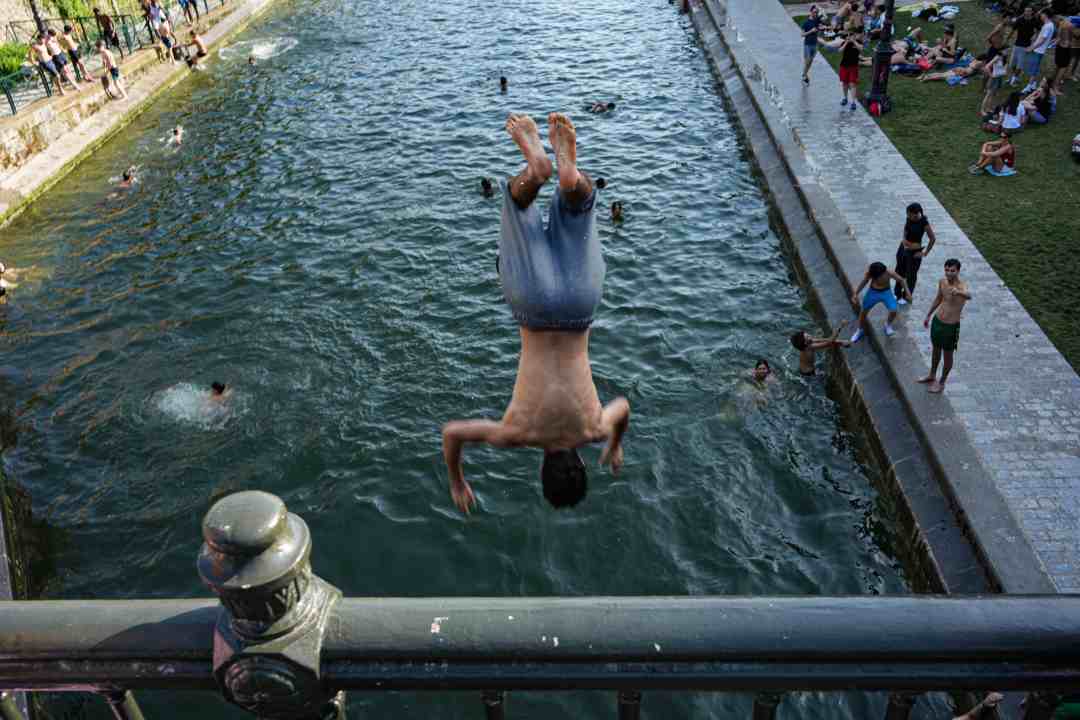
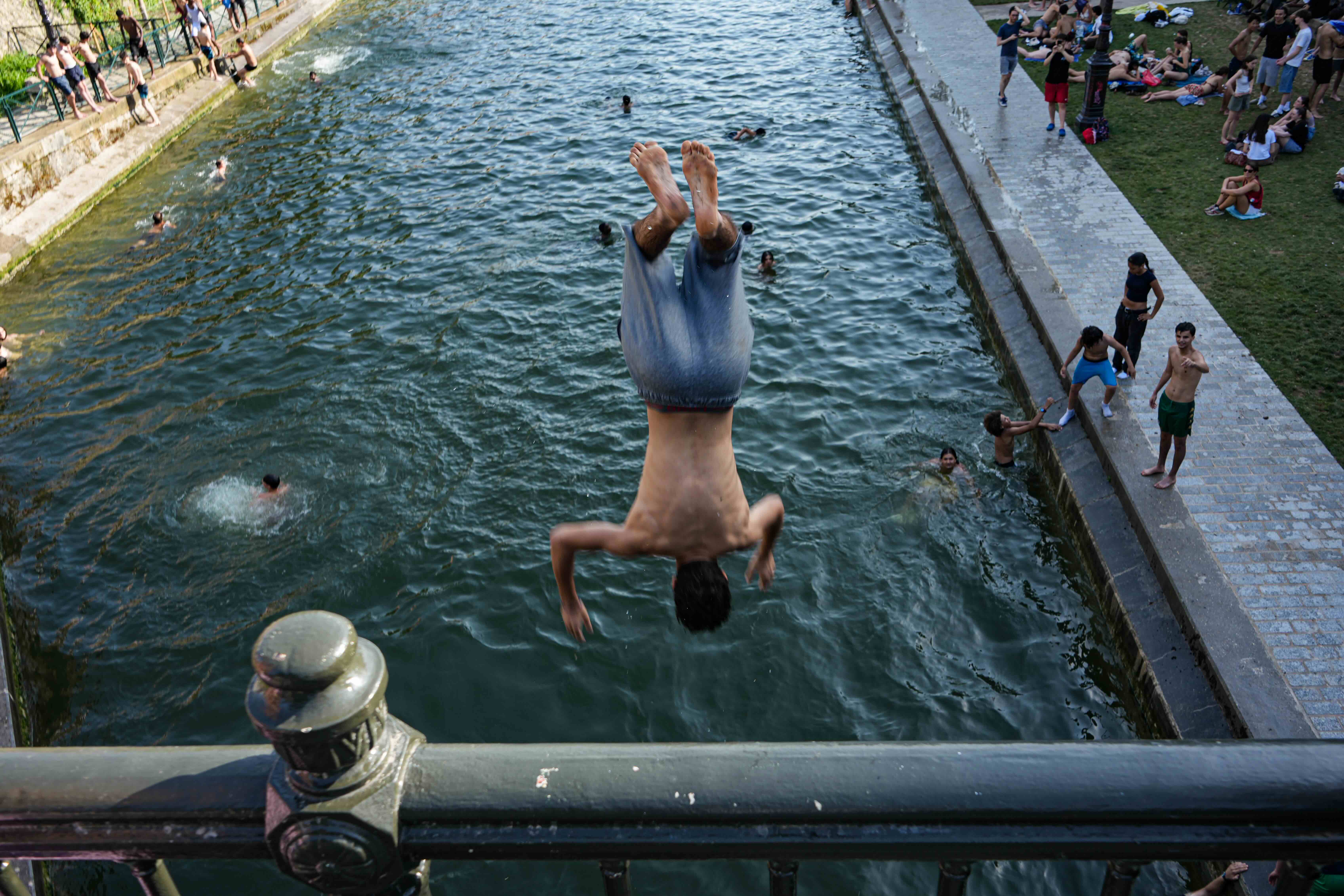
More than 90 people drowned in France between 19 June and the end of the month during the country’s intense heatwave. Government figures released last week were accompanied by a warning from sport and youth minister Marina Ferrari. ‘Very young children are particularly vulnerable and must not be left unsupervised,’ she said. ‘There are young people engaging in dangerous behaviour, such as “I’m going to jump off a bridge” or “I’m going into an unsupervised canal”.’
Such antics were de rigueur during the heatwave, particularly in cities such as Paris, where people cooled off by leaping from bridges into rivers and canals. In the Canal Saint-Martin, in the heart of the capital, two young men drowned in separate incidents.
The worry for the authorities in France is that the number of drownings will continue to rise now that the school holidays have arrived – just as another heatwave is set to sweep across the country. Temperatures this week in the south of France are expected to touch 40℃.
There were 409 drownings in France last year – a 16 per cent increase on the previous year – and among the victims were 57 children and teenagers. The lazy explanation for this rise is to blame climate change. Hotter summers are driving more people to take the plunge wherever they find water.
But that is only part of the story. ‘There is a vulnerability around swimming pools, particularly in rural areas, where there are fewer and fewer pools because of a problem with renovation,’ said Ferrari. Because of this shortage of municipal swimming pools in the provinces, people seek out rivers and lakes.
But it’s not just swimming pools that are in short supply: so are lifeguards. In a recent interview, Axel Lamotte, a spokesman for the French Federation of Lifeguards, said he was ‘outraged and saddened’ at the number of drownings because they are ‘entirely preventable’.
He accused the government of indifference to the problem as well as a lack of investment. ‘Every year, pools are closed due to economic decisions or a lack of lifeguards,’ explained Lamotte. ‘We have about 15,000 active lifeguards. We need between 20,000 and 22,000.’
Fewer lifeguards and pools are cited among several factors in the diminishing numbers of children who can swim
Lamotte says that few young people want to become a lifeguard because of poor pay and the administrative costs of qualifying, which are between €6,000 and €9,500 (£5,100 to £8,100). Ferrari has promised that the government is engaged in ‘ongoing structural efforts to make these professions more attractive’. While removing the bureaucracy involved would be a start, raising salaries to make the profession more appealing may be difficult for a state also drowning in debt. France’s public debt now stands at more than €3.5 trillion and is rising much faster than the country’s economic activity.
Fewer lifeguards and pools are cited among several factors in the diminishing numbers of children who can swim. One in three children entering secondary school in France can’t swim – a figure that soars to 74 per cent in Seine-Saint-Denis, the impoverished area to the north of Paris. The overall figures, incidentally, are similar to England. A report by Swim England found that just 70 per cent of 11 to 12 year-olds could swim ‘competently’ in 2024 – down by 10 per cent since the 2017-18 academic year.
‘In the past, schools taught swimming, regardless of their parents’ standard of living or social background,’ said Lamotte. ‘That’s no longer the case today. This creates further discrimination.’
There is another aspect, however, to the falling numbers of children who can swim in France, but it’s something very few dare broach: religion. A comprehensive survey in 2021 examined the influence of Islam in French schools. Among the more disturbing revelations to emerge was that one in three French schools had experienced pupils refusing swimming lessons because of their religious beliefs. A report last year into the relationship between Islam and French society as a whole disclosed that 43 per cent of Muslims disapprove of shaking hands, greeting a friend with a kiss or visiting a mixed-gender swimming pool.
There may also be a social media element to some of the drownings. Last winter in France was one of the worst for avalanche deaths. Some of those killed were skiing off-piste in search of the ultimate selfie. Social media in France has been awash recently with videos taken during the heatwave by youths showing off in the water.
In many towns and cities across the country, police have stepped up river patrols and called on people to behave more responsibly. There’s a reason why swimming is often banned in these rivers and that is the strong currents. However, policing rivers is the easy part; policing stupidity is much harder.





Comments