
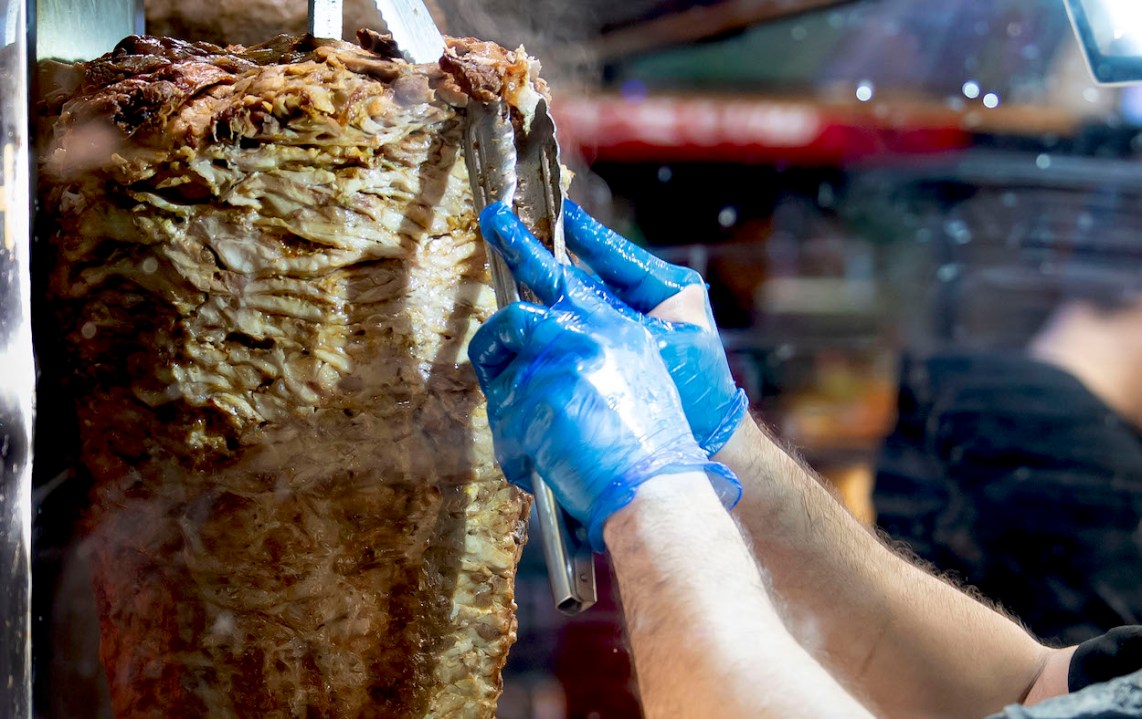
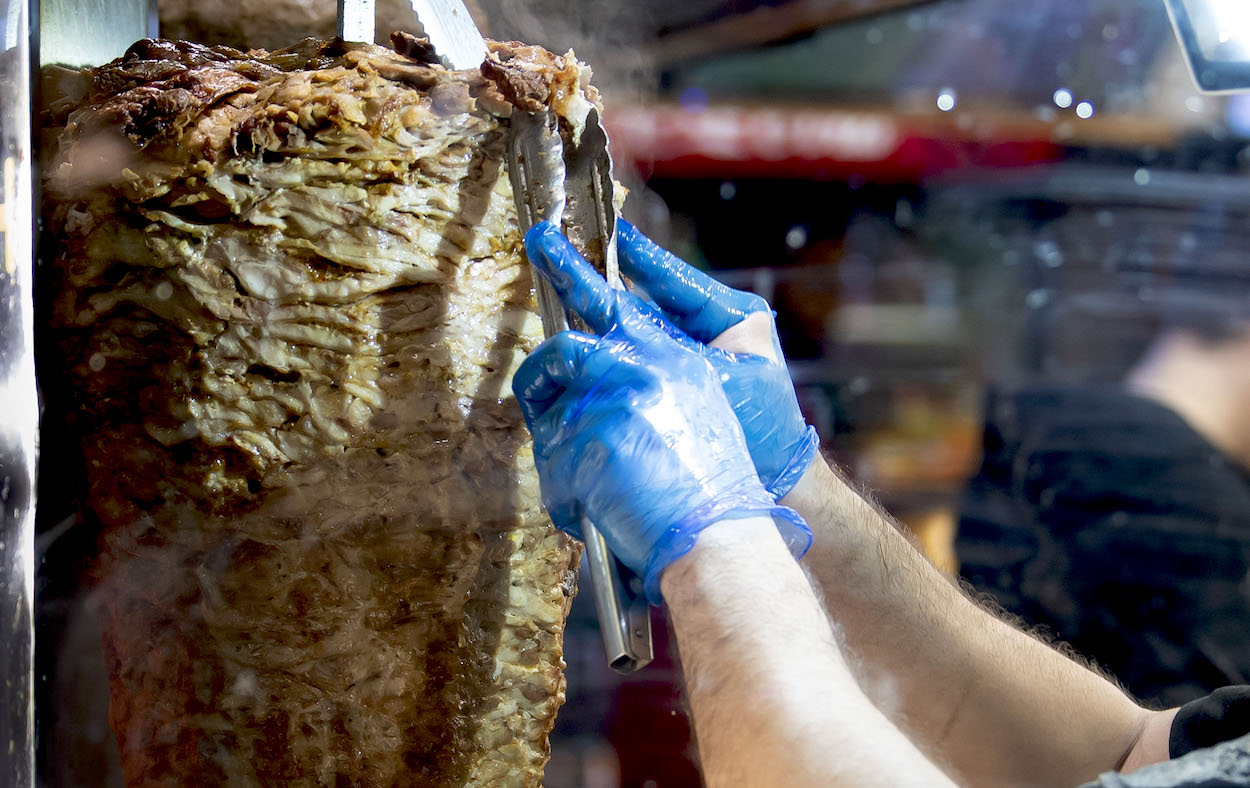
‘Laws, like sausages, cease to inspire respect in proportion as we know how they are made,’ John Godfrey Saxe warned way back in 1869. His jab was really at the ugly business of law-making rather than sausage production, but it was the sausage portion of the phrase that really stuck. The same could be said to go double for doner kebabs, which – in order to create their distinctive cone-like, shaveable structure – are often significantly more processed than the banger. And now the kebab and the law have collided.
Kismet Kebabs, a manufacturer that positions itself as one of the UK’s largest doner kebab meat suppliers, pleaded guilty last month at Swansea Crown Court to fraud by false representation, when the kebabs it supplies were shown to contain as little as 10 per cent sheep meat.
Based in Chelmsford, Kismet Kebabs advertised its kebabs as being made with up to 87 per cent lamb meat. In 2020 and 2021, Swansea Council Trading Standards began to DNA test take-away kebab meat. Following these DNA results, its officers raided the Kismet Kebabs factory in May 2021, taking further samples.
There are no official legal requirements for lamb content in doner kebab meat (and, indeed, German-style doner kebab meat tends to be beef-based). A small amount of doner kebab meat will always be made up of a combination of spice, rusk and bulking agent. But if it’s advertised as lamb doner meat, customers – both the restaurants and take-aways buying the meat, and the end-consumer – have a right to expect lamb as the only meat served.
During the Trading Standards raid of the premises, pallets of goat, meat trim, high-fat content offcuts, and boxes and bags of fat and skin were found, as well as mechanically separated meat (MSM). Mechanically separated meat does not meet the legal definition for meat, nor do the fat and skin. Perhaps most tellingly, Rhys Harries, team leader at Swansea Council Trading Standards, told the BBC: ‘We didn’t see any lamb apart from lamb fat.’ Company invoices showed that very little lamb was being bought by Kismet Kebabs. The skin, fat and goat were all present in the invoices, as was the MSM. Investigators found one production line using the same trays of doner meat to fill two differently labelled packets to be sent to customers; one described the meat as ‘70 per cent lamb’ and the other as ‘50 per cent lamb.’
Swansea Council Trading Standards took Kismet Kebabs to court, where they pleaded guilty and were fined £500,000 and ordered to pay prosecution costs of £259,298. The court heard that the company was estimated to have made £6 million from the fraud. They told the court that the charges are historical, when they ‘operated under a different leadership structure’. In 2021 – one of the years when this criminality was taking place – Kismet Kebabs won best supplier of the year at the British Kebab Awards.
Commentators have likened the incident to the horsemeat scandal. In 2013, DNA testing showed that there was horsemeat in beef-based processed foods that were being sold in major supermarkets across the UK. It’s worth noting that, unlike the 2013 scandal, there does not seem to be a suggestion that any of the meat was unsuitable for human consumption.
As it happens, goat is actually an environmentally sustainable choice of meat: goats tend to graze on marginal land, rather than crop spaces, which makes them a much more eco-friendly choice than other red meat options; goat is also comparatively low in total and saturated fat. Although goat is hugely popular around the world, in the UK it’s principally associated with West African and Caribbean cooking, and none of the major supermarkets stock it. But we do produce a significant amount of goat milk, and the UK dairy industry culls a huge number of male goats, which cannot produce milk – around 30,000-40,000 annually.
These goats are seen as a by-product of the dairy industry. Clearly, raising them for the food industry rather than culling them would reduce food waste. It’s actually a very good choice on a number of levels if you want to eat red meat – and it’s delicious, too: earthy, nutty, sweet and just slightly gamey.
Goat meat is earthy, nutty and sweet
But it doesn’t really matter what was found in the kebab meat. The criminality here was knowingly misleading the consumer. Whatever you think about the make-up of doner kebab meat, consumers are entitled to trust that if something holds itself out as lamb, it has more than a passing resemblance to that. It should not be a concoction of goat, fat, and can’t-legally-be-called-meat meat.
In the same way that the horsemeat scandal wasn’t a moral philosophy debate about the ethics of eating horse, this isn’t about the merits or otherwise of eating goat. It’s about fraud and traceability in the food supply chain. As Harries perhaps slightly cynically observes: ‘A consumer buying a kebab knows it’s probably not the best quality ingredients, but it’s still got to be what it says it is.’






Comments